

 Request a Demo
According to the Yangtze River Protection Law of the People's Republic of China (hereinafter referred to as Law), the highly toxic chemicals, as well as other hazardous chemicals that are prohibited from inland waterway transport (hereafter referred to as the 'prohibited chemicals'), are not allowed to transport in the Yangtze River Basin since March 1, 2021. The Shanghai Ministry of Maritime Administration (MSA) published a notice on February 18, 2021 to elaborate rules, reminding all shipping companies involved in relevant activities in Shanghai Port of Yangtze River (including Waigaoqiao Port) to strictly comply with the Law. Violations will result in a fine of up to two million yuan, and for severe violation, the license may be revoked. It provides a legal foundation for the Shanghai MSA to implement the rules, while controversy abounds in actual enforcement. Many shipping companies have required shippers to disclose 100% component information on the Safety Data Sheet (SDS) to determine if the DG cargoes are prohibited to ship in the Yangtze River Basin. However, full disclosure on SDS is not mandatory according to China GHS and obviously it may divulge trade secrets. To address the issues, the Shanghai MSA published a Notice on February 8, 2022. For more details of the Notice, please read this: Dangerous Goods Shipping in Yangtze River Basin: How to Deal with the Recent Ingredients Disclosure Requirements by Maritime Safety Administration
Regarding the Notice, here are the interpretations based on practical cases.
What are the prohibited chemicals?
The prohibited chemicals include:
Highly toxic chemicals: chemicals which are marked as “highly toxic” in the remarks column of the China Inventory of Hazardous Chemicals (2015) (hereinafter referred to as Inventory), including:
 1) 148 chemicals that are remarked as 'highly toxic' in the Inventory.
2) Chemicals not listed in the Inventory but meets the determination of severe acute toxicity - Acute toxicity category 1, which means meet any of the following requirements: Rat experiment, oral LD5 0≤ 5mg/kg, dermal LD50 ≤ 50mg/kg, inhalation (4h) LC50 ≤ 100ml/m3 (gas) or 0.5mg/L (vapor) or 0.05mg/L (dust/mist). Data of dermal LD50 from rabbit experiment is acceptable.
*Note: For substances listed in the Inventory but not remarked as 'highly toxic', they are not within the embargoed scope. If a product's ingredients contain high toxic chemicals but its hazard classification doesn't fall into Acute Toxicity Cat.1, it is not within the embargoed scope.
Other hazardous chemicals that are prohibited from inland waterway transport: chemicals included in the List of Hazardous Chemicals Prohibited from Inland Waterway Transport (2019) (hereinafter referred to as List), including:
 1) 313 chemicals in the List, containing 228 chemical substances which are prohibited from being transported on inland waterways by any means and in any form, and 85 substances which are prohibited from being transported on inland waterways in bulk.
2) For mixture that contains prohibited substances, it will also be regarded as embargoed goods if meets any of the followings: a) The mixture is an unstable explosive; b) The mixture contains hazardous chemicals listed by the International Maritime Organization that are prohibited from being transported, including: ammonium chlorate (CAS: 10192-29-7), > 72% perchloric acid (CAS: 7601-90-3), methyl nitrite (CAS: 624-91-9), zinc nitrite Ammonium (CAS: 63885-01-8), ammonium nitrate (CAS: 6484-52-2) containing ≤ 0.2% combustibles. c) Acute Aquatic Toxicity Cat. 1 or Chronic Aquatic Toxicity Cat. 1
Factors Determining whether Mixtures are Prohibited in Waigaoqiao Area of Shanghai Port
As per the Notice, there are two major factors in the determination that whether the mixtures can be imported, exported, transited or transferred through the Waigaoqiao Port Area:
Factor 1: Full (100%) ingredients disclosure on SDS or not;and
Factor 2: Three indicators - 'Acute Toxicity, Cat. 1', 'Acute Aquatic Toxicity, Cat. 1' and 'Chronic Aquatic Toxicity, Cat. 1'
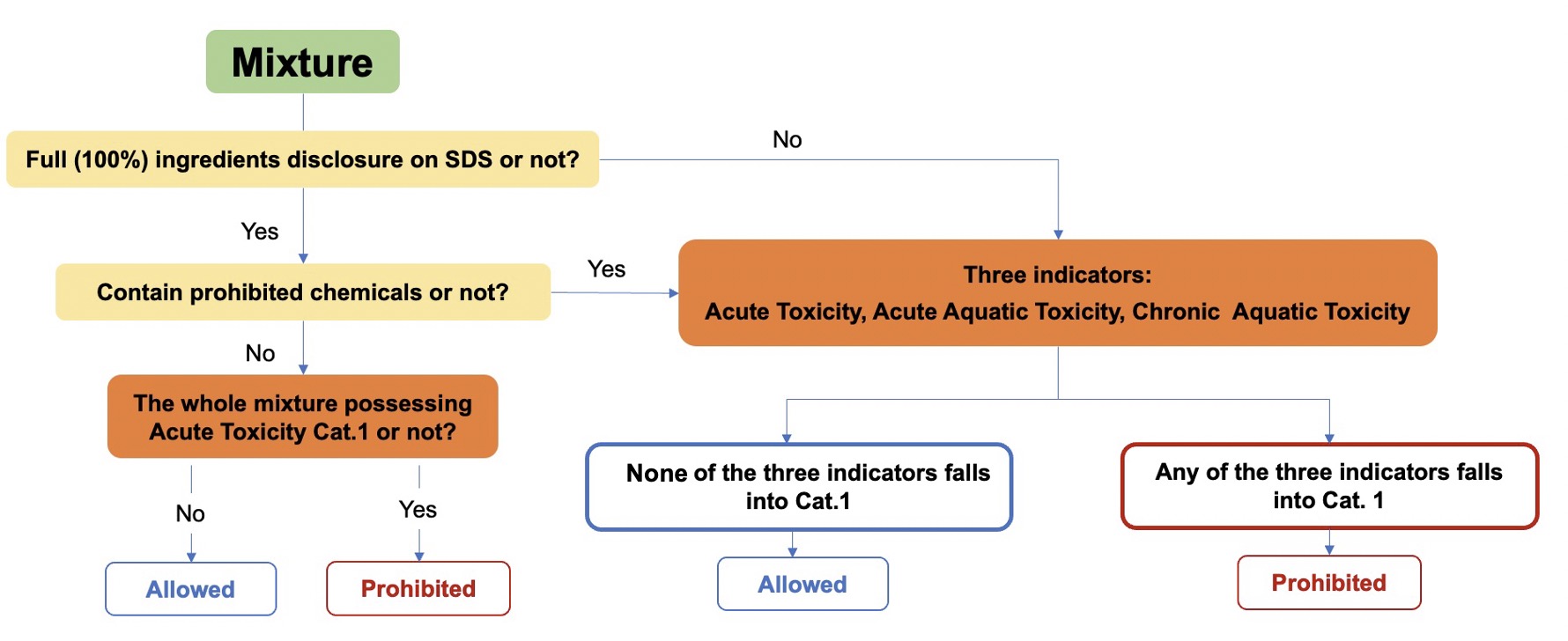
The table below shows some cases to facilitate your understanding.
Ingredients of the mixture | Hazard classification of the mixture | Factor 1 | Factor 2 | Prohibited in WGQ Port or not | |||||
Name | w/w (%) | CAS | Full ingredients disclosure on SDS or not | Acute Toxicity Cat.1. or not | Acute Aquatic Toxicity Cat. 1 or not | Chronic Aquatic Toxicity Cat. 1 or not | |||
Case 1 (Vulcanizing agent) | 2-Propenoic acid, 2-methyl-, zinc salt | 66-74 | 13189-00-9 | Reproductive Toxicity Cat.2 Specific Target Organ Toxicity (Single Exposure) Cat.1 Acute Aquatic Toxicity Cat.1 Chronic Aquatic Toxicity Cat.1 *Acute Toxicity (Ingestion), Acute Toxicity (Inhalation), and Acute Toxicity (Dermal) are unclassified. | Yes | No | Yes | Yes | Allowed |
Zinc oxide | 26-34 | 1314-13-2 | |||||||
Case 2 (Solution of benzenethiol) | Phenyl mercaptan | 70 | 108-98-5 | Flammable Liquids Cat.3 Acute Toxicity (Ingestion) Cat.2 Acute Toxicity (Dermal) Cat.2 Acute Toxicity (Inhalation) Cat.1 Skin Corrosion/Irritation Cat.2 Serious Eye Damage/Eye Irritation Cat.2A Reproductive Toxicity Cat.2 Specific Target Organ Toxicity (Single Exposure) Cat.2 Specific Target Organ Toxicity (Single Exposure) Cat.3-respiratory irritation Specific Target Organ Toxicity (Repeated Exposure) Cat.1 Acute Aquatic Toxicity Cat.1 Chronic Aquatic Toxicity Cat.1 | Yes | Yes | Yes | Yes | Prohibited |
Water | 30 | 7732-18-5 | |||||||
Case 3 (Gas mixture of 20v/v fluorine in nitrogen) | Nitrogen | 80 | 7727-37-9 | Oxidizing Gases: Cat.1 Skin Corrosion/Irritation: Cat.1A * Acute Toxicity (Ingestion), Acute Toxicity (Inhalation), Acute Toxicity (Dermal), Acute Aquatic Toxicity, and Chronic Aquatic Toxicity are unclassified. | Yes | No | No | No | Allowed |
Fluorine | 20 | 7782-41-4 | |||||||
Case 4 (Vulcanizing agent L) | Salts | 66-74 | / | Reproductive Toxicity Cat.2 Specific Target Organ Toxicity (Single Exposure) Cat.1 Acute Aquatic Toxicity Cat.1 Chronic Aquatic Toxicity Cat.1 *Acute Toxicity (Ingestion), Acute Toxicity (Inhalation), and Acute Toxicity (Dermal) are unclassified. | No | No | Yes | Yes | Prohibited |
Zinc oxide | 26-34 | 1314-13-2 | |||||||
Case 5 (Inkjet materials) | Isopropyl alcohol | 0.1-1 | 67-63-0 | Serious Eye Damage/Eye Irritation Cat.2 Chronic Aquatic Toxicity Cat.3 *Acute Toxicity (Ingestion), Acute Toxicity (Inhalation), Acute Toxicity (Dermal), and Acute Aquatic Toxicity are unclassified. | No | No | No | No | Allowed |
Propane-1,2-diol | 0.1-1 | 57-55-6 | |||||||
1,2-Benzisothiazol-3(2H)-one | < 0.05 | 2634-33-5 | |||||||
Notably, Shanghai MSA reminds shipping companies to pay attention to the followings:
For SDS that does not disclose 100% ingredients information, shippers shall ensure the SDS is qualified, not concealing the hazards of the mixtures. Moreover, shippers may be required to provide a statement issued by the identification agency that the mixtures do not fall under the scope of prohibited goods if full ingredients information is not disclosed on SDS.
In practices, the mixture is regarded as embargoed goods if the SDS indicates Acute Toxicity Category 1, even if all ingredients are not prohibited substances.
For aqueous solution, even if its SDS does not disclose the ingredient-Water, it will be regarded as disclosing 100% ingredients information.
Compliance Suggestions
1. Get a better view of the scope of prohibited chemicals to check whether the DG cargoes are prohibited in the Yangtze River Basin.
2. Get a better view of the complete information of the ingredients, including ingredient name, proportion and CAS number. etc. of each ingredient. It is recommended to disclose full (100%) ingredients information on SDS as appropriate if there is no need for CBI protection.
3. Classify a mixture according to China GHS and prepare SDS accordingly, especially indicate clearly the following hazard class, i.e. 'Health Hazards-Acute toxicity', 'Environmental Hazards-Acute Aquatic Toxicity' and 'Environmental Hazards-Chronic Aquatic Toxicity'.




