

 Request a Demo
1. Historical Perspective on Global Occupational Exposure Limits
Adverse health effects from occupational exposure to chemicals has been known for thousands of years. The Romans noted effects from lead and asbestos and later arsenic. A list of “poisons” that have been used for various purposes was well known.
Establishing occupational exposure limits for some of these chemicals started over 150 years ago. It is interesting to note that indoor air quality standards were recommended first because this research was funded by wealthy individuals to protect their health in their castles. The first actual chemical exposure standards for workers was set by Germany for the manufacturing of gas warfare agents (1912). The first peace-time occupational exposure limit was for quartz (inhalation causes silicosis and other lung diseases), which is still an exposure problem over 100 years later.
Occupational exposure limits exist in over 50 countries and regions. Some exposure levels apply to 8 hour occupational exposures, 15 minute Short Term Exposure Limit (STELs), ceiling limits, Immediately Dangerous to Life and Health limits (IDLH) and yet others are designed to address 24 hour exposures, cancer risks or reproductive risks. In the past decades, many countries, regions and organizations have worked on perfecting their exposure standards. Some historical highlights are shown as below.
1849: In Germany, Peterkoffer proposed first exposure standard for carbon dioxide of 1,000 ppm.
1930: Russia published first MAC (Maximum Allowable Concentration) list with 30 chemicals. By 2008 this list covered over 3,500 chemicals.
1938: Germany published a list of about 100 OELs (Occupational Exposure Limits.) Today this list contains over 1,000 chemicals.
1942: The American Conference of Governmental Hygienists (ACGIH) published their first table of 63 TLVs® (Threshold Limit Value) exposure limits. The list is published annually. Today this list contains almost 700 chemicals.
1949: India passed the Factories Act with their first table of 49 exposure limits.
1950: The People’s Republic of China published their first list of exposure standards. Today China’s list contains over 400 chemicals.
1978: American Industrial Hygiene Association (AIHA®) publishes the first Workplace Environmental Exposure Level (WEEL) Guides. AIHA® also published the Occupational Exposure Limits—Worldwide. Unfortunately, it only lists chemicals for which the US has standards and not all the chemicals other countries regulate that the US does not.
2000: First list of 1,000 TEELs (Temporary Emergency Exposure Limits) by the US Dept. of Energy (DOE). Standards were calculated based on toxicological modeling and published toxicological data. Today this list contains over 3,000 chemicals.
2006: The EU passes the Registration, Evaluation, Authorization and Restriction of Chemicals (REACH) regulations requiring manufacturers to develop Derived No Effect Levels (DNELs), Derived Minimal Effect Levels (DMELs), etc. for all chemicals produced or imported in quantities of more than 10 tons/year.
2008: AIHA published their ERPGs (Emergency Response Planning Guidelines to deal with short term exposure situations commonly found in emergencies such as large chemical leaks or spills.
2. Moving To Toxicology-Based Exposure Limits
A significant historical perspective is that of the ACGIH TLVs®. During the 1970s, many developing countries established their hygiene standard regulations by adopting the ACGIH TLVs® that were current at the time. Following this initial inception, these countries continued to use the ACGIH TLVs® as a significant reference in updating their existing chemical exposure standards. The chemical exposure limits for almost 1 billion workers worldwide have been based upon the ACGIH TLVs®.
The problem with the original TLVs was that they were “opinions” of US industrial hygienists as to what concentrations of chemicals employees did not seem to object to and what could be economically affordable. Because of this “opinion” controversy, in 1992 ACGIH developed a document titled “Documentation of the TLVs” which contained references to published exposure monitoring studies and very limited toxicological data to substantiate their exposure limits in the TLVs.
At the same time, both Germany and Russian were establishing their own exposure limits called Maximum Allowable Concentrations (MACs). Their exposure standards included almost 1,000 chemicals, almost twice that of the TLVs. Like the TLVs, most of their exposure standards were similar in evolution – based on employee tolerance, rather than toxicology.
In 2000, the ACGIH was sued by US manufacturers to stop implying that the TLVs® were employee exposure standards. ACGIH could not afford to fight this litigation and hence, now state that their “standards” are simply guidelines. All of these exposure standards were not based on a comprehensive toxicological model of humans and still lacked the hard science of modern-day toxicology modeling based on toxicological studies.
The first attempt at developing a database of chemical exposure limits based on toxicology modeling was started by the US Department of Energy in 2000. These DOE occupational exposure limits were known as TEELs. Temporary Emergency Exposure Limits. This toxicological modeling covered the different classes of exposure limits. There were 4 types of limits TEEL-1 through TEEL-4. TEEL-1 was similar to an 8-hour Permissible Exposure Limit - Time-Weighted Average (PEL - TWA). TEEL-2 was a 15-minute Short Term Exposure Limit (STEL), TEEL-3 lists Ceiling Limits (CL), and TEEL-4 are levels that are Immediately Dangerous to Life and Health (IDLH.)
Originally, the TEEL method used only hierarchies of published concentration limits (e.g. PEL or TLV-TWAs, STELs, CLs, and IDLHs) to provide estimated values approximating TEELs. However, there were hundreds to thousands of chemicals for which there are no exposure limits. For these chemicals, published toxicity data were used to set TEELs. [e.g. LC(50), LC(LO), LD(50) and LD(LO) for TEEL-3 and TC(LO) and TD(LO) for TEEL-2 toxicity parameters, such as LD50, LDLO, etc.] These TEELs were calculated from animal toxicology studies after making adjustments to extrapolate experimental results from animals to humans. For example, Table 3.2 (from U.S. Department of Energy (2008) titled Temporary Emergency Exposure Limits: Methods and Practice, DOE-HBK-1046-2008) shows the adjustment (concentration reduction) for Ceiling Limits and 15 STELs.
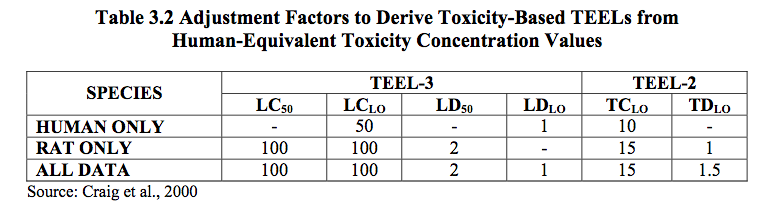
The toxicology model and its assumptions were freely available and published on the internet. This toxicology model was based on a broad review of all of the toxicological literature and the current science of inhalation toxicity. In general, the toxicology-based exposure limits were similar to the levels in the TLVs, but the DOE OEL list contained exposure limits for almost 3,000 chemicals, far more than the 650 chemicals listed in the ACGIH TLVs. Subsequently, default assumptions based on statistical correlations of AIHA ERPGs at different levels (e.g. ratios of ERPG-3s to ERPG-2s) were used to calculate TEELs where there were gaps in the data. This was a major step forward in establishing science- based exposure limits and, at the same time, establishing exposure limits for a majority of chemicals in the workplace. The US DOE updates the TEELs on an annual basis, adding new chemicals as they begin to use them.
In 2006, the next major step in toxicological based exposure standards occurred.
The European Union (EU) passed the Registration, Evaluation, Authorization and Restriction of Chemicals (REACH) regulations requiring manufacturers to develop Derived No Effect Levels (DNELs), or Derived Minimal Effect Levels (DMELs) for all chemicals produced or imported in quantities of more than 10 tons/year. The toxicology models and assumptions are published on the internet and easily available for review. (Guidance on Assessment Factors to Derive a DNEL ECETOC TR. 110. 211 pages.)
3. Exposure Standard Development Responsibility of Chemical Manufacturers
History has shown that chemical exposure standards have typically been developed by various governmental agencies often with different agendas. This has resulted in a “piece meal” approach to setting chemical exposure standards that do not coverall all the chemicals used in “commerce.” The point being that chemicals used in commerce are most likely to result in significant employee exposure.
Russia was the first country to set exposure standards for the major chemicals produced or in commerce. (This covers over 3,500 chemicals today.) The 2nd Agency to attempt to regulate all the chemicals used in their facilities was the US Dept of Energy. (This covered over 3,000 chemicals.)
However, the weakness in this historical government regulatory establishment system is that some chemical manufacturers may have more information about the potential health hazards of a chemical they manufacture than they disclose to the public or for publication. Further, legally, chemical manufacturers are liable for the adverse health effects of the chemicals they produce. Given these two facts, it makes sense that chemical manufactures should establish the “safe” level of exposure for the chemicals they produce and release into commerce. By having manufacturers set the exposure limits, manufacturers are the clear and responsible party for exposures to their products. By setting “safe standards” manufacturers could also potentially limit their liability.
In 2006, given this historical and legal perspective, the EU adopted this philosophy and required chemical manufacturers to establish both DNELs and DMELs for the chemicals they produce and distribute. This is required for all chemicals produced or imported in quantities of more than 10 tons per year. Initially, it was thought that this would be approximately 3,000 chemicals. Today, it covers over 10,000 chemicals and the list is still growing.
Why are the DNEL Different?
Very simplistically, the DNELs are comprehensive exposure assessments. They address acute or repeated exposure, different routes of exposure (inhalation or skin contact), differentiate between local and systemic health effects, and differentiate between worker exposure and general population exposure as appropriate for the intended use. Theoretically, up to 15 DNELs may be required for a specific chemical. The DNELs that are required will depend on the use selected (points of departure) and the assessment factors (AF) subsequently applied.
DNELs are defined as “safe exposure levels” for threshold effects. These are levels above which the exposed population will begin to exhibit symptoms of exposure. Such “safe levels” cannot be defined for non-threshold effects such as genotoxic carcinogens or mutagenic effects. For non-threshold effects, a DMEL needs be calculated.
4. Trends in Global Occupational Exposure Limits
Presently, there are approximately 3,000 DNELs that have been established.
However, globally, amongst all the countries and governmental agencies, there are occupational exposure standards for over 6,000 chemicals. Of the 6,000+ OELs worldwide, over 4,200 are regulated in more than one country. Interestingly, the application and adjustment of OELs in some countries vary significantly.
Here is a list of some of the more significant variations.
Germany has the most advanced system for developing OELs (MACs.) They have an occupational hygiene database for storing all empirical occupational hygiene data. As of 2005, the database had over 1,000,000 data sets. This exposure data is used in conjunction with the national health care data system to look for health effects of chemicals in workers and for other toxicological studies.
Russia has OELs (MACs) for more substances than any other country; over 3,500, including approximately 100 OELs for specific species of mold and bacteria. The MACs in Russia are designed to minimize not only adverse health effects for the majority of workers but also for future generations.
The US Department of Energy has the most OELs that are calculated based on animal toxicity. They also use data from the Russian OELs.
Singapore and the Philippines define STELs for all chemicals using a multiplier of the OEL when specific STELs have not been established.
The largest number of No Observable Effect Level (NOEL) standards have been set by the State of California and Santa Clara County, California Health Based Exposure Limits (HBELs.)
Hungary has the most comprehensive OELs for dealing with carcinogens and mutagens. They require toxicological addition of these combined exposures to assess exposure risk.
Japan differentiates between inhalation sensitizers and skin sensitizers.
Venezuela requires an adjustment of the OELs based upon a work week that is longer than 40 hours, (in addition to the adjustments typically made for a workday that is longer than an 8 hours.)
Austria established OELs for highly hazardous substances that averages employee exposures over a one year period.
New Zealand lists OELs for approximately 100 chemicals that they have not set standards for but are regulated by other countries. New Zealand has adjusted the OELs for respiration rate of the worker.
Some European countries have listed certain chemicals with an OEL of “0”. This is intended to mean that those chemicals are banned from use in their respective countries.
A number of countries adjust their OELs for altitude, standard temperature, pressure, and automatically adjust OELs for a 48-hour work week. Many of the OELs in other countries are lower than the current ACGIH TLVs®.
Given the myriad of exposure standards, what OELs should an occupational hygienist follow? Clearly, the starting point for any exposure assessment is to follow the legally required exposure standard in the employee’s country. However, this is not sufficient due diligence. All existing exposure standards that are more restrictive than a country’s regulatory standards should always be considered.
References :
“Global Occupational Exposure Standards for Over 6,000 Chemicals, 2nd ed.” Brandys and Brandys, OEHCS Publications, 2008.
“Temporary Emergency Exposure Limits for Chemicals: Methods and Practice,” U. S. Department of Energy, DOE-HDBK-1046-2008, August 2008.
“Guidance of Assessment Factors to Derive a DNEL,” European Center for Ecotoxicology and Toxicology of Chemicals, Technical Report No. 110. Brussels, October 2010 ISSN – 0773-8072-110.