Request a Demo
On March 19, 2024, the Council of the European Union published the Directive (EU) 2024/869 as regards the limit values for lead and its inorganic compounds and for diisocyanates. It shall amend the following OSH Regulations:
Directive 2004/37/EC on the protection of workers from the risks related to exposure to carcinogens, mutagens or reprotoxic substances at work
Council Directive 98/24/EC on the protection of the health and safety of workers from the risks related to chemical agents at work
Despite having established the occupational exposure limits (OELs) and biological exposure limits (BELs) for lead and its inorganic compounds, these two OSH Regulations are found outdated and do not take into account the latest scientific and technical developments and findings which enable the strengthening of workers’ protection from the risks arising from occupational exposure to lead and its inorganic compounds, which is a dangerous reprotoxic substance.
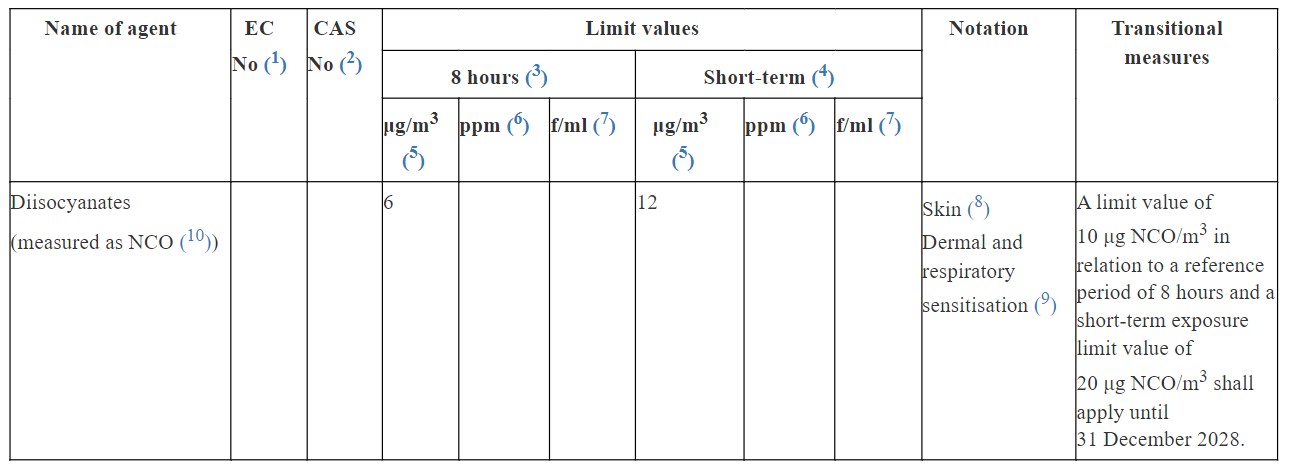
In addition, diisocyanates are considered hazardous chemical agents and should be introduced under Directive 98/24/EC with assigned OELs ( 8-hour TWA and 15-min STEL).
To this end, the amendment focuses on reducing OELs for lead and its inorganic compounds, introducing binding OELs for diisocyanates while strengthening health surveillance of the exposed workers.
Highlights of the amendment can be summarized below:
Directive 2004/37/EC
Adjust the definition of "mutagen" to align with the criteria for classification under CLP Regulations (Regulation (EC) No 1272/2008)
Annex III: Reduce the OELs (8-hour TWA) for lead and its inorganic compounds from 0.15 mg/m3 to 0.03 mg/m3
Annex III: Introduce the notation "non-threshold reprotoxic substance" for lead and its inorganic compounds
Annex IIIa: Establish that until 31 December 2028, the binding BELs for lead and its inorganic compounds is 30 μg Pb/100 ml blood, and from 1 January 2029, the binding BELs for lead and its inorganic compounds is 15 μg Pb/100 ml blood
Annex IIIa: The blood lead level above which the medical surveillance must be carried out is reduced from 40 μg Pb/100 ml blood to 9 μg Pb/100 ml blood
Council Directive 98/24/EC
Amend the Annex I as follows:
Delete the points 1, 1.1, 1.2 and 1.3 of Annex II