
 Request a Demo
A draft Chinese AQ Standard (industrial standard for work safety) on precautionary labels for chemicals in workplace has been released by the China SAWS on 15 July and is about to come effective from 1 October 2013. Chemical companies will be obliged to mark their manufacturing, using, storing workplaces and other work sites that constitute major hazard installations with the specific safety signs in light of the standard, coded as AQ 3047-2013.
A compliant workplace precautionary label consists of information about the identification of the hazardous chemical, physicochemical properties, hazard pictogram, signal word, hazard statement (H-phrases), precautionary statement (P-phrases), protective equipment statement, reference statement as well as the emergency telephone.
A workplace precautionary label sample prescribed in the standard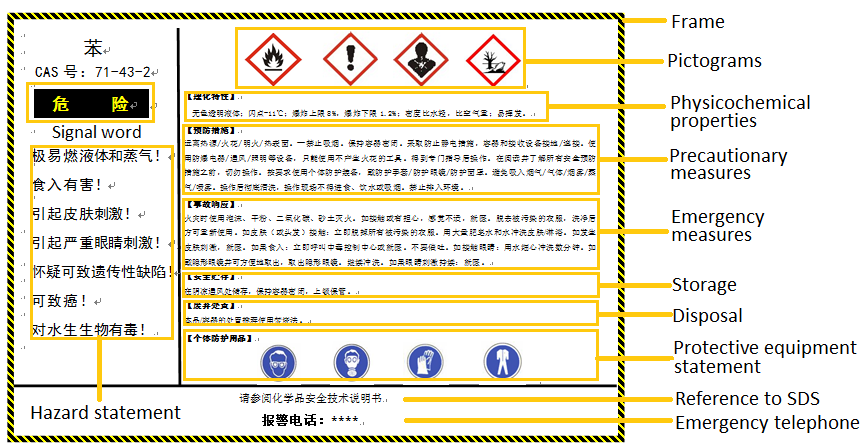 “The workplace label is quite similar to China’s GHS label for hazardous chemicals (in line with GB 15258) in terms of format and content, except for the addition of physicochemical properties and the protective equipment statement required for a workplace label;” remarks Ms. Sunny Wang of REACH24H, a leading chemical regulatory consulting agency based in China. The added information on physicochemical properties includes substance data such as flashing point, explosion limits, density and volatility, etc. The use of protective pictograms in the section of protective equipment statement has been consistent with GB 2894-2008, safety signs and guidance for the use.
“Where GHS labels and workplace labels are applied is also different: The GHS label is usually attached on the outer package of the specific hazardous chemical product; while the workplace label should be fixed at the entry/exit of the workplace, outside walls of the workplace or reaction vessel surface, pipelines of HazChems or other easily noticeable areas involved with the handling of HazChems.” Ms. Sunny adds, “a GHS label is much smaller than the workplace label in size and the latter contains more detailed precautionary information to warn and instruct the staff in the workplace”. However, the workplace label should not be placed on movable articles in the workplace such as doors, windows, shelves and racks.
The AQ standard will be incorporated in the China GHS system regarding precautionary labelling for hazardous chemicals. Mr. Chen Jinhe, China GHS researcher of the NRCC-SAWS who have co-drafted the workplace label standard and an earlier GB/T standard on China GHS hazard statement (see Chemlinked news on 16 July), reveals that “the authority might formulate in total three types of labelling standards to regulate the country’s overall chemical industry ----- an existing GHS labelling standard for HazChems GB 15258, the to-be-approved AQ 3047 and a planned GHS standard for the labelling of chemical consumer products.” With the upcoming release of other two types of standards pertaining to hazard labeling, a differentiated managing model could be established to better address the dynamic hazard issues caused by industrial chemicals (mostly HazChems) and consumer chemicals. As confirmation to Chen’s point, the draft hazard statement standard released in this July has indeed illustrated a category of precautionary statements --- general precautionary statements (P101-p103) --- particular for general consumer products.
So far, the China GHS system has covered 31 distinct standards concerning classification (28), labelling (2) and SDS communication (1), with all of their technical content cross-referenced. This year the China GHS roadmap is soon to enroll two standards on hazard statement and workplace label, respectively. A new GHS classification standard for aspiration hazard has been scheduled to come out in draft version in 2014. More technical specifications can be expected in the near future to extend the regulation to chemicals with hazard to the ozone layer and the HazChems in consumer products.