Request a Demo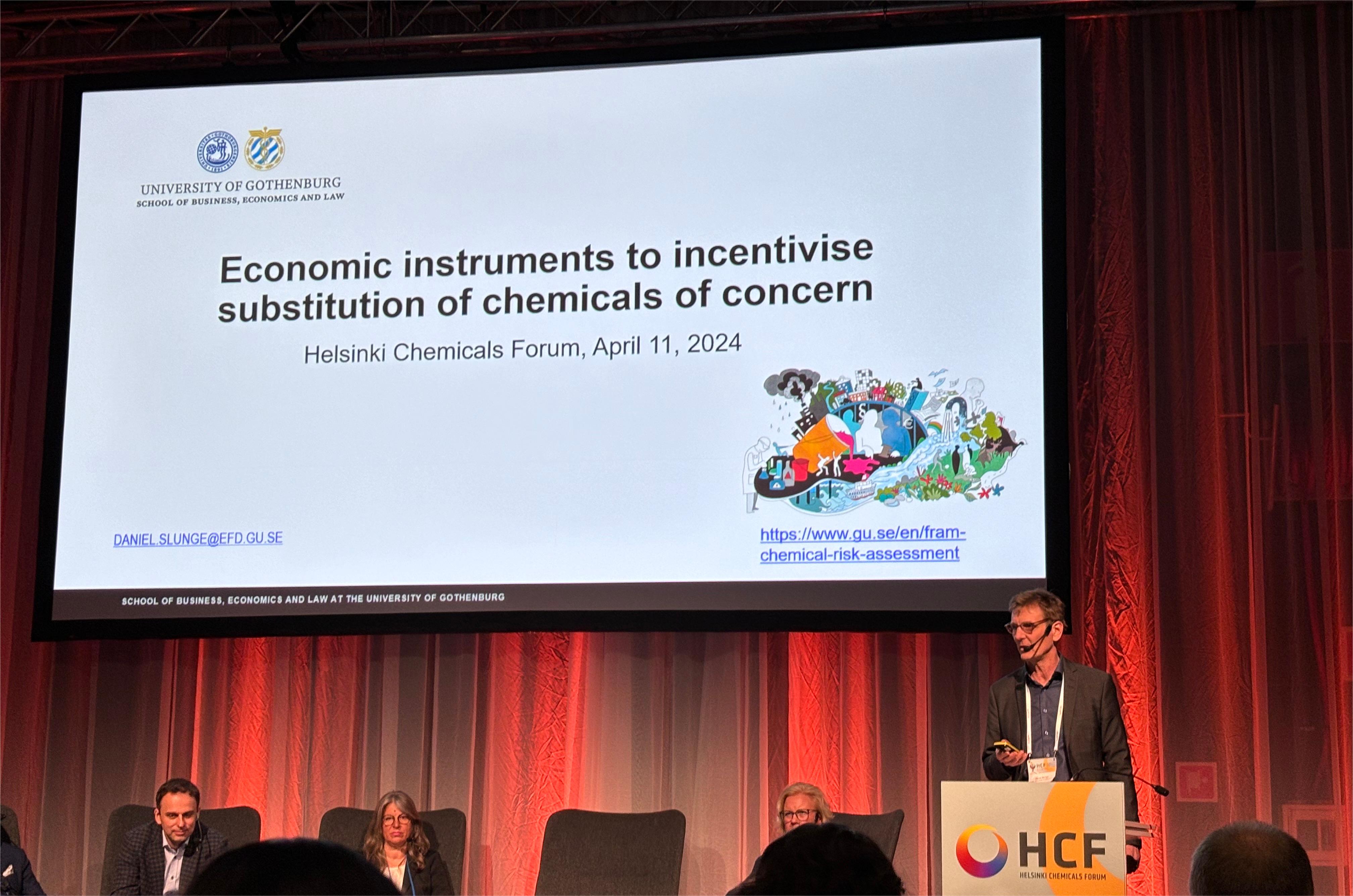
Economic instruments such as taxes and fees have been extensively used in various environmental fields but have been so far sparsely used in the chemical industry. Since chemicals are commodities that are produced for profits driven by market principles, it is inherently reasonable that economic instruments can be utilized for chemical management.
Speaking at the 2024 Helsinki Chemicals Forum held on April 11, 2024, Daniel Slunge from the University of Gothenburg shared the potential of economic instruments to incentivize substitution of substances of concern.
Regulating prices for SVHCs
Price-based instruments have been proven successful in phasing out particular groups of hazardous substances. For example, as Daniel cited, Norway introduced a tax of 50 NOK per kilogram on Trichloroethylene (TRI) and tetrachloroethene (PER) produced or imported in 2000. This tax led to a rapid decrease in the use of TRI and PER, resulting in its abolishment in January 2024 after their phased-out uses.
Similarly, a recent effort in France to ban products containing per- and polyfluoroalkyl substances (PFAS) also incorporated an environmental tax on manufacturers exceeding 100g of PFAS discharge, based on the Polluter Pays Principle.
What if the EU is to apply a fee per tonne on the use of Substances of Very High Concern (SVHCs)? To be more precise, what if a fee was established that exceeds the cost of the majority of available alternatives for SVHC applications? Based on Daniel's study, which estimated the costs of alternatives in 315 Authorization applications, it was found that 83% of SVHC uses have cheaper alternatives than a fee of 1000 EUR/tonne, a seemingly ideal choice for implementation.
In theory, if there is a price difference between chemicals of concern and their less hazardous alternatives, companies are consistently motivated to substitute the targeted chemicals as long as their marginal cost of substitution is lower than the cost of using the targeted chemicals. This difference, however, needs to be weighed carefully based on empirical studies to drive industry disruption but not the extent to destroy the industry.
Nevertheless, a fee introduced on all substances of concern can indeed drive the economic actors to internalize external health and environmental costs into prices and stimulate the industries to phase out the use of the listed SVHC, even without regulatory measures that request risk management or substitution.
Indeed, some companies required to pay to obtain REACH Authorization have already been incentivized to shift towards substances that do not require Authorization.
The revenues generated from the chemical management fees can also be earmarked for financing research and innovation on safer chemicals or other uses that further incentivize substitution.
Transferable quotas for SVHCs
On the other hand, right-based instruments such as tradable permits can also be envisioned as a powerful tool to create incentives for cost-effective substitution of SVHC. Daniel highlighted a recent example of the tradable quota system for fluorinated greenhouse gases (F-gases) in the EU. Since 2015, a quota has been required for producers and importers placing at least 100 tonnes of CO2 equivalent of HFCs in bulk on the market in a calendar year. According to a recent evaluation, the tradable quota system has been effective in reducing the total amount of F-gases in the EU.
Another early example is the tradable permit system for refineries used to phase out lead in the United States in the 1980s, which was highly cost-effective in reducing the phase-out time of lead in petrol.
So how to design the system to make it function? To start, similarly with the F-gases case, a reduction target (e.g., 50% to 0 from 2025-2050) for all SVHCs needs to be established by the official. Each tonne of a SVHC shall be weighted equally, unless assigned different weights by toxicologist. A quota will be allocated for SVHCs placed on the market for a budget period. New SVHCs receive an allocation from the next budget period. Two alternative methods for quota allocation are mainly considered:
Grandfathering: allocation of quotas based on volumes used in the previous period, at a fixed price per tonne
Auctions: manufacturers and importers buy quotas in an auction
Under this proposed system, companies are allowed to trade unused quotas and bank surplus quotas for the next period. A centralized SVHC portal will hold audited information for monitoring and verification.
While tradable permit systems have limited applications in hazardous chemicals, the existing example in lead and F-gases have shown that a similar system can be effective in stimulating the substitution of substances of concern with relatively low costs. In addition, its flexibility may increase policy acceptance among businesses.
Complementary tools but not substitutes
Despite all merits these identified economic instruments have, there are many situations where they are less appropriate, including when the health and environmental costs from exposure to a hazardous chemical are very high, where effects are location-specific and where threshold effects, i.e., an abrupt spike in the damage function after a given threshold, are likely. In such cases, bans or restrictive measures are more appropriate.
Furthermore, there is generally a lack of understanding regarding economic instruments in chemical management. Without comprehensive evaluation, it is challenging to determine whether levied fees will have the intended effect on SVHC usage.
In the end, as Daniel concluded, economic instruments are complements and can not substitute other chemical management tools.