Request a Demo
In order to reduce time and the financial burden for registrants of the same or similar new chemical substance(s), both the EU REACH regulation and China New Chemical Substance Notification (China REACH) have introduced a concept of joint submission (or joint notification). However, concrete terms of operation under the two legislation differ greatly from each other.
In contrast to the EU REACH, China's joint submission has no pre-set institutions like the Substance Information Exchange Forum (SIEF) or Consortium agreement on refund and reimbursement that underline reasonable models for data and cost sharing. Second, all joint notifiers under China REACH submit one notification dossier instead of purchasing the right to use data from an EU REACH Lead Registrant and using that data in one's separate dossier independently. Next, unlike the Consortia's approach to tear distinct endpoint data apart for sale, China's joint submission has more rigid restriction on the substance sameness for co-notifiers.
China REACH lays down four variants of joint submission: joint notification, repeat notification, serial notification and joint-serial notification. In joint notification, two or more notifying companies submit one notification dossier for the same new substance; sometimes it also stands for an umbrella term for all variants of joint submission. Repeat notification allows a later notifier of the same substance to use data from a previous notifier provided that he is given a formal consent by the previous one. Serial notifiers can make reference of some required data to their notified substances which are characterized with similar molecular structure, properties or use. Joint-serial notifiers combine both joint and serial methods .
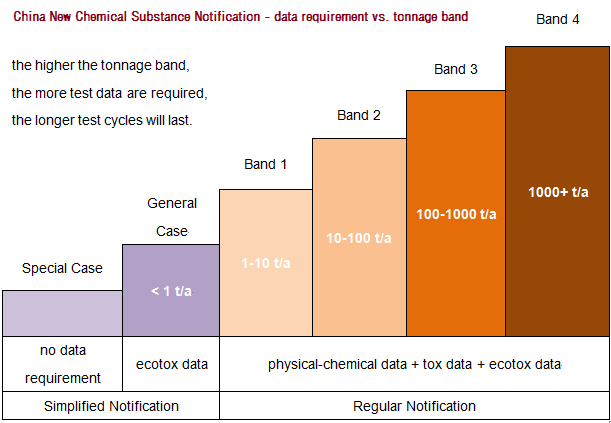
Finally, the most striking difference lies in China's unique requirement for tonnage aggregation. By tonnage aggregation, it means in a joint notification, data tests should be performed according to the total tonnage band from accumulating all notifiers' quantities. Usually the higher the tonnage band, the more test data are required and the longer the test cycle will last. This principle of tonnage aggregation applies to all types of joint submission under China REACH.
 For the above mentioned reasons, in particular the last one, joint notification has never been an easy choice as it looks for many interested non-Chinese exporters. "At present about 90% registrant clients [being in contact with REACH24H choose to arrange their own data testing and plan independent submissions", commented Ms. Alison Liu, domestic project manager of REACH24H China. How could the aggregation often turn China's joint notification into a hard-to-be-cashed commitment?
Let's start from a real case of REACH24H. A leading enterprise in the cosmetic field once called us that his head company was interested in submitting a regular notification (one notification dossier) for certain new ingredient substance which he hoped to cover the uses of all his sub companies in and outside China. The client considered everything, identification of the substance sameness, the head company and several subsidiaries as non-Chinese joint notifiers, his Chinese branch as the Chinese representative agent, agreed data and cost sharing calculations among all concerned parties, and a Power of Attorney signed by all joint notifiers, except one: total tonnage aggregated would make the testing costs increase substantially and test cycles really unpredictable!
Currently under China New Chemical Substance Notification, the overall tests of a regular notification (from Band 1 to Band 4) consist of four items: spectrum/chromatography tests, physical-chemical tests, toxicological tests and ecotoxicological tests. Costs of the first two items stay the same for all tonnages; the latter two types involve more endpoint tests and come out more expensive as the quantities of the registered substance increase.
Sometimes, the benefits brought by the joint notification are too high to be offset by additional test costs arising from the band aggregation. This happens often when two co-notifiers raise the aggregated tonnage band to one higher level (the so-called tonnage span) and both have relatively large quantities within its own Tonnage Band.
In one joint case, where the accumulated tonnage band of two joint notifiers reaches Band 2 (10-100 t/a) but neither of the separate tonnage is more than 10 t/a, the two notifiers have to prepare for six additional toxicological and eco-toxicological data tests in accordance with Band 2 requirements (3 tox data: 90-day repeated dose toxicity, reproductive/developmental toxicokinetics and toxicokinetics; 3 eco-tox data: fish 14-day, daphnia magna and bioaccumulation). Thus total test costs shared by two notifiers (690,000 - 1,020,000 RMB) could be a lot more expensive than a separate/independent notification under Band 1 (580,000 - 740,000 RMB).
Breakdowns of the cost of each test type in China New Chemical Substance Regular Notification *
Tonnage Band | Estimated Test Costs (10,000 RMB) | ||||
Spectrum /Chromatography | Physical-Chemical properties | Toxicology | Ecotoxicology | In total | |
Band 1 (1-10 t/a) | 0.4 | 4-5.5 | 13-17 | 12-14 | 29-37 (~33) |
Band 2 (10-100 t/a) | 0.4 | 4-5.5 | 40-56 | 25-40 | 69-102 (~85.5) |
Band 3 (100-1000 t/a) | 0.4 | 4-5.5 | 78-94 | 39-54 | 121-154 (~137.5) |
Band 4 (1000+ t/a) | 0.4 | 4-5.5 | 166-182 | 39-54 | 209-242 (~225.5) |
At other times, the tonnage span can be cost-effective for some while expensive for others. Take another example, three joint notifiers, at respective quantities of 2 t/a, 2 t/a, and 6 t/a, apply for a joint notification under the aggregated tonnage band 2 (10-100 t/a). According to the Chinese way of data cost sharing in proportion to tonnage ratio, in this case, 1:1:3, the three notifiers have to contribute respectively 1/5, 1/5 and 3/5 to the total test costs for Band 2. Although the first two smaller notifiers are sure to save a good deal of data costs (85.5*1/5=17.1; 33>17.1), the third one at quantities of 6 tons per annum would probably have to pay 180,000 RMB (85.5*3/5-33=18.5) more than if he chose otherwise!
What can be more annoying in a tonnage span than the increased data cost? Do not forget the cost of time. It is a factor crucial to the successful notification procedure and decisively related to new business deployment for new notifiers. Currently the testing duration for four regular notification bands ranges from 9 months (in Band 1) to 32 months or longer (in Band 4).*
Even with the reduced total data costs, the prolonged waiting time for the outcome of a test report, or even the final dossier caused by increased test items, may not be affordable for certain notifiers. For this reason, most notifiers in low quantities would not participate in a joint notification if the aggregated span is too big.
When and how to apply a joint notification? Usually the answer requires notifying companies to check several prerequisite conditions of a joint notification:
The sameness of the new substance;
Two or more valid/qualified joint notifiers;
The agreement on data and cost sharing calculation and other notification-related issues;
When all the first two criteria are met and it comes to question of cost sharing, joint notifiers are recommended to check if the aggregated total tonnage and individual tonnage band of each notifier are within the same band scope. In an ideal condition, "all within the same band scope", and a great deal of time and capital can be saved on the planning of additional new test items due to tonnage span. Furthermore, the gains-and-losses weighing for a specific co-notifier can be simplified. However, it is not to say one must stick to the principle of "all within the same band scope". There are numerous probabilities that joint notifications involving tonnage span do help reduce test cost share for each co-notifier and in given circumstances the prolonged test cycles can be tolerated. Also, from the perspective of the whole industry, joint notification in the condition of "all within the same band scope" is not realistic, and will inevitably lead to repeated dossier registration and data tests. What we are suggesting here is a general reference model of application through which an individual notifier can better achieve their most desired effective mechanism of data and cost sharing.
To identify the sameness of the new substance in a joint notification, each co-notifier must first go through the spectrum or chromatography of the substances, like in EU REACH registration, since this is the ultimate and unavoidable approach to decide if all joint notifiers will register for the identical substance. In China REACH, the average test cost for spectrum or chromatography is 4,000 RMB if performed in a Chinese-based laboratory. Non-Chinese notifiers can also use spectrum or chromatography test data generated from a foreign GLP lab. But three eco-tox data for Band 1- 4, that is, degradation, aquatic acute toxicity (preferred fish) and terrestrial acute toxicity (preferred earthworm), must be generated from either one of the nine labs appointed by China's Ministry of Environmental Protection (MEP).
A valid/qualified joint notifier is a direct exporter, importer or a Chinese manufacturer or producer. In joint notification, a registration certificate is issued to each respective joint notifier and marked with each one's own tonnage (though the notification dossier is completed based on the aggregated tonnage). Chinese downstream users may re-notify in case of any use change of the registered substance. It must be noticed that non-Chinese suppliers who export through non-Chinese (including Hong Kong, Taiwan and Macao) distributors to China are not deemed as valid notifiers. For cross-national enterprises that have multiple branches all over the world, it is also important to check whether all the co-notifiers are direct exporters or importers in their trade with China.
Common joint notifiers that do not come under the same head company may be concerned about the same question. Will joint notification damage my CBI ? Here is another interesting case about the joint notification of two non-Chinese exporters. The two suppliers exported the same substance to one Chinese importer, both at the tonnage of about 150 t/a (Band 3), where total aggregated tonnage band falls still within Band 3 and luckily no additional data test is needed. Their Chinese importer was struck with an idea: I hope my two suppliers join hands in submitting a regular notification on the condition that they do not know each other and I assume the secret coordinator. Could it work? According to the current China REACH Guidance, only the registered substance name applies to the policy of commercial business information when the notifier substitutes it with a generic name in the disseminated list of registered substances published by China MEP. The MEP also makes public information on the name of the notifier (company), type of notification (like joint notification) and the management type (like a general new substance or a hazardous new substance), but excludes specific tonnage or tonnage band.
To sum up, joint notification under China REACH regular notification is still subject to the restriction of multiple factors like the lack of SIEF system, the aggregation of tonnage and limitation to the notification subjects, etc. All of them contribute to the fact that massive regular notifiers could not make the best of this would-be-widely-spread approach. Yet a prudent and adept employment of joint notification is expected to help companies greatly reduce their registration costs. REACH24H will keep working on this research and will continue sharing our practical China REACH experience with every company in need of regulatory compliance