
 Request a Demo
Increased awareness of the health risks posed by food contact materials has precipitated increased regulation in the sector. Today, even though the regulatory system for FCM is relatively well-developed, issues surrounding the potential for non-intentionally added substances to impact the safety of FCMS have still not been fully addressed. In this article insights from the Director of China’s National FCM laboratory, Zhong Huaining will be offered to look at how China is tackling this issue.
WHERE DO RISKS COME FROM?
China’s national food safety law GB 4806.1-2016 General Safety Standard for FCM defines it as “all kinds of materials and articles which are, or might be, in contact with food when used under the intended conditions, including food packaging materials, containers, utensils and machines applied during food manufacturing, processing, packaging, transportation, storage and selling, as well as printing ink, adhesive, grease etc. that may directly or indirectly contact food”. The primary risks of FCMs are associated with the potential of FCM chemicals to migrate into foods.
Health risks posed by FCM are originated from:
Base material (resin, polymer, paper fiber)
Additives
NIAS (including impurities)
The migration amount of base materials and additives is much more than NIAS for they are applied intentionally during production, but they are more controllable because risks are quantified and traceable. The government outlined national food safety standards GB4806 series to regulate FCM, mainly by the maximum migration limit and GMP etc. Quantitative and qualitative analysis of NIAS is inherently more difficult and costly and as such suffer from a significantly less developed regulatory system.
Ø Formation of NIAS
Chinese national food safety standard GB 4806.1-2016 General Safety Requirements for Food Contact Materials and Articles is the first regulation in China that defines NIAS “a substance which exists in an FCM but is not added willfully, it can be impurities of the raw and auxiliary materials, an outcome of degradation of ingredients, contaminants and reaction intermediates during production, sale, application and so forth”.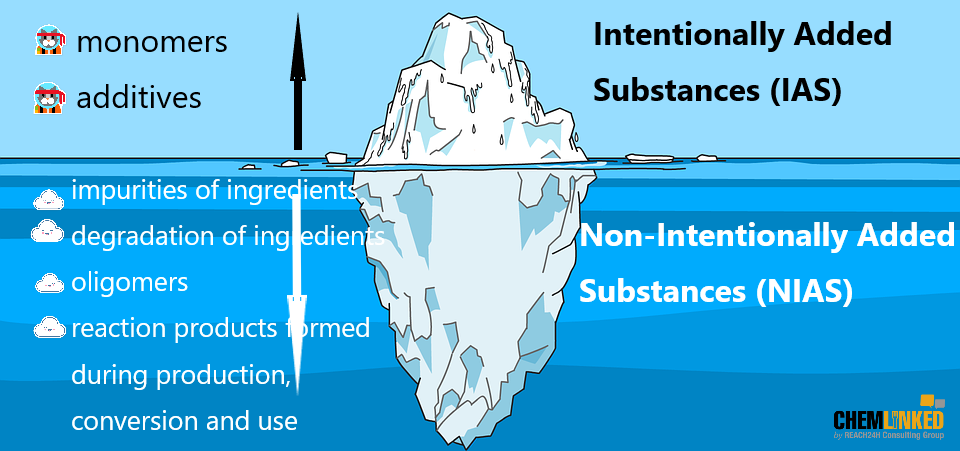 Let’s take two of the most common food contact materials as examples: PET bottle and pack box of dairy food products.
NIAS of PET bottle
PET bottle are manufactured from the material polyethylene terephthalate and commonly used as liquid containers. NIASs data is shown in the table below. 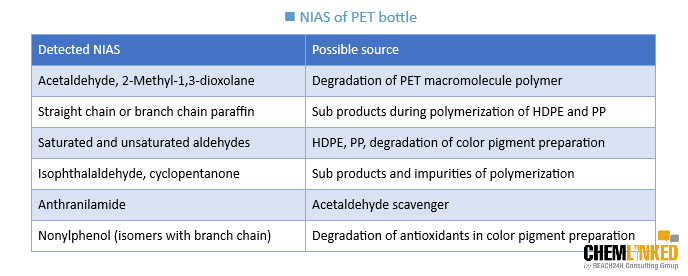
NIAS of dairy product package
Research by Key National FCM Laboratory in recent years shows various NIASs exist in dairy product package box/bottle. They classify them by volatility: 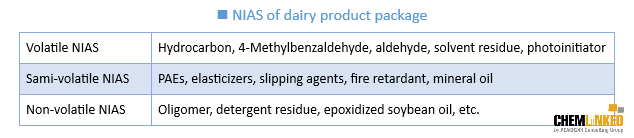
Safety Risk Caused by NIAS
Though the migration amount of NIAS to food is generally low, and won’t damage human body immediately, some harmful NIASs in food remain concerning. Examples of NIAS’s risk are provided.
Ø Mineral oil, the latent killer
In 2016, Kinder Chocolate under Ferrero was found to contain mineral oil, up to 1.2mg/kg. WHO classifies unrefined or slightly refined mineral oil into level 1 carcinogen, and highly refined mineral oil as a level 3 carcinogen, i.e. not regarded as carcinogenic, but there is no evidence supporting its non-carcinogenicity. It is commonly used as a food and cosmetic additive.
According to the European Food Safety Authority (EFSA), bread and rolls contains the most mineral oil of all food categories (from bakery machinery). (see chart below)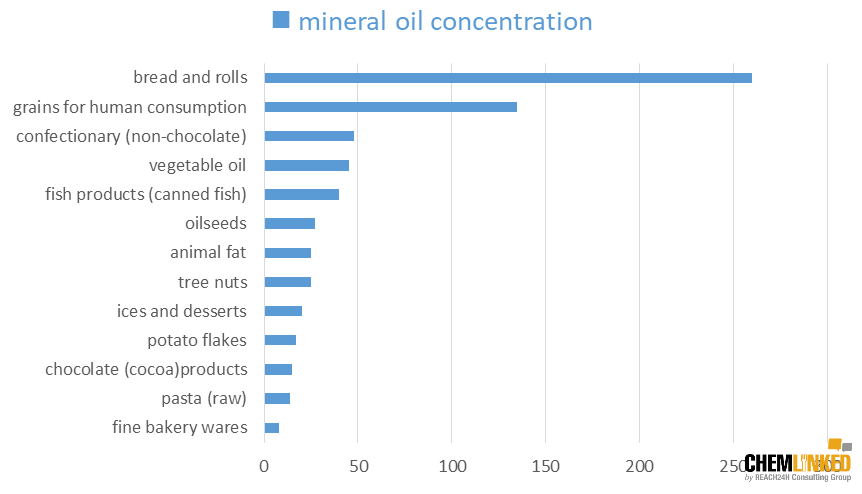
Health risk of mineral oil
| Perspective | Facts about mineral oil |
| Acute toxicity | low toxicity |
| Chronic toxicity | The accumulation of mineral oil saturated hydrocarbons (MOSH) in animal tissues will lead to fibrosis, necrosis etc. |
| Carcinogenicity/ mutagenicity | Mineral oil aromatic hydrocarbons (MOAH) could be carcinogenic, especially those contain more than 3 benzene rings; and some MOAH are tumor promoter. |
| Endocrine disruption | Experiments in vitro show estrogenic properties of MOAH, so it is viewed as a potential endocrine disruption. |
ØNP - Endocrine disruptors in milk powder
Nonyl phenol is a crucial chemical in the production of surface active agent, plasticizer, antioxidant, lubricant additive etc. that are universally applied in plastic membrane, inside coating of milk powder tin and plastic nursing bottle. Two representative surface active agents are TNPP (tris nonylphenyl phosphite) and NPEOs (nonylphenol ethoxylates). The residue of raw materials, degradation of TNPP, and bioactive metabolites of NPEOs contain NP.
A research on dietary exposure to bisphenol A and NP carried out by China Disease Control and Prevention Center in 2015 (see table below) suggested that milk powder is badly polluted by NP with an average detected concentration of 196~2101μg/kg. Equivalent studies in Germany, Spain and Italy pointed to a similar conclusion: milk powder feeding is the major cause of infants’ exposure to NP.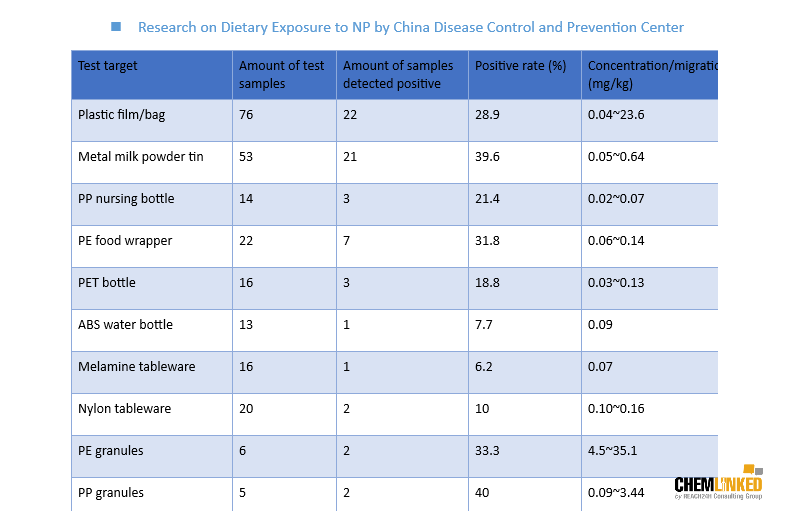
FCM Supervision and NIAS Risk Control
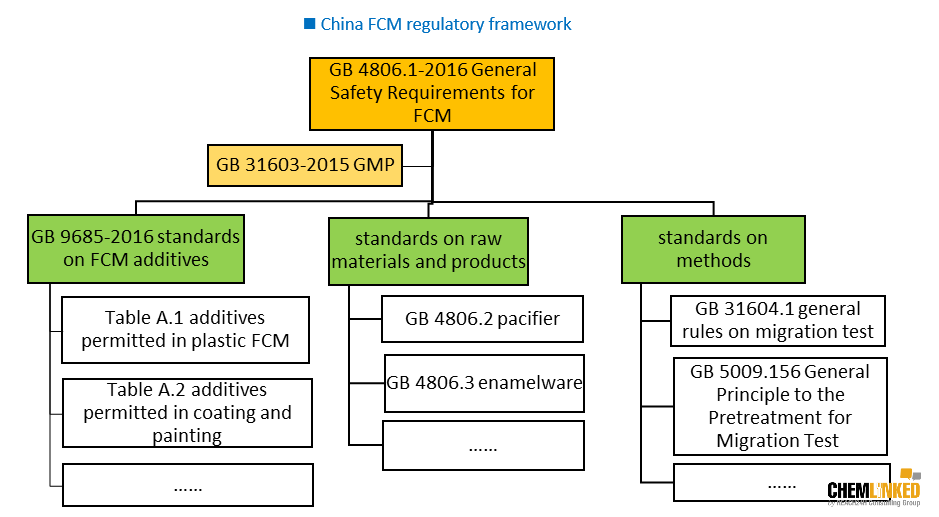 FCM regulatory system consists of general safety rule, positive lists of raw materials and additives, testing methods, and GMP. National standard GB 4806.1 General Safety Requirements for FCM is a leading rule that stipulates basic criteria, maximum limit of ingredients, composition principle, testing methods, traceability and product information. It applies to all FCM products. In GB 4806.1, articles mentioning NIAS are:
the migration of NIAS into food shall not cause damage to human body;
the substances migrating to food shall not bring changes to food composition, structure, color and flavor, or confer any technical functionality on food (except for special rules)
Ø Challenges hindering NIAS supervision and risk control
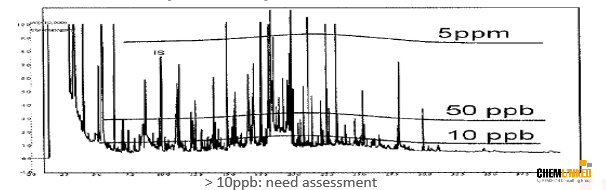
Technical aspect: NIAS qualitative and quantitative studies are complicated and involve multiple steps requiring initial identification, quantitative studies etc., (see picture). It will take a lot of time and considerable resources and efforts to detect and assess all possible NIAS.
Risk assessment: the lack of toxicological information of many substances is a big problem in risk assessment.
Animal welfare: animal testing is also a big issue.
Ø Rise to challenges
“NIAS vary from product to product, so risk management and screening should be conducted case by case”, noted Mr. Zhong in his keynote speech on NIAS at the 2018 CRAC summit.
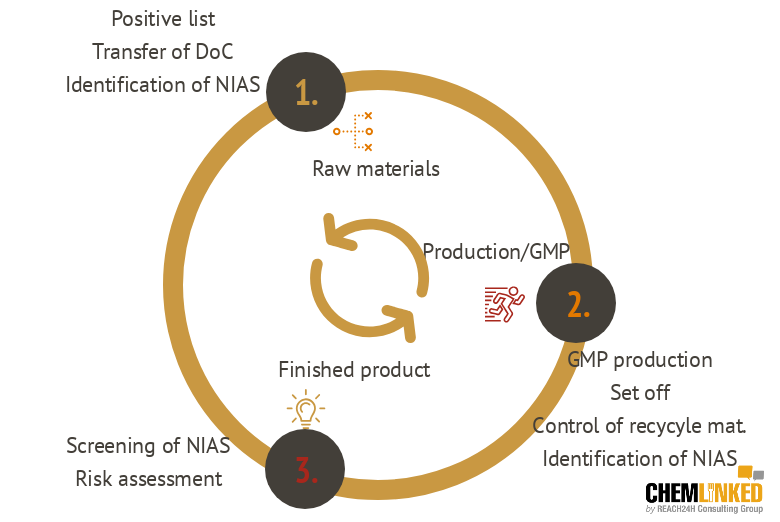
Use permitted FCM additives and raw materials
Get to know information of FCM additives, prohibited substances, NIAS from Declaration of Compliance (DoC), and deduce probable NIAS (based on identified NIAS, manufacturers alone the whole supply chain can adjust or improve their production equipment, methods etc. to avoid these NIAS to certain extent.);
Stick to GMP, control adhesion problem and manage recycled materials.
Failure to comply with the above rules will require more complicated analysis and then risk identification (see graphs below).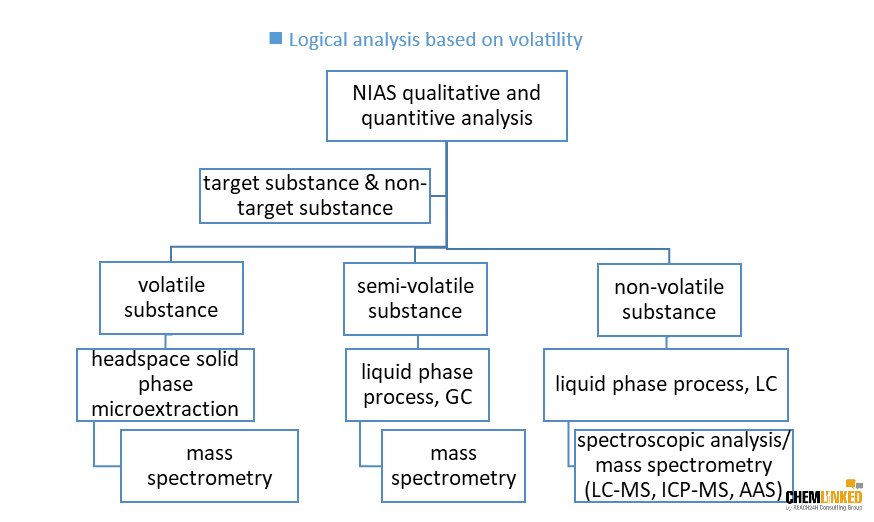
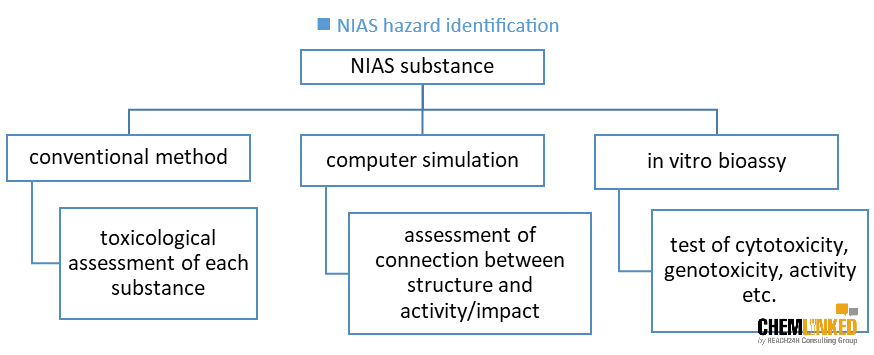 However the analysis and tests listed above entails a prohibitively high financial and time investment. The world has not yet come up with an effective and most importantly an economically feasible identification and assessment system to regulate NIAS migration in food. Under current circumstances, the responsibility of managing NIAS should be on the shoulders of suppliers of raw materials and final product manufacturers.