Request a Demo
At the seminar held in Shanghai on 23 March 2023, Mr. Chen Jun, an official from the Ministry of Emergency Management (MEM), shared the latest information on the management of hazardous chemicals (Hazchem) in China, focusing on the Hazchem registration system and Hazchem QR code application.
According to Mr. Chen, the MEM currently does not have enough information on imported hazardous chemicals. Many imported hazardous chemicals have not been registered via the Hazchem registration system, which supports the automatic generation of QR codes (called “hazardous chemical safety information codes”) for registered hazardous chemicals. In light of this situation, the MEM intends to expand the scope of enterprises that are subject to Hazchem registration in order to improve the collection and transmission of hazard information. That is, certain enterprises engaged in Hazchem business operations will also be required to fulfill the obligation of Hazchem registration to generate Hazchem QR codes. “If they have a concern about the leakage of confidential business information or supply chain information, they can apply for special QR codes with their own identity information via the Hazchem registration system,” said Mr. Chen at the seminar. Furthermore, the MEM will step up inspection on Hazchem registration this year. A list of about 30 key hazardous chemicals will be issued. Enterprises involving these target chemicals will be prioritized for inspection.
Mr. Chen addressed that, “The MEM plans to roll out hazardous chemical management based on QR codes across the Yangtze River Delta region this year”. Guangdong, as the first province to pilot the QR code program since June 2021, has achieved promising results. Following the “One enterprise, one chemical product, and one QR code” principle, Shandong and Suzhou (a city in Jiangsu) successively piloted the Hazchem QR code program in 2022. Building on the success of these pilot programs, Zhejiang, Shanghai and Jiangsu will pilot the Hazchem QR codes program in 2023. Besides, some Chinese central state-owned chemical enterprises will be designated to pilot the Hazchem QR code program. They may require downstream suppliers to provide Hazchem QR codes, regardless of whether the downstream suppliers are in the pilot regions or not.
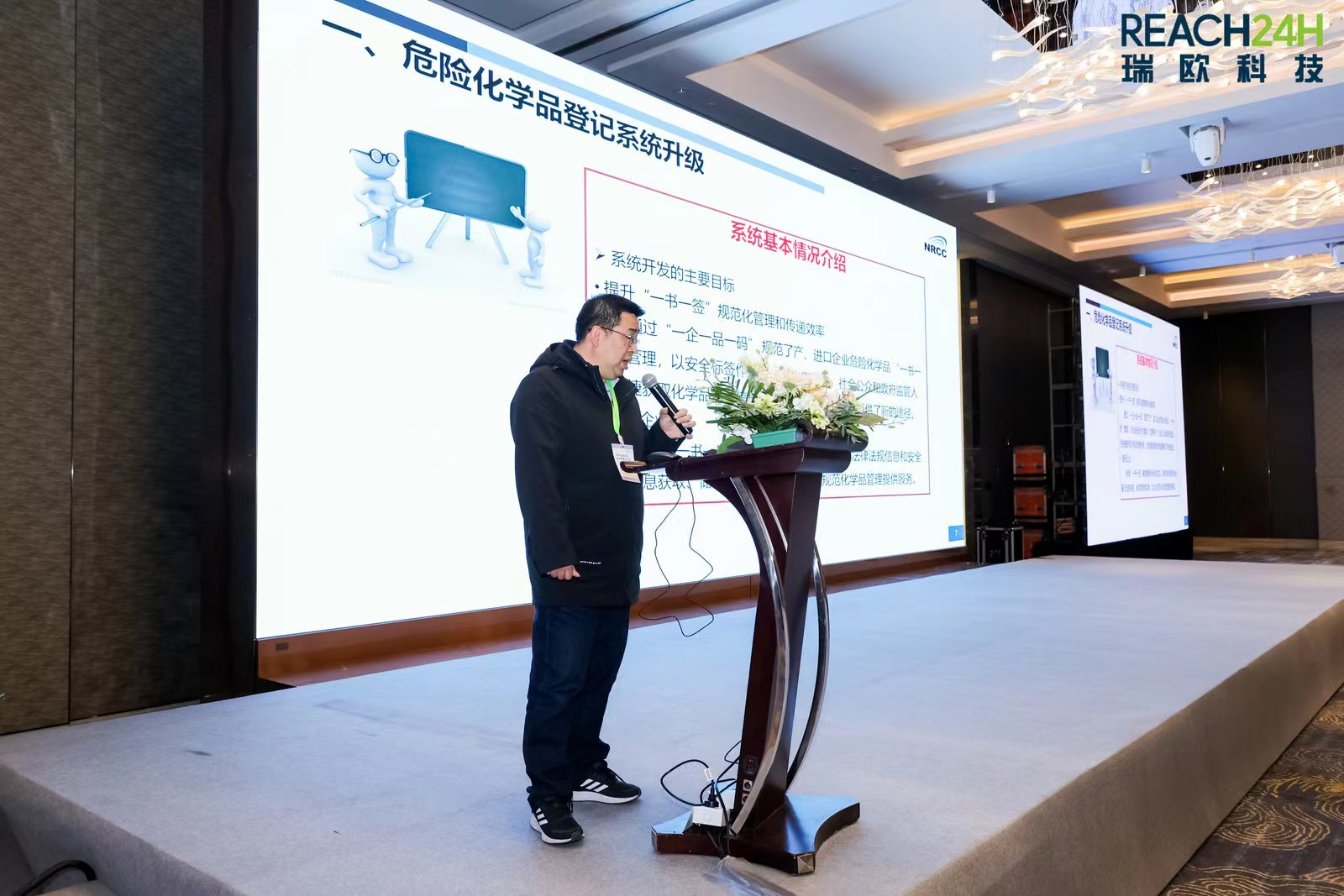
Attendees showed great interest in China’s Hazchem QR code application at the seminar. They raised the most concerned question - “Can an overseas enterprise appoint a representative agent to comply with the Hazchem QR requirements in China?”. If not, they consider a great compliance burden will be imposed on oversea enterprises. Mr. Chen replied that it is still under consideration, depending on the further development of the Hazchem QR codes pilot programs in China. It should be noted that the appointment of a representative agent for Hazchem QR code generation does not mean the adoption of representative agent concerning Hazchem registration under Decree No. 591 (Regulations on the Control over Safety of Hazardous Chemicals).
Note: Once the Hazchem QR code becomes mandatory for hazardous chemical management within the territory of China, for imported hazardous chemicals, a Hazchem QR code shall be affixed to the blank space in the lower right corner of the label before the product enters customs, or the Hazchem QR code shall be displayed on the label and printed together. Overseas manufacturers are obliged to assist importers in China to affix the Hazchem QR codes. If it cannot be completed by overseas manufacturers before entering customs, importers must affix the Hazchem QR codes to the corresponding products before entering the market. That is, importers in China can transport the imported hazardous chemicals to their warehouses after customs clearance first and affix the Hazchem QR codes when repacking them, and then they can be circulated in China’s market. |
To regulate the management and use of hazardous chemical safety information codes, and promote the effective transfer of hazardous characteristics, safe disposal, etc., the MEM isssued the Regulations on the Management of Hazardous Chemical Safety Information Codes (Trial) on February 1, 2022. At the seminar, Mr. Chen also shared some future plans regarding the legal basis for China’s hazardous chemical management based on QR codes:
The proposed regulation on the Hazchem QR Code application is still under preparation. The MEM recommends that local authorities formulate local regulations in this regard. Guangdong may introduce a local regulation this year to standardize the Hazchem QR code management.
In 2023, the MEM plans to revise SAWS Order No. 53 (Measures for the Administration of Hazardous Chemicals Registration) to consolidate the experience of recent years. The revision will not come out very soon, which is expected to take 2 or 3 years.