

 Request a Demo
Asia Pacific is a diverse, dynamic, and growing region, presenting chemical industries with opportunities and challenges. Chemical regulation developments will affect the commerce and chemical activities of industrial enterprises, which attracts many stakeholders’ attention. At the First Week of CRAC-HCF 2021 Virtual Forum held by REACH24H in November, professionals from this field have introduced the regulatory developments in Korea, India, and Chinese mainland and Taiwan. Speaking at the Second Week of CRAC-HCF 2021 Virtual Forum held on December 6, 2021, Mr. Jeff Li, the principal scientist of P&G Beijing Technology Co., Ltd, introduced the latest developments in chemical regulations of some other countries across the region, and shared his opinions on the future trend of Asia-Pacific chemical regulatory.
ChemLinked summarized major highlights of Mr. Li’s speech as follows:
The Philippines
According to Mr. Li, new legislation on chemical management is not going to be formulated in the Philippines, however, management on new chemical substances are further tightened. More specifically, data requirements for Pre-Manufacture and Pre-Importation Notification (PMPIN) of new chemical substances are stringent, even the abbreviated form of notification. The data source (original version), usages, downstream users, etc. are mandatory.
The official review period in Philippines would be extended, stated by Mr. Li. During the review period, registrants may be required to provide 100% composition information of the product, aiming to check whether other substances contained are listed into the Philippine Inventory of Chemicals and Chemical Substances (PICCS) and whether the chemicals subject to PMPIN have been notified. Besides, importers in Philippines shall submit the PMPIN application to the Philippines Environmental Management Bureau under the Department of Environment and Natural Resources (DENR-EMB) before importing certain chemical substances.
Starting from 2020, the Philippines has considered adding over 50 high volume chemicals into the Priority Chemicals List (PCL) for further management. According to the DENR-EMB, the prioritization of management would be based on the outcome of risk assessments of these chemicals. It is also promoting the use of animal testing alternatives, e.g. QSAR and read-across methods.
Vietnam
The Vietnam National Chemical Inventory (NCI) is the overall list of existing chemical substances in Vietnam. As of October 2021, there are over 50,000 chemical substances that have been nominated to the NCI, of which the number is almost ten times compared with 2016. Many chemical substances nominated have been approved by the Vietnamese authorities. All chemical substances manufactured and imported in Vietnam shall be checked whether they are in the NCI or not. For the issue that most enterprises concerned about – ‘are chemical substances without CAS number applicable for the nomination to the NCI’, Mr. Li shared with audience the reply he got from the authority that only chemicals with CAS number could be nominated to the NCI. More details about the supplementation of NCI and the draft of new substance act were also reported by ChemLinked (CL news).
Mr. Li also indicated that there were conflict items between the existing Law on Chemicals and the draft New Substances Act. As the Law is basis for formulating the new act and it is panned to be revised in 2023, it’ll be a long time before the implementation of the Vietnamese New Substance Act.
Thailand
In 2020, Thailand's Department of Industrial Works (DIW) published the First Thailand Existing Chemicals Inventory (CL news), which provides the basis for future differentiated management of existing chemical substances and new chemical substances in Thailand. Mr. Li got the first-hand information from the authorities that the DIW would publish the second version of Thailand existing chemical inventory in 2022. The DIW plans to promote the project on the risk assessments of existing chemical substances in Thailand from January to August in 2022. High-priority substances will be selected to pilot risk assessments, which will be the foundation for the establishment of Thailand’s system for chemical risk assessments.
In January of 2021, Thailand IPCS under Food and Drug Administration (FDA) published the fourth draft version of Chemical Substance Act (CL news), which aims to replace the Hazardous Substance Act to manage the chemical substances in Thailand. Mr. Li shared the flowchart below showing the framework of this draft act.
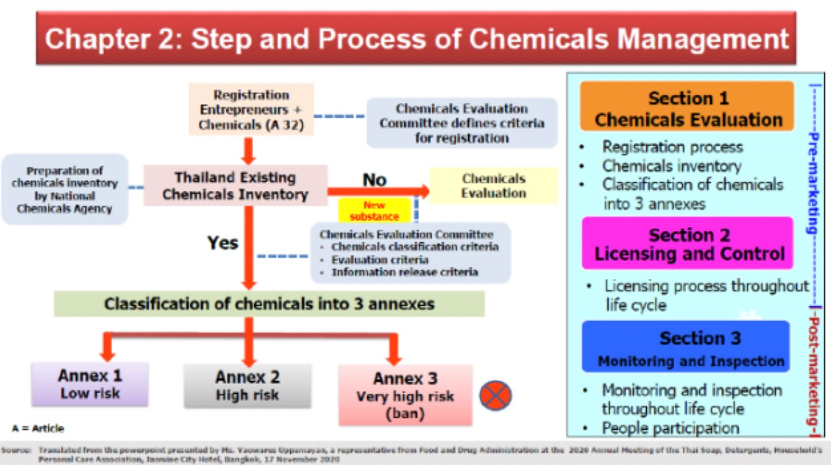 * It should be noted that the existing chemical inventory under the draft act formulated by FDA is different from the foregoing inventory published by the DIW. As for what the final version of the inventory under this act will be like, it has not been stipulated yet.
The FDA is actively promoting the legislation on chemicals. Over 30 subordinate regulations of the draft act are under preparation, including the regulation on the risks screening and assessment of chemical substances. Domestic industries and NGOs in Thailand are invited to engage in shaping the management rules. The FDA expects to implement these subordinate regulations within two years after the implementation of the Chemical Substances Act.
In Mr. Li’s view, although there are differences between chemical regulations published by Thailand’s DIW and FDA, the trend of chemical regulatory developments in Thailand is becoming more and more scientific.
India
At the first virtual week of CRAC-HCF 2021 held in November, Mr. Shisher Kumra, who is from one of the only two NGOs involved in reviewing the Indian Chemicals (Management and Safety) Rules (CMSR), have introduced the update on India’s chemical regulation (Details can be accessed here). Mr. Li indicated that Indian authorities didn’t adopt the suggestions given by enterprises on shaping the regulation, such as calling off spectral data for the notification of new chemical substances and cutting down notification fees. Regarding the implementation date of CMSR, the legislation faced stagnation due to Covid-19 and other priorities of governmental affairs. As planned the CMSR will take effect six months after its issuance, which leaves only a short period for enterprises to make corresponding adjustments before enforcement. Mr. Li suggested relevant enterprises pay more attention to the compliance with the CMSR for its complicated management and obligations.
Although the chemical management in many Asia-Pacific countries has progressed slowly due to the epidemic, Mr. Li believes that chemical regulation across the Asia-Pacific region will undergo great changes in the next 1-5 years in general, with a trend towards the assessments of new and existing chemical substances.
To learn more about this coference, please click here for live playback.




