Request a Demo
Work Safety Law of the People's Republic of China was promulgated on 29 June 2002, and amended in 2009, 2014, and 2021 respectively. The latest revision entered into force on September 1, 2021. There are 119 articles in total, in which 56 articles have been modified, accounting for about 49% of the 2014 version.
The Work Safety Law, which took effect in 2002, has helped reduce malpractice, but many problems still need to be addressed. Specifically, government regulations and standards are not being properly implemented at the local level. Light punishment and lack of supervision are believed to be among the major reasons for the negligence behind a number of high-profile workplace accidents that have occurred since 2015. Therefore, the amendment is especially necessary to enhance work safety, and prevent and reduce work safety accidents.
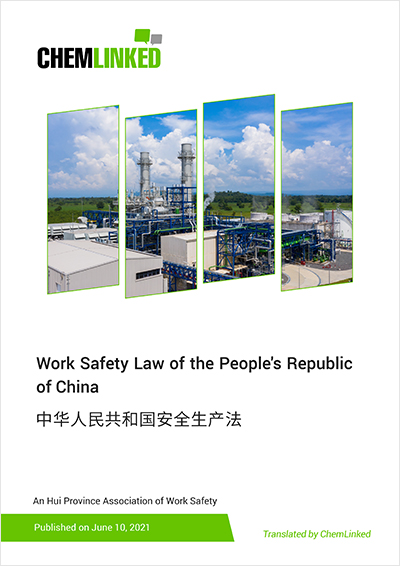 (The English Translation of Work Safety Law by Chemlinked)
In the 13th Chemical Regulatory Annual Conference (CRAC) and Asian Helsinki Chemicals Forum (HCF), Lu Nianming, Secretary General of China Chemical Safety Association, explained to us the main changes in the Work Safety Law:
Clarifying the main responsibility for work safety of businesses
It is stipulated in the amendment to implement the "Industry safety, business safety, production and operation safety", and the primary responsibilities for work safety of businesses and regulatory responsibilities of related departments are clarified. In cases where a business is not covered by a specific supervising authority, the amendment makes it possible for county and higher levels of governments to designate a government body to oversee work safety. The amendment indicates that employees are also responsible forwork safety, correcting the misconception that "only the safety department and safety managers are responsible for work safety". It also adds provisions concerning workplace safety in emerging industries, including the platform economy, to fulfill their responsibility for work safety, as well as other prominent problems affecting work safety efforts.
Imposing heavier penalties on delinquent enterprises
The amendment provides significantly higher fines for production and operations entities (and may also be subject to criminal liability) in relation to non-compliance and workplace accidents. "Responsible persons" may also have personal liability in the form of fines for workplace accidents that occur under their supervision. Aside from tougher penalties, violators can be fined for each passing day they do not rectify the situation. Previously, the maximum fine for a workplace accident stood at 20 million yuan. Now the upper limit is lifted to 100 million yuan.
According to the amendment, greater efforts shall be taken by relevant departments to close down production and operation units with violations, revoke their licenses according to the law, and impose occupational bans on the main person in charge. According to the Law, the departments for work safety shall timely collect, share, disclose to the public the information on administrative penalties for business units. The departments shall also strengthen social supervision over illegal and trust-breaking business units and employees, and improve the integrity of work safety in the whole society.
Establishing a prevention-oriented work safety mechanism
The amendment adds provisions to establish a dual mechanism of “hierarchical management and control” and “hidden risk identification and control” for safety risks, and promptly report the investigation and management status of the potential serious accidents to the related departments.
Introducing criminal justice in administrative law enforcement
The amendment adds provisions regarding crimesconcerning work safety as referred to the Amendment XI to Criminal Law of the People's Republic of China. It is stipulated that business entities must not shut down or destroy monitoring, alarm, protection, and life-saving equipment and facilities that are directly related to work safety, or tamper with, conceal, or destroy related data and information. Whoever in violation of the provision, posing a real danger of causing any major casualty accident or other serious consequence, shall be sentenced to imprisonment of not more than one year, limited incarceration, or probation.
To learn more about this coference, please click here for live playback.