Request a Demo
It has been more than one year since MEP started to implement the Measures for the Registration of Hazardous Chemicals for Environmental Management (trial) (MEP order 22). Only recently in April, 2014 did the Ministry officially issue the List of Hazardous Chemicals of Priority Environmental Concern, which includes 84 chemical substances. The list is the basis upon which the regulation is implemented. Companies producing or using chemicals in this list will have a series of regulatory obligations to comply with including submitting a risk assessment report and reporting release and transfer data. According to the Measures, companies are required to publically release information on pollutant discharge and transfer data by March every year. The MEP is taking the substantial step of collecting information of chemicals from individual companies in order to better ascertain the chemicals currently circulating in the marketplace.
While the list demonstrates a significant step forward for China’s chemical policy, there is room for improvement in terms of the selection of chemicals. The list falls short of adequately assessing chemicals under health and environmental impact criteria such as carcinogenic, mutagenic, or toxic to reproduction (CMRs) and endocrine disrupting chemicals (EDCs). The delay in finalizing the list also highlights the administrative shortcomings inherent in China’s chemical management system.
Massive Reduction in MEP’s list: CMR and some major EDCs excluded
A closer look at the list reveals that it has dramatically reduced the number of chemicals by almost 50% compared with last year’s draft version of 142 chemicals. This huge reduction comes as a surprise, as the List was generally expected to serve as China’s counterpart to EU REACH’s ‘SVHC list’. It is possible to surmise that the reason behind this is likely due to lobbying and pressure exerted by influential industry representatives.
The list does not reflect the ambition for China’s future chemical management regime (2011-2015) espoused during the 12th Five-Year-Plan . In China’s first ever Five-Year-Plan on chemicals environmental management released in 2013, the MEP vowed to take ‘priority’ actions to a list of 58 substances, most of which are persistent, bio accumulative and toxic (PBTs), very persistent and very bio accumulative (vPvBs), CMRs or EDCs .Only 6 of the “Accumulative Risk Chemicals” in 12th Five-Year-Plan list are included in MEP’s list, endocrine disruptors such as BPA, phthalates and TBTC which pose serious environmental and health risks have all failed to be listed.
In comparison to its original strategy and agenda, the list is a no more than a token effort. The window of opportunity has passed for the MEP to effectively regulate the chemicals in its first Five-Year-Plan. It will take another a few years before the list is updated and these chemicals are adequately regulated.
A comparison with the international priority chemical lists: MEP’s list prioritizes acute effects
For reference sake, we use the SVHC list and the NGO SIN List as benchmarks. The purpose is to demonstrate the relative importance each list gives to different groups of chemicals and identify any gap that may exist.
SVHC (Substance of Very High Concerns) list is a chemical substance for which it has been proposed that the use within the European Union be subject to authorization under the REACH Regulation. Its criteria mainly consist of CMRs, PBTs and Equivalent Concern chemicals. The SIN List, developed by the Swedish NGO ChemSec , has been widely acknowledged as a comprehensive chemical list based on intrinsic hazardous properties, now including 626 chemicals. The substances in this list were picked out from a selection of around 2000 chemicals adopting the same criteria as REACH SVHC Candidate List (exception is for Endocrine Disruption Chemicals, for which REACH does not provide clear criteria yet). It has been updated 3 times since the first version was published in September 2008.
An analysis of chemicals in the China’s MEP Priority Substance List gives the following result:
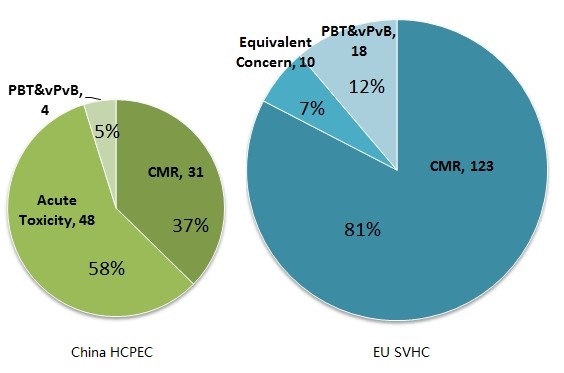
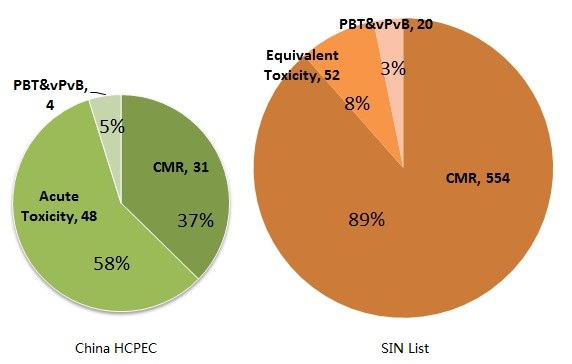
Fig.1 - Inclusion of PBT, vPvB and CMR substances of China’s HCPEC List (left) vs. SVHC and SIN List (right)
Among the 84 chemicals in China’s List, 31 (37%) are found under the CMR category (one of or all of the Carcinogenicity, Mutagenicity and Reproductive toxicity) and 4 (5%) are found under the PBT & vPvB category. A comparative analysis using the hazard statement in the Classification & Labeling Inventory shows that nearly 94% chemicals do have acute toxicity or aquatic acute toxicity, including some CMRs as well. Consequently, MEP’s list prioritizes acute effects more than the chronic toxicity.
The comparison shows that China’s List is less logically structured and contains mixed chemicals using different assessment criteria. It includes some heavy metals and their inorganic compounds (mercury, lead or arsenic etc.), hazardous organic chemicals (benzene, naphthalene, etc.) and several pesticides. While China’s list puts more emphasis on acute effects chemicals (94% chemical substances in the list have acute toxicity, including some CMR chemicals), chemicals with PBT or EDC properties are poorly represented in this list.
Dispersed regulatory power impedes efficient management of priority chemicals
The inclusion of a majority of acute toxic chemicals in the MEP’s List might be due to the fact that the list is legally only a subset of the larger Inventory of Hazardous Chemicals, which is still not officially issued. The formulation of the Inventory of Hazardous Chemicals is an undertaking requiring the synergistic action and coordination of 10 ministries led by the State Administration of Work Safety and participated by 9 other ministries. The rationale is that regulation should cover the entire life cycle of a chemical from aspects including environmental, agricultural, quality control, transportation management etc. The fact that the compilation of the Inventory and the decision made during the process requires the consensus of 10 ministries has not only greatly hindered the introduction of the Inventory, (which is still being ‘consulted’ among ministries), but has also significantly limited MEP’s goal to comprehensively assess chemical hazards beyond their ‘conventional’ hazards. It means that any chemical included in MEP’s smaller list must run the approval gauntlet of 9 other ministries. This also explains why several chemicals identified by the MEP’s 12th Five Year Plan on chemical risk prevention as “Accumulative Risk Chemicals,” such as DEHP and BPA, failed to appear in the final list.
According to the Measures (MEP Order 22), companies producing or using chemicals in the List are required to report release and transfer data to the environmental authority. Failure to include more hazardous chemicals with long-term environmental and health hazards, such as phthalate and DEHP almost certainly means that data will not be collected for such chemicals this year. It is also unclear whether the List will be regularly updated to allow future addition of such chemicals. This means that in the future when further regulatory actions are needed for such chemicals, China will still face difficulty making informed decisions based on available use and release data.