Request a Demo
In order to ensure the safety transportation of dangerous goods, no person could transport dangerous goods unless they are properly marked, labeled or placarded, described and certified on a transport document according to the relevant transport regulation.
1. Marking of Packages (including the intermediate bulk containers)
1.1 General Marking
Unless provided elsewhere, each package containing dangerous goods should be properly marked on the outside of the packaging (including the IBC - intermediate bulk containers). In case of unpackaged articles, the marking should be displayed on the article, on its cradle or on its handling, storage or launching device.
The contents of mark should consist of the proper shipping name (PSN) for the dangerous goods and the corresponding UN number (UN No.) preceded by the letters “UN”. The proper shipping name is that portion of the entry most accurately describing the goods in the Dangerous Goods List, which is shown in upper case characters. For instance, if the entry in the Dangerous Goods List is UN 2583 ALKYLSULPHONIC ACIDS, SOLID or ARYLSULPHONIC ACIDS, SOLID with more than 5% free sulphuric acid”, the proper shipping name could be “ALKYLSULPHONIC ACIDS, SOLID” or “ARYLSULPHONIC ACIDS, SOLID”.
The UN number is the serial number assigned to a dangerous article or substance by the United Nations Sub-Committee of Experts on the Transport of Dangerous Goods. A typical package marking is “ALKYLSULPHONIC ACIDS, SOLID UN 2583”.
1.2 Special Marking
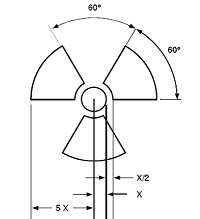
1. Special marking provisions for class 7 Radioactive material: Each package containing radioactive materials shall be legibly and durably marked the radioactive mark on the outside of the packaging (trefoil). |
|
2. Special marking provisions for environmentally hazardous substances: Packages containing substances meeting the criteria of environmentally hazardous substances shall be durably marked with the environmentally hazardous substance mark (tree and fish). The environmentally hazardous substance mark shall be located adjacent to the proper shipping name and the UN number, and the dimensions of the environmentally hazardous substance mark shall be at least 100 mm × 100 mm, except for the case of packages of such dimensions that they can only bear smaller marks. |
|
3. Package orientation arrows: Unless provided otherwise, combination packages having inner packages containing liquid dangerous goods, single packages fitted with vents and cryogenic receptacles intended for the transport of refrigerated liquefied gases shall be legibly marked with package orientation arrows. The orientation arrows shall appear on two opposite vertical sides of the package with the arrows pointing in the correct upright direction. |
|
4. Excepted quantities mark: Packages containing excepted quantities of dangerous goods shall be durably and legibly marked with excepted quantities mark. The primary hazard class of each of the dangerous goods contained in the package shall be shown in the mark. Where the name of the consignor or consignee is not shown elsewhere on the package this information shall be included within the mark. |
|
5. Limited quantity mark: Packages containing dangerous goods in limited quantities shall be durably and legibly marked with limited quantity mark, and these packages need not be labelled nor marked with the marine pollutant mark, proper shipping name or UN number of the contents. |
|

 or
or

 or
or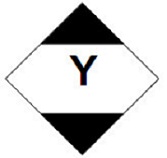
1.3 Provisions for marking
All package markings shall be readily visible and legible, and that the information will still be identifiable on packages surviving at least three month's immersion in the sea. All the markings shall be displayed on a background of contrasting colour on the external surface of the package. In addition, salvage packagings and salvage pressure receptacles shall additionally be marked with the word “SALVAGE”. Intermediate bulk containers of more than 450 litres capacity and large packages shall be marked on two opposing sides.
2. Labelling of packages (including the Intermediate Bulk Containers)
2.1 Specimen labels
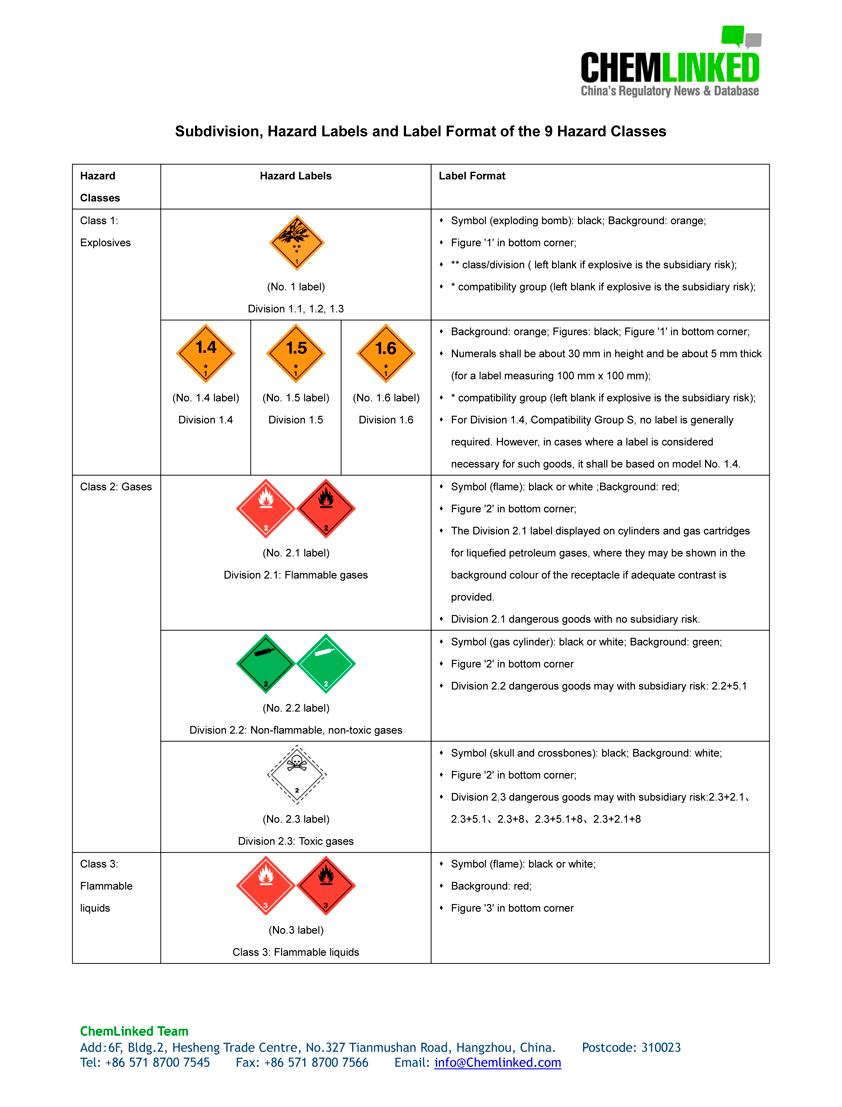
Chemicals (including mixtures and solutions) and articles subject to this standard are assigned to one of the nine classes according to the hazard or the most predominant hazards they present. Some of these classes are subdivided into divisions. Each hazard class or division has corresponding label.
Excerpt of Table 2.
Please click here to download the full table.
2.2 Provisions for labelling
All the labels should be in conformity with the provisions of colour, symbols, figure and general format. Labels should be displayed on a background of contrasting colour, and cannot be covered or blocked
The minimum dimension of label is100 mm by 100 mm. Only packages of such dimensions can they bear smaller labels. Labels should be in the form of a square set at an angle of 45° (diamond-shaped). If the packages are large enough, the labels should be located adjacent to the proper shipping name. When the packages are irregular or are too small to bear the labels, the label may be secured or through other methods to be fixed on the packages. Intermediate bulk containers of more than 450 litres capacity and large packages should be labeled on two opposing sides.
Except that the label for class 7 radioactive materials has been set with a mandatory text, other labels may include text such as the UN number, words describing the hazard class providing that the text does not obscure or block other required label elements.
2.3 Placarding of cargo transport units
In a sense, the placard is an enlarged label. Placards and marks should be affixed to the exterior surfaces of a cargo transport unit to provide a warning that the contents of the unit are dangerous goods and present risks, unless the labels and/or marks affixed to the packages are clearly visible from the exterior of the cargo transport unit. A cargo transport unit containing dangerous goods or residues of dangerous goods should clearly display placards as follows:
a freight container, semi-trailer or portable tank: one on each side and one on each end of the unit;
a railway wagon: at least on each side;
a multiple-compartment tank containing more than one dangerous substance or their residues: along each side at the positions of the relevant compartments;
any other cargo transport unit: at least on both sides and on the back of the unit.
It is recommended that companies which might transport dangerous goods should provide proper marks and labels to ensure the safety transport of dangerous goods. With the proper marks, labels and placards, each staff engaged in the transportation of dangerous goods at any time and any circumstance can identify the hazard, and take the corresponding safety precautions. In case of emergency, they can take appropriate action quickly and correctly.
Clikc here to download the lables of dangerous goods.