
 Request a Demo
1. What is Off-Site Consequence Analyses?
According Chemicals Control Act[2](CCA), Off-site consequence analyses (OCA) is an analysis report outlining hazards and risks in a hazardous chemical facility and assesses the hypothetical negative impacts of an accident involving hazardous chemicals on people or the environment around the place of business.
As described in OCA teaching materials released by KCMA (Korea Chemicals Management Association[3], the OCA institution is to ascertain whether hazardous chemicals handling facilities are designed or installed safely and in such a way as to avoid or minimize the risk of accidents and damage to surrounding people or the environment.
2.Who shall submit Off-Site Consequence Analyses?
Any person who intends to install and operate a hazardous chemical handling facility shall prepare in advance an off-site consequence analysis and submit it to the president of National Institute of Chemical Safety (NICS). The OCA shall be submitted by no later than 30 days before the commencement day of the work for construction of the relevant facility. It is important to note that when enlarging a handling facility in the same workplace, changing the location of a handling facility within the boundary of the workplace or changing a handled hazardous chemical, an OCA is required to be submitted as well.
According to CCA, "Hazardous chemical" means toxic chemicals, chemicals requiring a permission, restricted chemicals or prohibited chemicals, chemicals requiring preparation for accidents, or other chemicals which present or are likely to present a hazard or risk.
2. The term "chemicals requiring permission" means chemicals that are likely to pose a risk, as publicly notified by the Minister of Environment. Such chemicals may be manufactured, imported, or used with permission from the Minister of Environment;
3. The term "restricted chemicals" means chemicals recognized as having a high risk if they are used for specific purposes, which are publicly notified by the Minister of Environment to prohibit the manufacture, importation, sale, keeping, storage, transport, or use of such chemicals for such purposes;
4. The term "prohibited chemicals" means chemicals recognized as having a high risk if they are used for specific purposes, which is designated and publicly notified by the Minister of Environment to prohibit the manufacture, importation, sale, keeping, storage, transport or use of such chemicals for all purposes;
5. The term "chemicals requiring preparation for accidents" means chemicals highly likely to cause chemical accidents due to their high acute hazard, explosiveness, etc. or likely to cause severe damage where a chemical accident occurs, as designated and publicly notified by the Minister of Environment to make preparation for chemical accidents caused by such chemicals;
The inventories of hazardous chemicals please refer to ChemLinked Database[4].
3. Contents of OCA
| Basic Analyses Information | 1) Chemical handling Information: Chemical list, volume of handled chemicals, hazard information 2) Chemical handling facilities information: Facility list ,details, process safety information, process operating procedures and matters requiring attention 3) Information on neighboring environment where the handling facility locals |
| Off-Site Analyses Information | 1) Risk analyses, accidents scenarios, accident probability and risk degree analyses 2) Consequence analyses of surrounding neighboring 3) Safety assurance scheme |
| Other Information | Information on the influences affected by chemical handling facilities delegated in other laws and laws and regulations |
4. OCA Review Process
When the president of NICS receives an OCA, he/she shall review it and notify the person who submitted it of the risk the hazardous chemical handling facility poses (High risk, Middle risk or Low risk) and of whether the facility is adequate to deal with such hazard in 30 days.
The president may request the complement or adjustment of the OCA when he/she determines it's necessary for the review.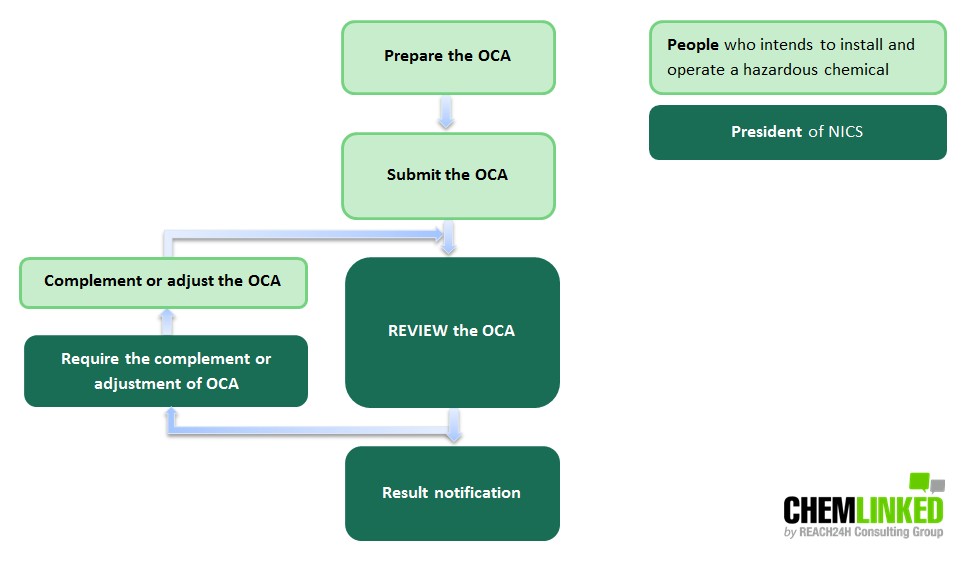
The president of NICS will review the OCA on the following 3 aspects:
(2) Where hazardous chemicals flow out or leak into the area around the place of business due to the occurrence of a chemical accident, the degree of effects on human health or the neighboring environment;
(3)Whether the location, etc. of a hazardous chemical handling facility is in contravention of other Acts.
In the result of OCA review, the risk degree will be listed as “High risk”, “Middle risk” or “Low risk”. For different risk class, the safety inspection period varies.
High risk: every 4 years
Middle risk: every 8 years
Low risk: every 12 years
5.Grace Period
(1) Person who has got the business registration of toxic chemicals or business permission for restricted chemicals or prohibited chemicals under the prior Toxic Chemicals Control Act may submit the OCA in the below grace period:
1) Person preparing process safety report of 7 delegated industries and safety improvement plan: 2015. 12. 31
2) Person perparing process safety report who operates hazardous and dangerous substances over 1000 ton/year: 2016.12.31
3) Person preparing process safety report who operates hazardous and dangerous substances less than 1000 ton/year: 2017.12.31
4) Person under above 1)~3) who operates hazardous chemicals over 100 ton/year: 18.12.31
5) Person under above 1)~3) who operates hazardous chemicals less than 100 ton/year: 19.12.31
(2) Other person who has installed hazardous chemicals handling facilities before CCA implemented (before 2014.12.31):
1) Over 100 ton/year: 2018.12.31
2) Less than 100 ton/year: 2019.12.31
(3) Person who was installing hazardous chemicals handling facilities when CCA implemented: 2015.12.31
(4) Person who intended to install new hazardous chemicals handling facilities: 2015.12.31
6. MOE's supporting on OCA preparation
As the maximum grace period will come to the end, enterprises complained that the preparation of OCA was too difficult to complete by enterprises themselves and the cost of engaging 3rd party consulting agencies was too high. For these concerns Ministry of Environment (MOE) indicated in a statement[5] that since CCA came into force on Jan 1st, 2015, industry has up to a 5-year grace period to comply with the specific requirements under CCA. MOE has also listed 77 specialized agencies[6] that can create an OCA. The OCA can also be prepared by a person in charge of the workplace after taking certain courses [education on hazardous chemicals safety(16 hours) and education on person preparing OCA (16 hours)].
Information of a part of specialized OCA agencies:
| Agency Specialized No. | Agency Name | President | Company Address |
| ORA-AT-2015-038 | Korea Testing & Research Institute | Byun, Jong-Rip | Gwacheon HQ [13810] 98, Gyoyukwon-ro, Gwacheon-si, Gyeonggi-do, South Korea Fax +82-2-2634-1008 |
| ORA-AT2015-059 | Korea Explosion-proof Certification Center | Jeng, Su-Yeon | No. 57-2, 427 beon-gil, Heungandaero, Anyang-si, Gyeonggi-do, South Korea |
| ORA-AT2015-052 | MS Consulting | Bae, Geun-Sin | 301, 1799, Chungangdaero, Geumjeong-gu, Busan-si, South Korea |
| … | … | … | … |