



 Request a Demo
*This article is amended on Jan 3rd 2018 and the information of some other provinces are supplemented.
It has been over 2 years since the Pilot Measures on VOC Emission Charge issued by China Ministry of Environmental Protection (MEP) took effect on Oct 1st 2015. 21 out of 32 provincial administrative sectors in Chinese mainland has followed the pilot measures and carried out their own local charging policies on VOC emission, including 18 provinces and 3 cities that are directly under the central government. However, the charging policies are different between these provinces and cities due to the various emission and industrial conditions. Some cities adopt the MEP's charging standard based on the pollution equivalent, while some regions innovate and expand on the system and charge based on the total amount of the VOC emission. Some are cautious about the charging targets and only implement charges on 2 major pilot industries, while some others are more stringent and charge many other industries. To make things clear and easy to compare, ChemLinked summarized the charging policies of 10 regions as following:
Region | Effective Date | Charging Standard | Affected Industries |
Beijing | Oct 1st 2015 | 20 RMB/kg | Petroleum, packaging and printing, furniture making, automobile manufacture, and electronics. |
Shanghai | Oct 1st 2015 | 10 RMB/kg | Petroleum, packaging and printing, ship building, coating and other 8 industries. |
Jul 1st 2016 | 15 RMB/kg | ||
Jan 1st 2017 | 20 RMB/kg | ||
Anhui | Oct 1st 2015 | 1.2 RMB/equivalent | Pilot industries: petroleum and packaging and printing. |
Jiangsu | Jan 1st 2016 | 3.6 RMB/equivalent | Pilot industries: petroleum and packaging and printing. |
Jan 1st 2018 | 4.8 RMB/equivalent | ||
Hebei | Jan 1st 2016 | 2.4 RMB/equivalent | Pilot industries: petroleum and packaging and printing. |
Jan 1st 2017 | 4.8 RMB/equivalent | ||
Jan 1st 2020 | 6 RMB/equivalent | ||
Hunan | Mar 1st 2016 | 1.2 RMB/equivalent | Pilot industries: petroleum and packaging and printing. |
Sichuan | Mar 1st 2016 | 1.2 RMB/equivalent | Pilot industries: petroleum and packaging and printing. |
Liaoning | Apr 1st 2016 | 1.2 RMB/equivalent | Pilot industries: petroleum and packaging and printing. |
Tianjin | May 1st 2016 | 10 RMB/kg | Pilot industries: petroleum and packaging and printing. |
Zhejiang | Jul 1st 2016 | 3.6 RMB/equivalent | Pilot industries: petroleum and packaging and printing. |
Jan 1st 2018 | 4.8 RMB/equivalent | ||
| Shandong | Jun 1st 2016 | 3.0 RMB/equivalent | Pilot industries: petroleum and packaging and printing. |
| Jan 1st 2017 | 6.0 RMB/equivalent | Pilot industries and automobile, furniture and aluminium profile industry. | |
| Hainan | Aug 1st 2016 | 1.2 RMB/equivalent | Pilot industries: petroleum and packaging and printing. |
| Shanxi | Sep 1st 2016 | Taiyuan City: 1.8 RMB/equivalent | Pilot industries: petroleum and packaging and printing. |
Other cities: 1.2 RMB/equivalent | |||
Hubei | Oct 1st 2016 | 1.2 RMB/equivalent | Pilot industries: petroleum and packaging and printing. |
| Jiangxi | Nov 1st, 2016 | 1.2 RMB/equivalent | Pilot industries: petroleum and packaging and printing. |
| Fujian | Jan 1st, 2017 | 1.2 RMB/equivalent | Pilot industries: petroleum and packaging and printing. |
| Yunnan | Jan 1st, 2017 | 1.2 RMB/equivalent | Pilot industries: petroleum and packaging and printing. |
| Guangxi | April 1st, 2017 | 1.2 RMB/equivalent | Pilot industries: petroleum and packaging and printing. |
| Henan | July 1st, 2017 | 1.2 RMB/equivalent | Pilot industries: petroleum and packaging and printing. |
| Xinjiang | Octorber 1st, 2017 | 1.5 RMB/equivalent in key areas for air pollution control; 1.2 RMB/equivalent in other area | Petroleum refining, raw material for organic chemical industries, primary form plastics manufacturing, synthetic resin manufacturing, synthetic rubber manufacturing, synthetic fiber monomer (polymer) manufacturing, warehousing, package printing |
| Heilongjiang | November 1st, 2017 | 1.2 RMB/equivalent | Pilot industries: petroleum and packaging and printing. |
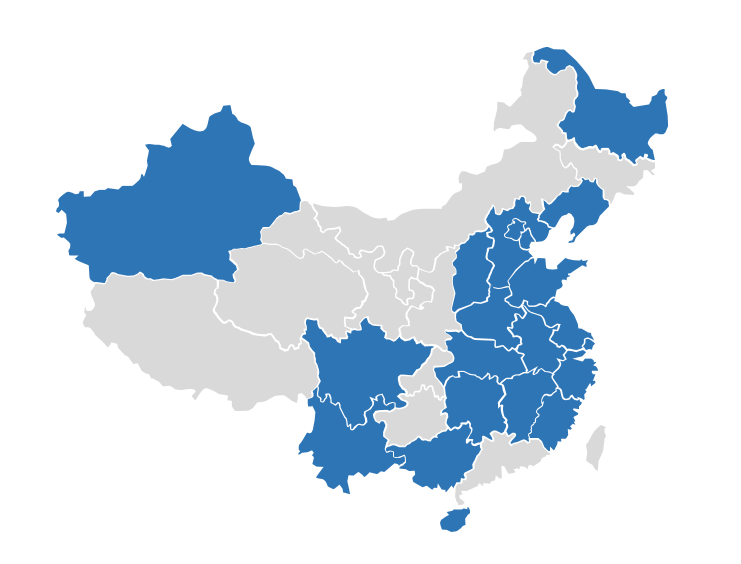
Figure 1. 21 Provinces and Cities that have local VOC charge policies
Followings are the details of the 21 charging policies, with some unique features that are developed by different regions highlighted in yellow:
Beijing
For the details of charging policy of Beijing, please click here to see ChemLinked report.
Shanghai
For the details of charging policy of Beijing, please click here to see ChemLinked report.
Anhui
The charge is doubled for enterprises that exceed the emission limit.
The charge is halved for enterprises whose emission is below 50% of the emission limit.
Jiangsu
If the emission concentrate is between 80%-100% of the emission limit, then the charge doesn’t change.
If the emission concentration is between 50%-80% (including 80%) of the emission limit, then the charge is 80%.
If the emission concentration is below 50% (including 50%) of the emission limit, then the charge is halved.
Same as others, if the emission concentration is above the limit, then the charge is doubled.
Hebei
The charge is doubled for enterprises that exceed the emission limit.
The charge is halved for enterprises whose emission is below 50% of the emission limit.
Enterprises can have a 5% off discount on the emission charge if their pollution treatment facilities are operated by a third party institution.
Hunan
For the details of charging policy of Beijing, please click here to see ChemLinked report.
Sichuan
If the emission concentration is lower than 50% of the limit and the enterprise hasn’t been penalized in the current month, then the charge is halved for that particular month.
If the emission concentration or the total amount is above the limit, then the charge is tripled.
Liaoning
The charge is doubled for enterprises that exceed the emission limit.
The charge is halved for enterprises whose emission is below 50% of the emission limit.
Tianjin
For the details of charging policy of Tianjin, please click here to see ChemLinked report.
Zhejiang
The charge is doubled for enterprises that exceed the emission limit.
The charge is halved for enterprises whose emission is below 50% of the emission limit.
Shandong
For the details of charging policy of Beijing, please click here to see ChemLinked report.
Hainan
The charge is halved for enterprises whose emission is below 50% of the emission limit.
The charge is doubled for enterprises, whose emission concentration exceeds the limit, or total emission amount exceeds the limit, or instances where governments have earmarked specific production processes to be phased out based on excessive pollution and environmental/safety risks.
The charge is tripled for enterprises that meet any 2 of the 3 above conditions.
The charge is quadrupled for enterprises that meet all 3 above conditions.
Hubei
The charge is halved for enterprises whose emission is below 50% of the emission limit.
The charge is doubled for enterprises with emission concentration exceeding the limit, or total emission amount exceeds the limit, or instances where governments have earmarked specific production processes to be phased out based on excessive pollution and environmental/safety risks.
The charge is tripled for enterprises that meet any 2 of the 3 above conditions.
The charge is quadrupled for enterprises that meet all 3 above conditions.
If the emission concentration is between 90%-70% (including 70%) of the emission limit, then the charge is 80%.
If the emission concentration is between 70%-50% (including 50%) of the emission limit, then the charge is 60%.
Shanxi
The charge is halved for enterprises whose emission is below 50% of the emission limit.
The charge is doubled for enterprises whose emission concentration exceeds the limit, or instances where governments have earmarked specific production processes to be phased out based on excessive pollution and environmental/safety risks.
The charge is tripled for enterprises that meet any 2 of the 3 above conditions.
The charge is quadrupled for enterprises that meet all 3 above conditions.
Jiangxi
The emission amount of benzene, methylbenzene and xylene should be deducted from the total VOC emission amount if these pollutants are already charged separately.
The charge is doubled for enterprises, whose emission concentration exceeds the limit, or total emission amount exceeds the limit.
The charge is tripled for enterprises that meet both above conditions.
The charge is doubled for production processes, equipment and products that are required to be phased out based on excessive pollution and environmental/safety risks.
The charge is halved for enterprises whose emission is below 50% of the emission limit.
Fujian
The charge is doubled for enterprises, whose emission concentration exceeds the limit, or total emission amount exceeds the limit. The charge is also doubled for production processes, equipment and products that are required to be phased out based on excessive pollution and environmental/safety risks.
The charge is tripled for enterprises that meet any 2 of the 3 above conditions.
The charge is quadrupled for enterprises that meet all 3 above conditions.
The charge is halved for enterprises whose emission is below 50% of the emission limit.
Yunnan
The charge is doubled for enterprises, whose emission concentration exceeds the limit, or total emission amount exceeds the limit.
The charge is tripled for enterprises that meet both above conditions.
The charge is doubled for production processes, equipment and products that are required to be phased out based on excessive pollution and environmental/safety risks.
The charge is halved for enterprises whose emission is below 50% of the emission limit.
Guangxi
The charge is halved for enterprises whose emission is below 50% of the emission limit.
The emission amount of benzene, methylbenzene and xylene should be deducted from the total VOC emission amount if these pollutants are already charged separately.
The charge is doubled for enterprises, whose emission concentration exceeds the limit, or total emission amount exceeds the limit. The charge is tripled for enterprises that meet both above conditions.
The charge is doubled for production processes, equipment and products that are required to be phased out based on excessive pollution and environmental/safety risks.
Henan
The charge is halved for enterprises whose emission is below 50% of the emission limit.
The charge is doubled for enterprises, whose emission concentration exceeds the limit, or total emission amount exceeds the limit.
The charge is tripled for enterprises that meet both above conditions.
The charge is doubled for production processes, equipment and products that are required to be phased out based on excessive pollution and environmental/safety risks.
Xinjiang
1.5 RMB/equivalent in Key areas for air pollution control; 1.2 RMB/equivalent in other area.
Heilongjiang
The charge is halved for enterprises whose emission is below 50% of the emission limit.
The charge is doubled for enterprises, whose emission concentration exceeds the limit, or total emission amount exceeds the limit. The charge is tripled for enterprises that meet both above conditions.
The charge is doubled for production processes, equipment and products that are required to be phased out based on excessive pollution and environmental/safety risks.
According to MEP’s pilot measures, the calculation method for the pollution equivalent is: pollution equivalent = VOCs emission (kg)/ VOCs equivalent value (kg). MEP currently set the VOCs equivalent as 0.95 kg. So when comparing these two major charging types in 10 regions, which are based on total emission amount (kg) and pollution equivalent, it is clear that the method based on total emission amount is more stringent than MEP's standard. Regions that adopt the charging policy based on total emission amount will provide a greater stimulus for industry reform and we can expect these regions to have a more obvious effect on the reduction of VOC emission.
Interestingly, the three regions that charge based on total VOC emission amount are all cities directly under central government. They have smaller areas and are more economically developed than most provinces in China, and therefore have higher demands for air quality. Furthermore, these more developed cities have greater capacity to transfer their heavy industries to other less developed areas and focus on cleaner industries, such as financial and information technology.
Other provinces in China are also in the process of working out the local VOC charge policies that suit their development and industrial levels. The next question, and a more important one is, how to measure and record accurate VOC emission of the enterprises and to carry out the policies thoroughly.





