Request a Demo
On March 7th 2014, Standard SS 586: 2014 “Specification for hazard communication for hazardous chemicals and dangerous goods” was approved by the Singapore Chemical Standards Committee and took effect thereafter. The new version SS 586 was revised from the former SS 586: 2008 and stipulates more detailed requirements on the storage and road transportation of dangerous goods in Singapore.
1. Scope and definition
The standard applies to the storage and transportation of dangerous goods by road in Singapore, including carriages in bulk, tank-vehicles, and vehicles with demountable tanks and vehicles carrying dangerous goods in packages. The standard doesn’t apply to the transportation of dangerous goods by sea and air.
Chemical manufactures, importers, suppliers, users and supply chain service providers are expected to follow the standards. The definition of “chemical” in the standard applies to both substances and mixtures. Dangerous Goods are defined as substances or articles that may present an immediate and severe danger during transport.
2. Classes of dangerous goods
SS 586 adopts the United Nation’s Recommendations on the Transport of Dangerous Goods (UNRTDG). In line with UNRTDG, dangerous goods are divided into 9 classes in SS 586:
Explosives
Gases
Flammable liquids
Flammable solids
Oxidizing substances and organic peroxides
Toxic and infectious substances
Radioactive material
Corrosive substances
Miscellaneous dangerous substances/articles (including environmentally hazardous substances and wastes)
3. Transport requirements
a) Bulk transport
The road transportation of dangerous goods in bulk should require a Transport Emergency Information Panel (TEIP, the detailed information of TEIP is provided below). There shall also be a placard affixed to the exterior surface of the vehicle to show the risk of the dangerous goods in the vehicle. The minimum size of the placard is 250 mm by 250 mm, with a line running 12.5 mm inside the edge and parallel with it.
b) Package transport
The requirements of package transport of dangerous goods are in line with UNRTDG.
For dangerous goods that exceed certain quantity, TEIP and placard are also required to be affixed to the exterior surface of transport unit to warn about the hazardous risk of the dangerous goods. The minimum quantities are specified in Annex of SS 586.
c) TEIP and placard
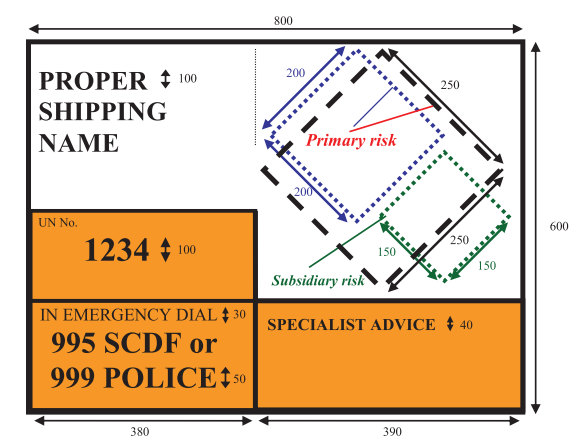
A Transport Emergency Information Panel is required to be used on transport vehicles in Singapore for dangerous goods that meet the criteria. Each vehicle should have 3 TEIPs, one on each side and one on the rear. TEIP should contain the following information:
Correct technical name or proper shipping name of the substance.
UN number of the substance.
Telephone numbers and names of the emergency response services.
Dangerous goods class label and subsidiary risk label.
Telephone numbers and names of the company or organization located in Singapore, from which specialist advice can be obtained during the transport of dangerous goods.
The figure below is an example of TEIP:
4. Storage requirements
a) Bulk storage
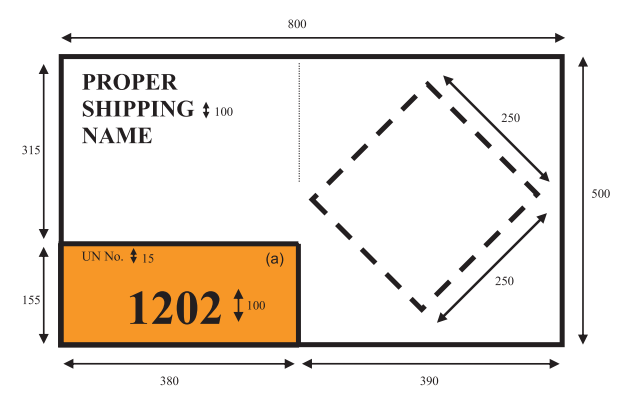
Storage Emergency Information Panel (SEIP) is required for bulk storage of dangerous goods in Singapore. The SEIP should contain the information for emergency responders to deal with an emergency. It should include:
Class label and subsidiary risk label of the dangerous goods.
Technical name or proper shipping name of the substance.
UN number of the substance.
If the dangerous goods are stored in tanks or bulk form outside of a building, then the SEIP should be posted on or adjacent to the tank or bulk store. For bulk stores within a building, the SEIP should be posted at each entrance to the store.
The figure below is an example of a SEIP:
b) Package storage
Placards are required for package storage of dangerous goods.
If the dangerous goods are stored within a building, then the placard should be posted at the main entrance to the building.
If the dangerous goods are stored in a room within a building, then additional placards should be posted at every entrance to the room.
If the dangerous goods are not stored within a building, then the placard should be displayed at the designated storage area.
c) In public areas
A warning panel is required for dangerous goods stored in public areas. It should contain:
Class label and subsidiary risk label.
Proper shipping name.
UN number.
Emergency contact numbers.
A “Danger” word.
Information on hazards and precautions.