Request a Demo
New food related products refer to new materials and additives used for food contact materials, containers, detergent, disinfector and tools/equipment for food production and operation. In China, the application of new food related products should be submitted to National Health Commission (NHC). The final application result will be delivered after undergoing technical review and public consultation. In this article, ChemLinked summarizes the application status quo of new food contact materials and articles (FCMs) in 2022, including FCM additives, resins and materials.
Registration approval
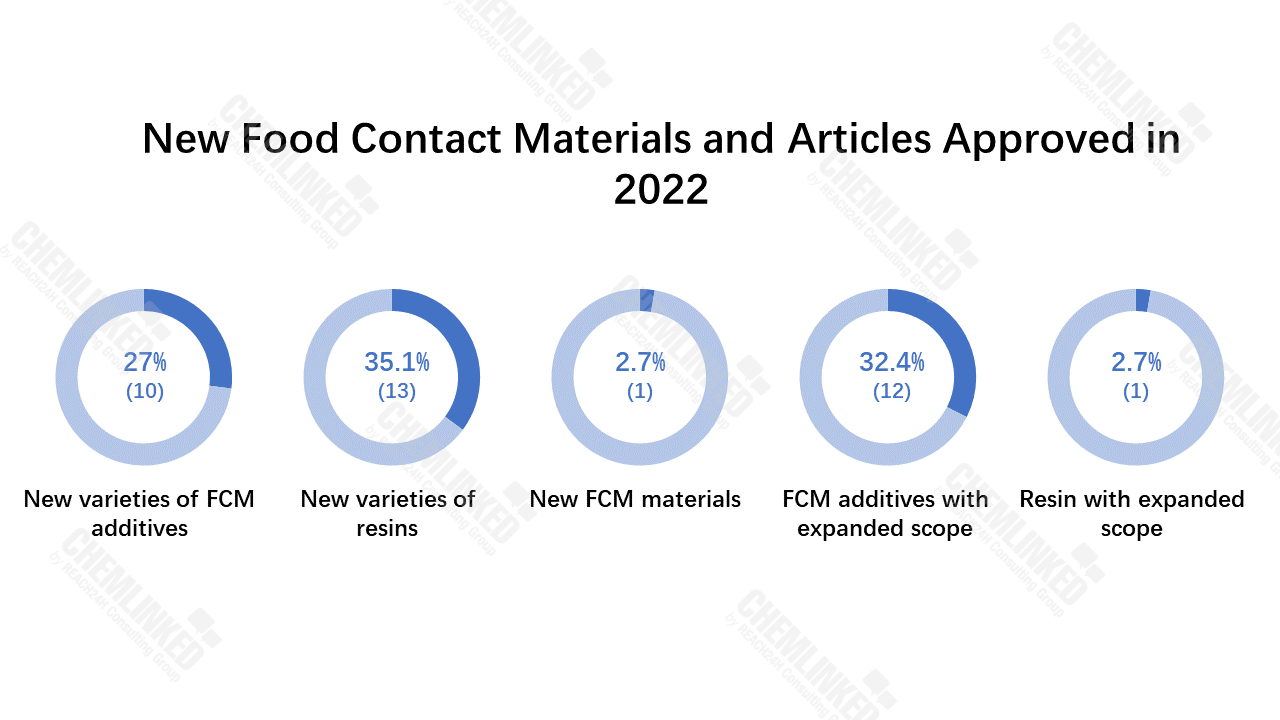
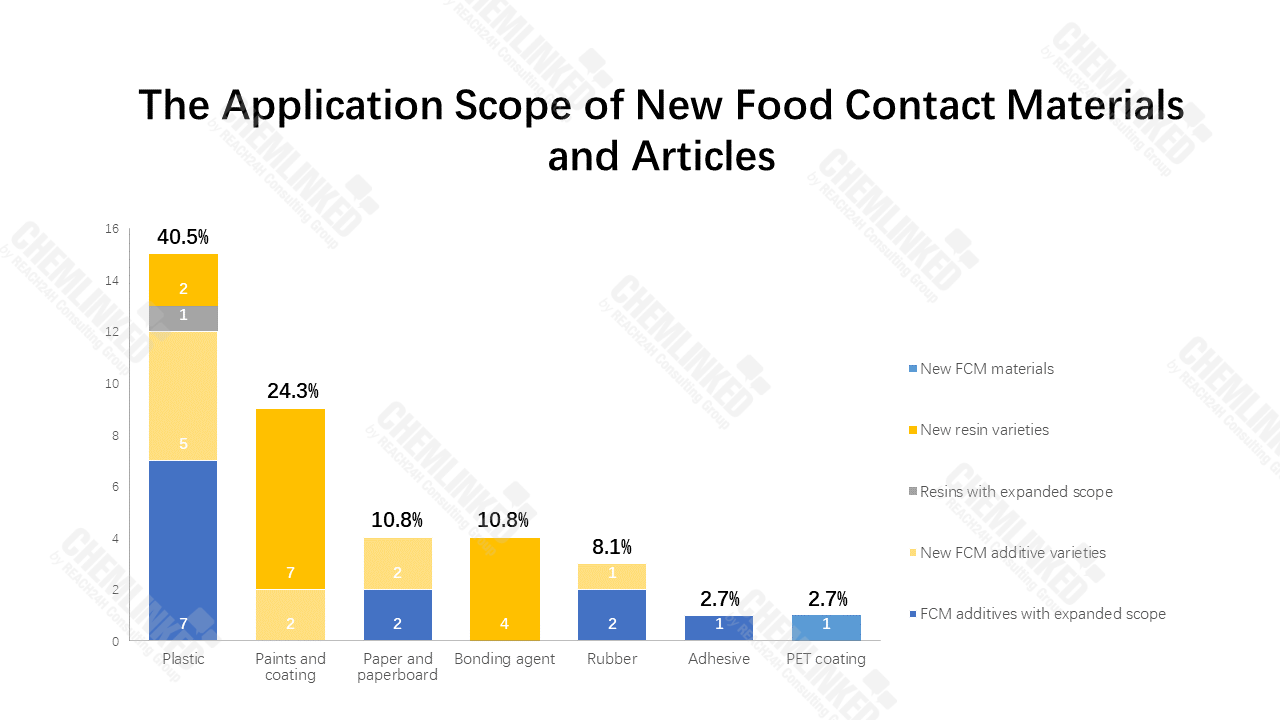
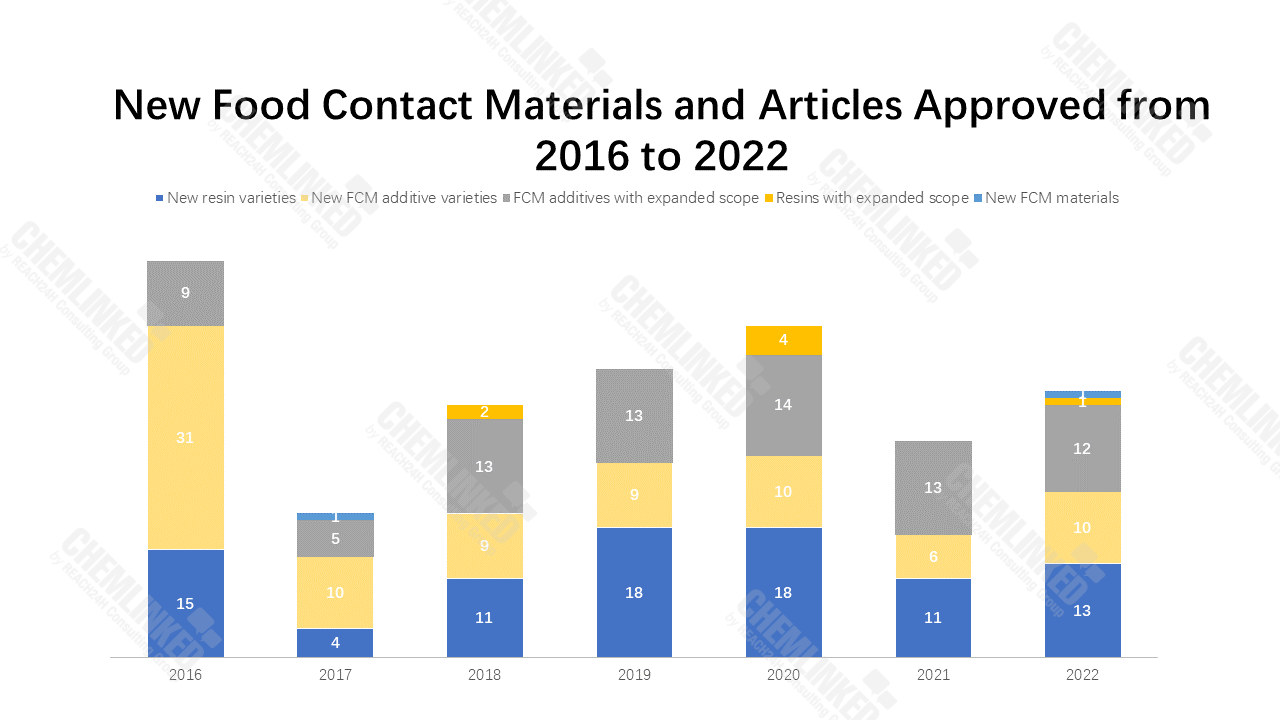
In 2022, 37 new FCMs were granted administrative approval, including 10 new varieties of FCM additives, 13 new varieties of resins, 1 new FCM materials, 12 FCM additives with expanded scope, and 1 resin with expanded scope. Most of them are applied in plastic, representing 40.5%. Paints and coating ranked the second (24.3%), followed by paper and paperboard (10.8%).
 For detailed information of the approved substances, please check the following links:
The chart below showcases the approval status quo from 2016 to 2022, where the approval number of each year fluctuated. Compared with 2021, the number of permitted new varieties of resin and additive both increased in 2022.
Public consultation
China National Center for Food Safety Risk Assessment (CFSA) consulted on the new food contact materials and articles for five times. 19 new substances pass the technical review, including:
9 new varieties of resins
3 new varieties of FCM additives
5 FCM additives with expanded scope
2 resins with expanded scope
Some substances that entered the public consultation stage in 2022 was granted approval in the same year
1,3-Benzenedicarboxylic acid, polymer with 1,3-benzenedimethanamine and hexanedioic acid (consulted in February)
2-(5-Chloro-2H-benzotriazol-2-yl)-6-(1,1-dimethylethyl)-4-methylphenol (consulted in April)
Hexane, 1, 6-diisocyanato-, polymer with poly (oxy-1,2-ethanediyl), α-methyl-ω-hydroxy (consulted in April)
1,4-benzenedicarboxylic acid, polymer with 1,3-benzenedicarboxylic acid, 2,2,4,4-tetramethyl-1,3-cyclobutanediol, 1,4-cyclohexanedimethanol, 1,3-propanediol, 2-methyl-, and adipic acid (consulted in April)
Please check A Look Back at 2022 with ChemLinked: Global Food Regulation Updates for the completed list of new FCMs sought for public feedback in 2022.
Application acceptance
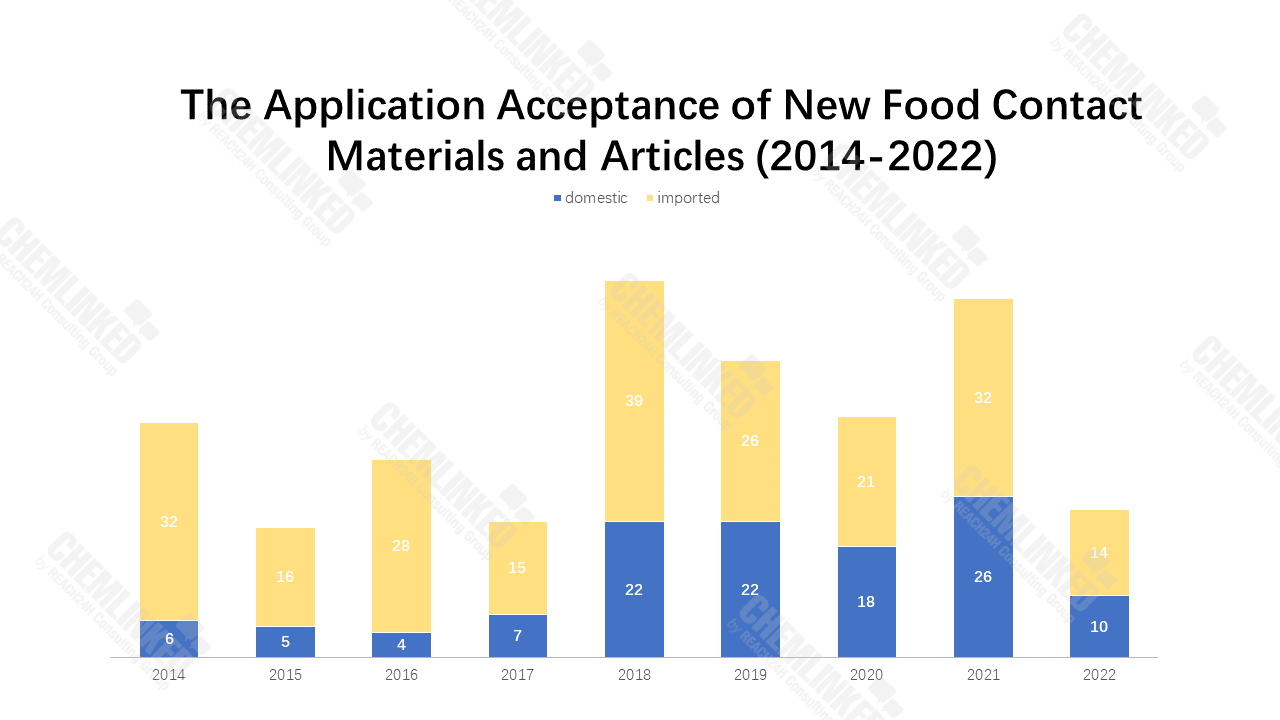
National Health Commission accepted the applications of 24 new FCMs in 2022, including 10 Chinese domestic products and 14 imported products. Affected by COVID-19, lots of enterprises were suffering a hard period and led to a sharp decrease in the number of new substance application. In addition, imported products still dominate the new substance application in China, suggesting that Chinese domestic enterprises need to further improve their R&D and innovation capabilities.
Approval period
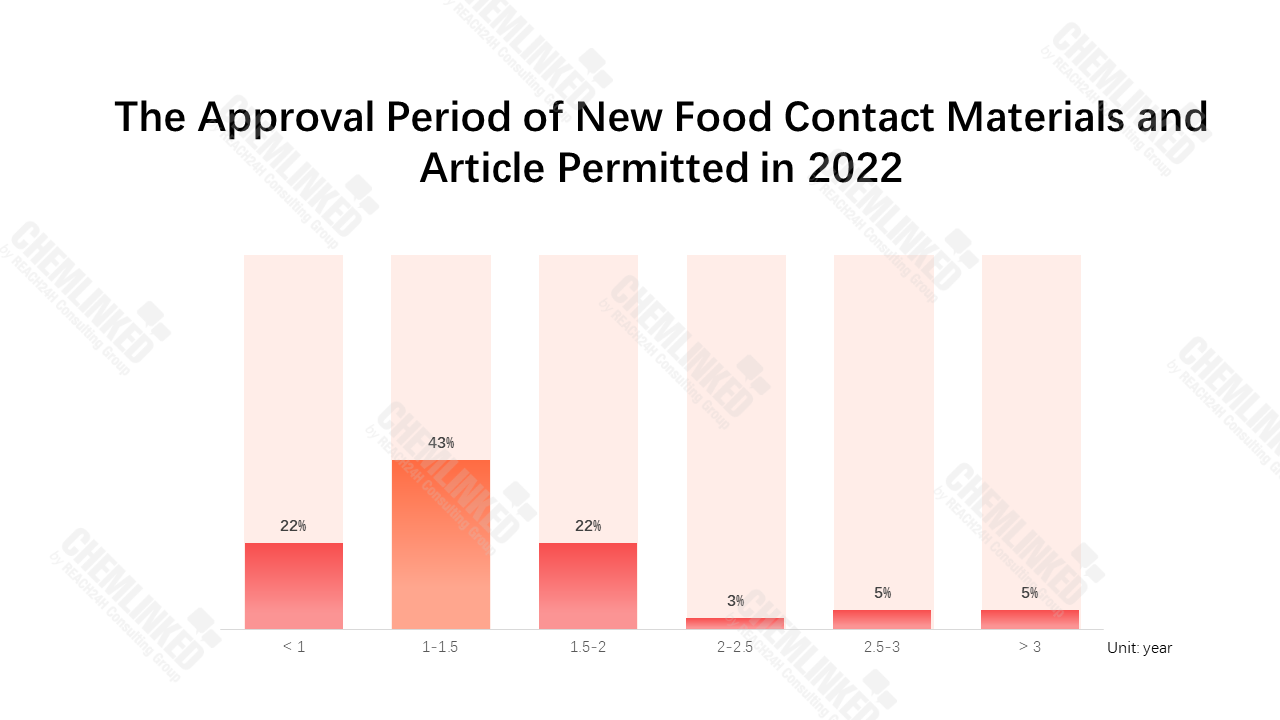
The approval period refers to the duration from accepting the application to delivering the approval results. After analyzing new substances permitted in 2022, ChemLinked found that the approval period of most applications ranged from 1 to 1.5 years, representing 43%.
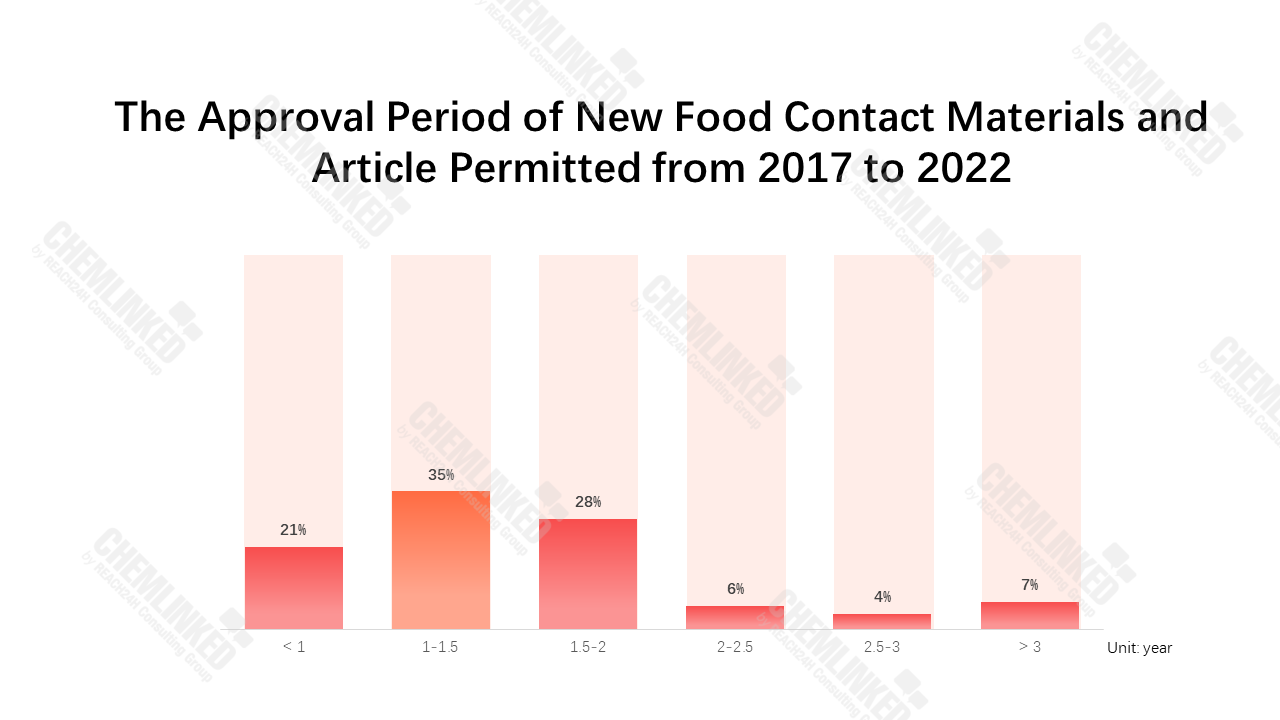
From 2017 to 2022, most new FCM substances obtained approval in 1 to 2 years, accounting for 63%. Therefore, enterprises should make preparation in advance if you intend to apply for new food contact materials and articles.
Suggestions for stakeholders
Technical review is the key section for the registration process of new FCMs. Therefore, enteprises should well prepare the documents as required before submitting the application. Completed and persuasive materials can also help to shorten the approval period.
REACH24H Consulting Group, the company that ChemLinked belongs to, has abundant experience in the regulatory compliance of food related products, and successfully assisted multiple global enterprises obtain the registration approval of new food contact materials. Feel free to contact us if you have any questions or need any help.