Request a Demo
As revealed by the NHC notice [1] released on August 14, 2020, 21 new ingredients have passed the safety evaluation and were granted approval, which included 5 new food additives and 16 new food-related products. The details are as follows:
Five New Food Additives
1 New variety of enzyme for food industry use
Serial No. | Name | Source | Note |
1 | Protein glutaminase | Chryseobacterium proteolyticum | It can enhance protein solubility and improve emulsification. The quality specification shall conform to GB 1886.174 Enzyme Preparations for Food Industry |
2 Food additives with expanded application scope
Serial No. | Name | Function | Food categories | Food name | Maximum usage amount (g/kg) | Note |
1 | dl-tartaric acid | Acidity regulator | 04.02.02.03 | Pickled vegetable | 3.0 | Calculated as tartaric acid. The quality specification shall conform to GB 1886.42. |
06.05.02.01 | Silk noodles and vermicelli | 2.0 | ||||
2 | Sucrose esters of fatty acid | Emulsifier | 01.02.02 | Flavored fermented milk | 1.5 | The quality specification shall conform toGB 1886.27. |
1 Processing acid with expanded application scope
Serial No. | Name | Function | Application scope | Note |
1 | Manganese sulfate | Nutritional substance for fermentation use | Fermentation process | The quality specification shall conform to GB 29208. |
1 Nutritional fortifier with expanded application scope
Name: 6S-5-methyltetrahydrofolate calcium
Food Category No. | Food Category Name | Usage amount (g/kg) |
01.01.03 | Modified milk (for children and the pregnant only) | The usage amount shall conform to the rules about folic acid in GB 14880. |
01.03.02 | Modified milk powder (for children only) | |
Modified milk powder (for the pregnant only) | ||
06.06 | Instant grains, including rolled oats (slice) | |
14.02.03 | Fruit and vegetable juice (syrup) drinks, including fermented products | |
13.03 | Food for special medical purpose (excluding 13.01) | Source of folic acid. The usage amount shall conform to the rules about folic acid in GB 29922. |
16 New varieties of food-related products
3 New additives of FCM and the products thereof
No. | Name | CAS No. | Application scope | Maximum usage amount/% | SML/(mg/kg) | QM/(mg/kg) | Note |
1 | Microfibrillated cellulose pulp | 65996-61-4 | Paper and paperboard | 5 (calculated as dried fiber) | — | — | — |
2 | 2-Butenedioic acid (2E)-, dibutyl ester, homopolymer | — | Paints and coatings | 2 | — | — | FCM paints and coatings added with this substance shall not contact infant food and breast milk. The maximum usage temperature is 121 ℃. |
3 | 2-Propenoic acid, ethyl ester, polymer with 2-methyl-2-propenamide | 25085-36-3 | Plastic: ABS | 1 | 6 (calculated as propenoic acid); ND (Methacrylamide, DL=0.01 mg/kg) | — | — |
5 Additives with expanded application scope
No. | Name | CAS No. | Application scope | Maximum usage amount/% | SML/(mg/kg) | QM/(mg/kg) | Note |
1 | Calcium stearate | 1592-23-0 | Plastic: PEEK | 0.03 | — | — | — |
2 | 2,5-Furandione, dihydro-, mono-C15~20-alkenyl derivs. | 68784-12-3 | Plastics: PE, PP | 0.48 | 30 (calculated as maleic acid) | — | PE and PP material and products added with this substance shall not contact infant food and breast milk. The maximum usage temperature is 100 ℃. |
3 | Polyethylene | 9002-88-4 | Rubber | 2 | — | — | Only applicable to the production of rubber material and products that can be used repeatedly. |
4 | C.I. Solvent Violet 36; 1,8-bis[(4-Methylphenyl)amino]-9,10-anthracenedione | 82-16-6 | Plastic: AS | 0.0005 | — | — | The purity of this substance shall comply with the corresponding requirements of colorants regulated in Appendix A, GB 9685-2016. The maximum usage amount of AS plastic material and product added with this substance is 100℃. |
5 | Octadecyl 3-(3,5-di-tert-butyl-4-hydroxyphenyl)propionate | 2082-79-3 | Plastic: PB-1 | 0.045 | 6 | — | — |
8 Varieties of resins
No. | Name | CAS No. | Application scope | Maximum usage amount/% | SML/(mg/kg) | QM/(mg/kg) | Note |
1 | Fatty acid, C18-unsaturated, dimers, polymers with caprolactam and hexamethylenediamine | 2068097-08-3 | Plastics | — | 15 (calculated as caprolactam); 2.4 (Hexamethylenediamine); 0.05 (calculated as the sum of unhydrogenated C18-unsaturated fatty acid dimers and hydrogenated dimer C18-unsaturated fatty acid) | — | Plastic material and products thereof using this substance as raw material shall not contact infant food and breast milk. It shall be filled and stored in room temperature (including the hot filling and pasteurization under the condition of T≤70℃, t≤2h or T≤100℃, t≤15min). |
2 | Styrene block polymers with 2-methyl-1,3-butadiene and 1,3-butadiene, hydrogenated | 132778-07-5 | Plastics | — | ND (2-methyl-1,3-butadiene, DL=0.01 mg/kg); ND (1,3-butadiene, DL=0.01 mg/kg) | 1 (2-methyl-1,3-butadiene); 1 (1,3-Butadiene); 0.5% (Styrene) | — |
3 | Phenol, 4,4’-(1-methylethylidene)bis-, polymer with (chloromethyl)oxirane, benzoate | 52907-82-1 | Paints and coatings | 19.7 (calculated as paint formula) | 0.6 (Bisphenol A) | 1 (Epichlorohydrin) | Paints and coatings using this substance as the raw material shall not contact infant food and breast milk. |
4 | Polymer of 1,4-bis(hydroxymethyl)cyclohexane,2-methylpropane-1,3-diol, tricycle(5.2.1.02,7)decan-4,8-dimethanol,benzene-1,4-dicarboxylic acid, benzene-1,3-dicarboxylic acid, cis-butenedioic acid, 5-isocyanato-1-isocyanatomethyl-1,3,3-trimethyl cyclohexane | — | Paints and coatings | 30 (calculated as paint formula) | 5 (2-Methyl-1,3-propanediol); 0.05 (tricycle[5.2.1.02,7]decan-4,8-dimethanol); 7.5 (calculated as benzene-1,4-dicarboxylic acid); 5 (calculated as benzene-1,3-dicarboxylic acid); 30 (cis-butenedioic acid) | 1 (calculated as isocyanate) | Paints and coatings using this substance as the raw material shall not contact infant food and breast milk. |
5 | Polymer of butanediol-1,4, ethylene glycol, propylene glycol-1,2, trimethylolpropane, dimethyl terephthalate, isophthalic acid and sebacic acid | — | Paints and coatings | 30 (calculated as paint formula) | 5 (calculated as 1,4-Butanediol); 30 (calculated as Ethylene glycol); 6 (Trimethylolpropane); 5 (calculated as isophthalic acid) | — | Paints and coatings using this substance as the raw material shall not contact infant food and breast milk. |
6 | 1,3-Benzenedicarboxylic acid, polymer with 1,4-benzenedicarboxylic acid and 1,2-ethanediol | 24938-04-3 | Paints and coatings | 20 (calculated as paint formula) | 5 (calculated as 1,3-benzenedicarboxylic acid); 7.5 (calculated as 1,4-benzenedicarboxylic acid); 30 (calculated as ethanediol) | — | Paints and coatings using this substance as the raw material shall not contact infant food and breast milk. The maximum usage temperature is 130 ℃. |
7 | 2-Propenoic acid, 2-methyl-,polymer with butyl 2-methyl-2-propenoate, 2-(chloromethyl)oxirane, ethenylbenzene, ethyl 2-propenoate, 4,4’-(1-methylethylidene)bis[phenol] and 2-propenoic acid, reaction products with 2-(dimethylamino)ethanol | — | Paints and coatings | 85 (calculated as paint formula) | 6 (calculated as methacrylic acid); ND (Epichlorohydrin, DL=0.01 mg/kg); 6 (calculated as acrylic acid); 0.6 (Bisphenol A); 18 (2-Dimethylaminoethanol) | 1 (Epichlorohydrin) | Paints and coatings using this substance as the raw material shall not contact infant food and breast milk. The maximum usage temperature is 130 ℃. |
8 | 1,3-Benzenedicarboxylic acid, polymer with 1,4-benzenedicarboxylic acid, 1,4-butanediol, 1,8-octanedicarboxylic acid and 1,2-ethanediol | 61039-00-7 | Paints and coatings | 50 (calculated as paint formula) | 5 (calculated as isophthalic acid); 7.5 (calculated as terephthalic acid); 5 (calculated as (S,S)-2,3-Butanediol); 30 (calculated as ethylene glycol) | — | Paints and coatings using this substance as the raw material shall not contact infant food and breast milk. The maximum usage temperature is 130 ℃. |
Detailed requirements will be uploaded to our China Food Additive Database and our Flist (New Food Raw Material, Bacterial Cultures and FCM approved in China).
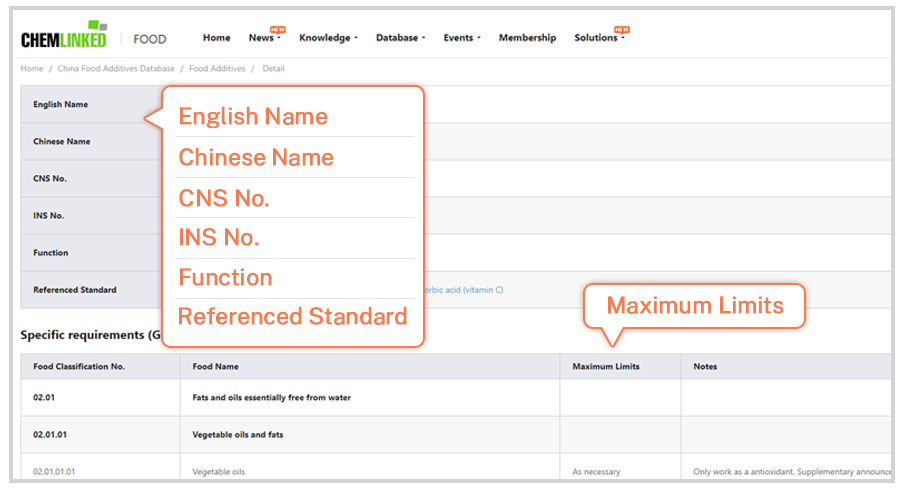
*ChemLinked newly launched a Food Additive Database. This database is a comprehensive compilation of over 2,500 permitted food additives in China (both regulated in GB 2760 and in the official notices) and their conditions of use. It provides up-to-date details about officially released requirements for food additives, helping you quickly access accurate regulatory data and navigate compliance challenges.
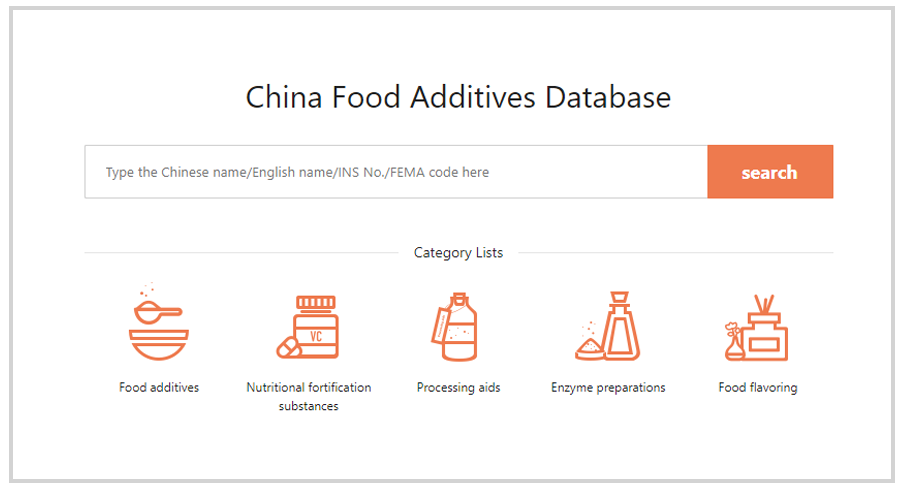 Detailed requirements of food additives are displayed as follows.