Request a Demo
As the most populated country in the world, China faces unique challenges to ensure the occupational safety and health of its labor force. There are more deaths caused by occupational diseases every year than actual production accidents in China. The situation varies greatly among different industries and areas and the central government has been trying to establish a comprehensive legal system to prevent occupational disease in its labor force. Mr. Huanyong Du from China Academy of Safety Science and Technology gave a detailed introduction to the legal framework of the prevention and control of occupational hazards and the implementation status quo during his presentation at REACH24H’s Chemical Regulatory Annual Conference (CRAC 2015) which concluded in Hangzhou on Nov 3rd.
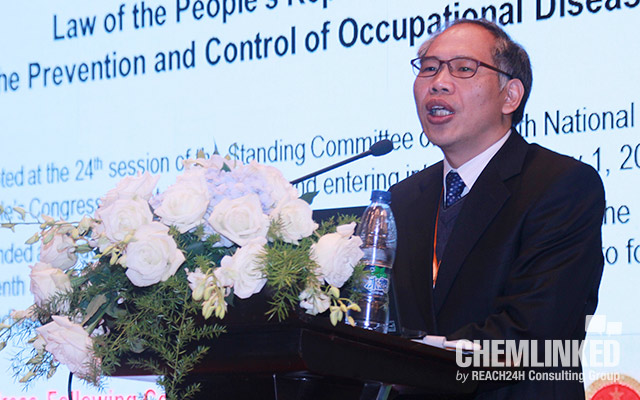
The overarching regulation in the field of occupational safety and health of China is the Law on the Prevention and Control of Occupational Diseases, which was adopted at the Standing Committee of the 9th National People’s Congress on Oct 27th 2001 and entered into force on May 1st 2002. On Dec 31st 2011, the law was amended and adopted by National People’s Congress and entered into force immediately. According to the law, the management and supervision of occupational health is divided into three parts: the work safety administration focuses on the prevention of occupational hazards, the health and hygiene department focuses on the treatment of occupational diseases while the labor security department is responsible for the social security of the labor force. These three departments, along with other administrations and ministries such as the Labor Union and the Ministry of Finance, developed and implemented numerous regulations and national standards, comprising the overall legal system for occupational safety and health. The major laws and regulations include:
Law on the Prevention and Control of occupational Disease
Labor Law
Labor Contract Law
Regulations on the Prevention and Treatment of Pneumoconiosis
Regulations on Labor Protection in Workplaces Where Toxic Substances Are Used
Special Rules on the Labor Protection of Female Employees
Administrative License Law
Law on Administrative Penalty
Administrative Reconsideration Law
Administrative Litigation Law
Administrative Compulsion Law
Law on State Compensation
State Administration of Work Safety (SAWS) plays the most important role in supervising employers and safeguarding the health of the labor force. It has issued 7 orders on production safety, which are:
Provisions on the Supervision and Administration of Occupational Health at Workplace (SAWS Order No. 47)
Measures for the Notification of Projects with Occupational Hazards (SAWS Order No. 48)
Measures for the Supervision and Administration of Employers’ Occupational Health Surveillance (SAWS Order No. 49)
Interim Measures for Supervision and Administration of the “Three Simultaneities” for Occupational Health at Construction Projects (SAWS Order No. 51)
Interim Measures for Supervision and Administration of Occupational Health Technical Service Institutions (SAWS Order No. 50)
Provisions on the Prevention and Control of Occupational Hazards at Workplace of Coal Mines (SAWS Order No. 73)
Eight Rules for the Prevention and Control of Occupational Hazards by Employers (SAWS Order No. 76)
There are also many national standards that raise the requirements for occupational safety and health. The main compulsory standards include:
Hygienic Standards for the Design of Industrial Enterprises (GBZ 1-2010)
Occupational Exposure Limits for Hazardous Agents in the Workplace – Part 1: Physical Agents (GBZ 2.2-2007)
Warning Signs for Occupational Hazards in the Workplace (GBZ 158-2003)
Specifications of Air Sampling for Hazardous Substances Monitoring in the Workplace (GBZ 159-2004)
Technical Specifications for Occupational Health Surveillance (GBZ 188-2014)
And some recommended Standards:
Methods for Determination of Toxicants in the Air of Workplace (GBZ/T 160)
Methods for Determination of Dust in the Air of Workplace (GBZ/T 192)
Specification of Prevention and Control on occupational Hazards in Closed Space (GBZ/T 205-2007)
Specification of Setting Monitoring and Alarming Devices for Toxic Gas in the Workplace (GBZ/T 223-2009)
Guideline for Employer of Prevention and Control of Occupational Disease (GBZ/T 225-2010)
However, Mr. Du revealed that the implementation of these regulations and standards were still not optimal to ensure occupational health and safety, especially in situations where employers delegate technical service providers to comply with their regulatory obligations. During supervision activities, authorities found many compliance problems including:
Lack of technical expertise on the part of the technical service provider during the risk and exposure assessment
Fraud in the hazard data and information
Malfunctioning of the necessary equipment and facilities
Cut backs and cost lowering
Therefore, Mr. Du emphasized that the competent authorities will in future put greater effort into the supervision and management of employers and technical service providers. There will be an annual special examination of third party technical service providers and the business licenses of severe violators could be suspended or withdrawn.
Another noteworthy piece of information given by Mr. Du is that for enterprises notifying their new chemical substances, it is required to report the toxicological information and data to the administration of work safety for reference at the same time.