Request a Demo
China has been actively working on policies to encouraging green alternatives since the 14th Five-Year Plan (2021-2025). In 2021, the State Council issued a Circular On Deepening the Efforts To Combat Pollution Prevention and Control, which encourages the substitution of raw and auxiliary materials and products. In 2022, China issued an Action Plan on New Pollutant Treatment, promoting the development of green alternative technologies, stressing it as an imperative to phase out or restrict the production or use of toxic, hazardous chemicals.
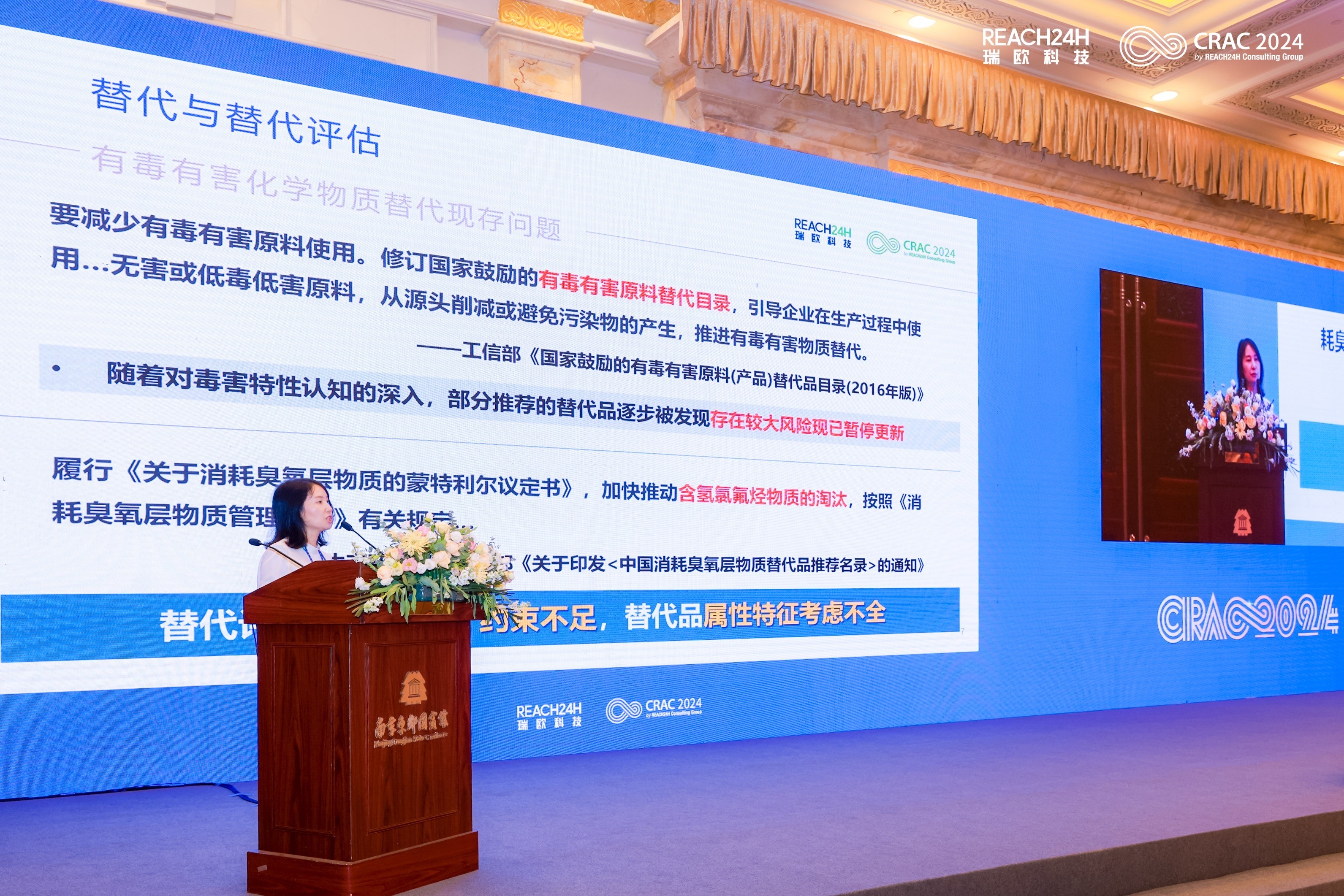
In spite of the strong policy background, the assessment and application of green alternatives in China has revealed significant drawbacks that are in need of improvement, said Ms. Yun Liu, a senior engineer from South China Institute of Environmental Science (SCIES) speaking at the 16th Chemical Regulatory Annual Conference (CRAC) on September 6, 2024 in Nanjing.
Existing issues concerning green alternatives assessment
One of the problems occurs when a chemical believed to be less hazardous turns out to have an unexpected hazard, which is also called “Regrettable Substitution”.
To substantiate this point, the restriction of Freon (CFCs) under the 1976 Montreal Protocol was a direct response to their contribution to ozone depletion. While hydrofluorocarbons (HFCs) were introduced as a "safer" alternative to address environmental concerns, their use ultimately led to increased emissions. This culminated in the Kigali Amendment in 2016, which aimed to phase out HFCs. The substitution of CFCs with HFCs was viewed as a temporary measure rather than a sustainable, long-term solution, thereby hindering the development and adoption of genuinely eco-friendly alternatives.
In the field of alternatives assessment, there are also other issues such as inadequate methods, incomplete indicators, and reliance on list-based substitutions. To solve these issues, it is essential to establish a systematic and sound assessment approach which thoroughly evaluates the complete profiles and attributes of alternatives, backed by effective enforcement policies. Unlike toxicity assessments, which concentrate on a limited set of toxicological endpoints, alternative assessments demand a comprehensive methodology to ensure that replacements are safe for both human health and the environment. Prudence is always important in practice, stressed Ms. Liu.
Ongoing efforts to improve assessment for green alternatives
So far, China has already published a few recommended safer ingredient lists, such as the Catalogue of Substitutes to Toxic and Hazardous Raw Materials Encouraged by the State (2016 version) and Recommended list of substitutes for ozone-depleting substances in China. However, these lists only serve as a reference and require constant updates to maintain effective.
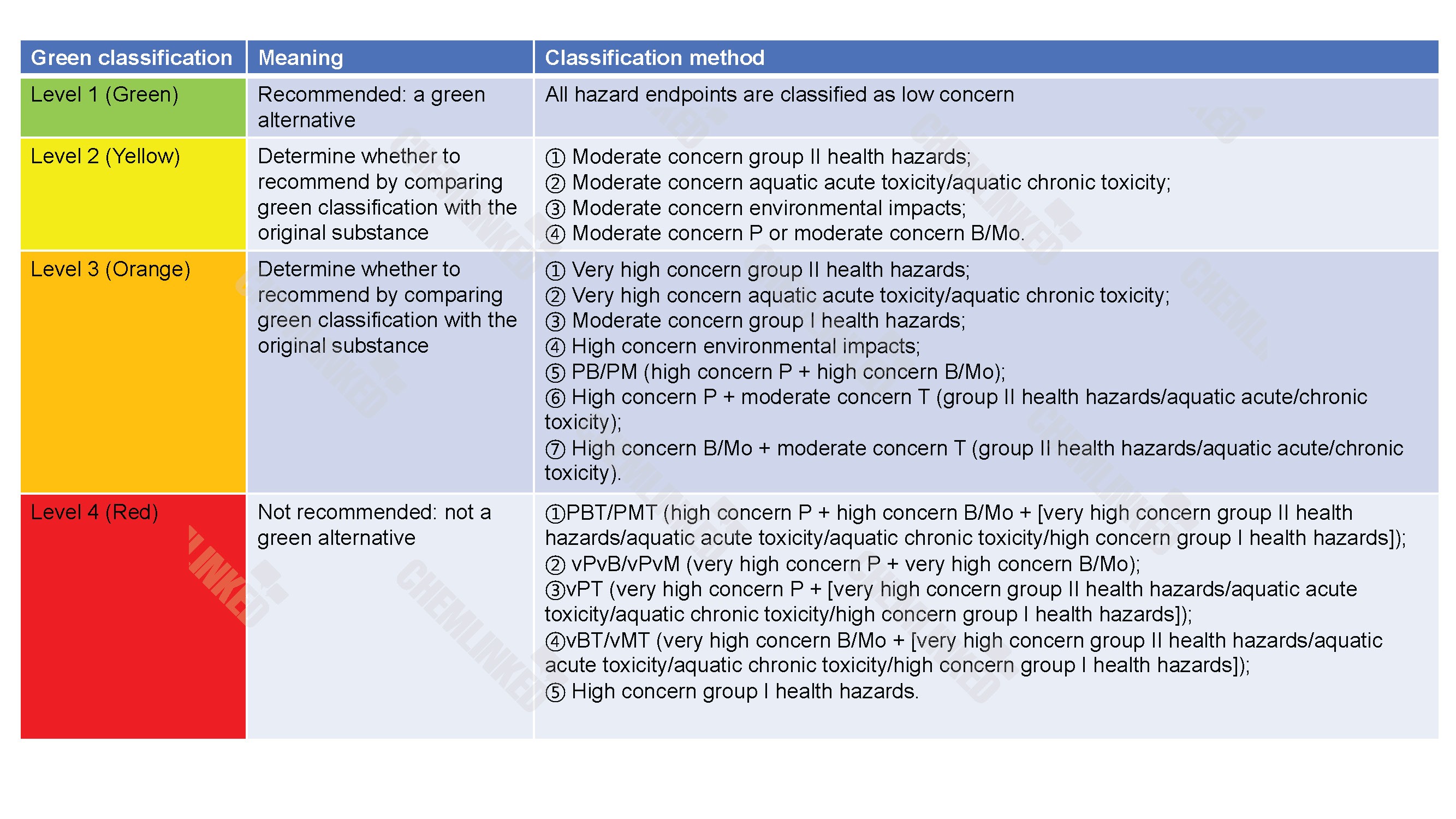
To establish a consistent assessment methodology for green alternatives, SCIES has developed a group standard T/CSES 151-2024 Technical Guidance for the Assessment of Green Alternatives. Similar to the assessment approach adopted by U.S. EPA, this standard also establishes a green classification system based on 20 high-concern hazard endpoints for health hazards, ecotoxicity, and environmental impacts. The GHS classification for each hazard endpoint should be collected and assessed based on GB 30000 series. Where certain hazard endpoints (like PBT) are not adopted in GB 30000 series, other applicable GHS classification criteria also applies. Each hazard endpoint is classified into 4 levels based on the level of concern: very high concern (vH), high concern (H), moderate concern (M), and low concern (L).
The green classification for alternatives is then determined into 4 levels as follows:
The Ministry of Ecology and Environment (MEE) is also proposing to publish technical guidance for assessing the environmental friendliness of alternatives/technologies under the Framework for Environmental Risk Assessment and Control Technical Standards for Chemical Substances (Draft). The release of T/CSES 151-2024 signals that the official is dipping a toe in the water, with more standards likely to follow to establish a scientific approach for assessing green alternatives.
Application and outlook
In working with the coating industry, SCIES has created a Reference Manual on Green Classification and Substitution of Chemical Substances for Coating Manufacturing Industry (C2641), covering 27 major categories and 73 subcategories of use, including solvents, plasticizers and biocides.
Furthermore, SCIES has spearheaded the creation of the Green Chemicals Assessment System for Toxic and Hazardous Substances and Substitutes (GCAS). This comprehensive system encompasses the GHS classification, CLH classification, measured data, projected data, and green classification of around 500 substances. In combination with the recently published T/CSES 151-2024, these resources will serve as a robust policy toolbox for assessing green alternatives, offering valuable data and technical support.
In addition to the official movement, some industry leaders like Apple has already developed its own screening and assessment tools for green alternatives across its value chains. Companies may also seek third-party assessment services like GreenScreen from a licensed GreenScreen Profilers like REACH24H.