Request a Demo
Due to loose supervision, a confusing regulatory framework and the limited safety awareness of manufacturers and consumers, the Food Contact Material (FCM) regulatory system has been highlighted as a priority food safety regulatory target and thus earmarked for reform. The EU Rapid Alert System for Food and Feed (RASSF) system reported that in the last 5 years more than 80% of noncompliant FCM products came from China. Food packaging safety was also a key regulatory target in China’s new Food Safety. Chinese authorities have established a plan to streamline the current food contact material regulation system.
Revision of FCM Standards
Food contact material is regulated by a series of compulsory national standards but there is too much overlap, repetition and conflicting content in the numerous standards. Lots of standards were issued in the late 1990s mostly focusing on supervision of physical and mechanical properties, which are now out of date. In 2012, the previous Ministry of Health released the 12th Five Year Plan for National Food Safety Standard. The China National Center for Food Safety Risk Assessment (CFSA) started to revise and integrate the food safety standard system covering milk, food additive, fungi and toxin limit, prepackage food label and nutritional labeling, pesticide residue limits and food packaging materials. The aim is to build more practical and clear standards considering applicability, generality, supervision, industrial development, and most importantly risk assessment. CFSA collected 265 food related product standards (including detergent, FCM and disinfectant). When finished the final number of standards will be reduced by 80%. 
By the end of 2015, CFSA has more or less completed the FCM standard revision. In addition to revising and integrating overlapping product standards, CFSA also established new production standards and detection method standards. Revised product standard relating to glass, ceramic, rubber, metal, paper, coating and plastic products were submitted for review at the end of 2015. According to ChemLinked’s internal resource, the authority is going to organize a promotion conference and training on new FCM product standards in the second half of 2016.
When revising the FCM regulatory framework, the authority has researched and referred to USA, EU and EU member country and Japanese FCM regulatory frameworks. Similar to the EU FCM framework regulation (EU 1935/2004), the Chinese new FCM standard system has also built a clear framework with four standard categories covering production standard, general product standard, specific product standard, and testing method standard. Previous scattered product standards are integrated by product categories now. The old product standards were identified based on starting monomers and starting reactants, but the new specific product standard is based on polymers. For example, the previous product standard of nylon, PP, PE, PVC, PVDC, UP, PET, and PC are integrated into one standard for food contact resin standard covering 103 types of resins. New product standards of plastic article, ink, textile, lubricant, adhesive, craft work, metal, and silicone rubber products will be newly created step by step.
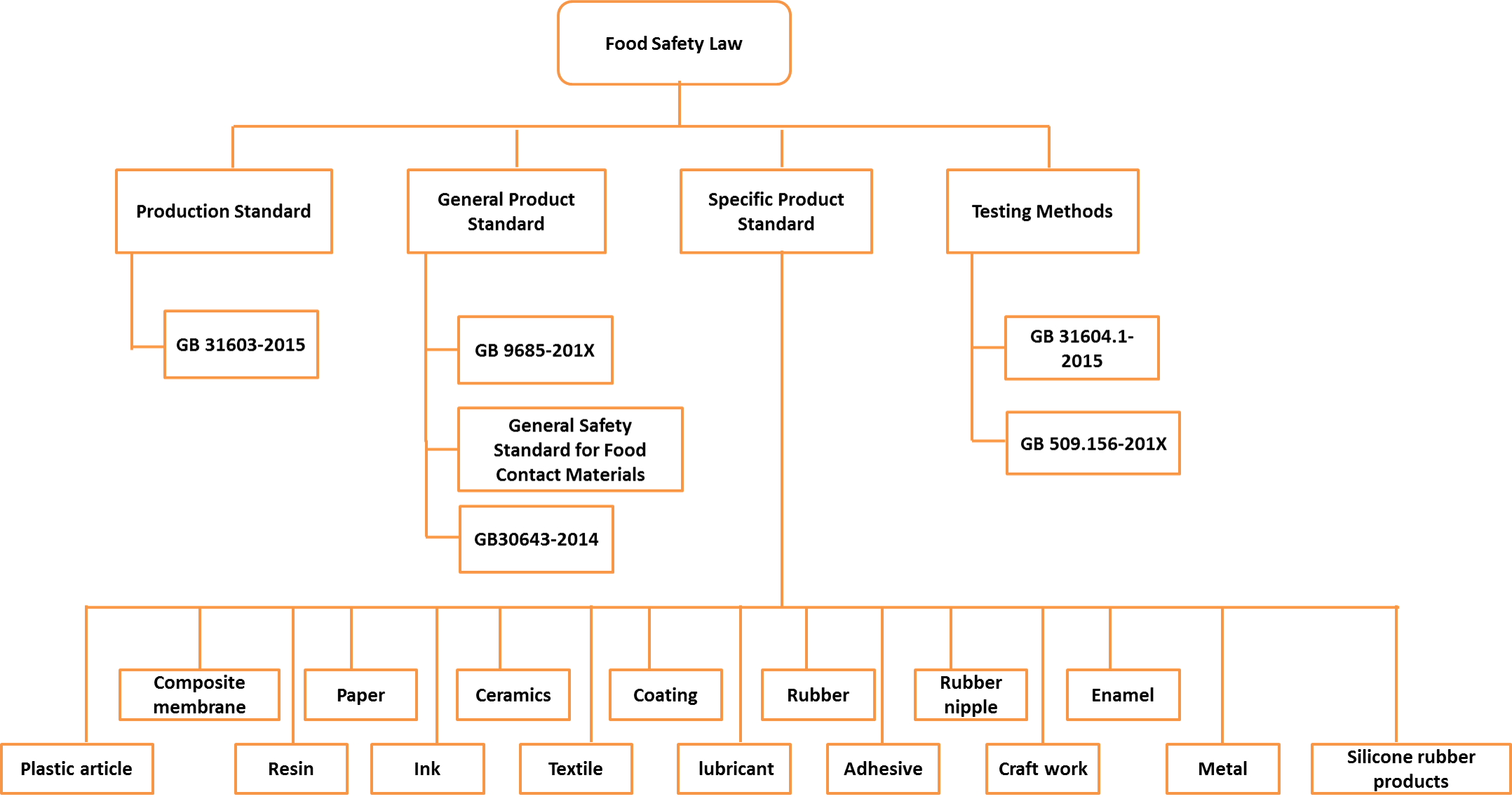
In the new Food Safety Law, the Chinese authority have paid significant attention to whole process risk control including– the production process, which was overlooked before. Processing assessment and production plant audit are requested in food registration and filing, and food production approvals. This ideology is also applied in food packaging materials as well. Domestic FCM manufacturers have to comply with the production hygiene standard to strengthen safety control in raw material, production, transportation, and storage and hygiene management. It is notable that imported FCM products should only comply with the general and specific product standard and testing method standard.
Standards on a General Level
Type | Regulations | Effective Date | Scope |
Production requirement | 21 Sep. 2016 | This standard specifies the basic hygienic requirements and management rules for sites, facilities and staff in each link of production of food contact materials & its products, from raw material purchase, processing, packaging to storage and transportation. | |
General product standard | GB 9685-XXXX “National Standard for Uses of Additives in Food Contact Materials and Articles” | Draft for public consultation in January of 2015 | It defines permitted substances added during the manufacturing process of food contact materials and articles. |
“General Safety Requirements for Food Contact Materials and Articles” | Draft for public consultation in June of 2015 | It specifies the basic requirements and compliance principles for food-contact materials and articles, including provisions relating to testing methods, Declarations of Compliance (DoC), traceability, and product labeling. | |
GB/T 30643-2014 “General Rules for Labeling of Food Contact Materials and Articles” | 1 Sep. 2015 | This standard specifies the basic principles, making requirements and contents for the labelling of food contact materials and articles, applicable to those that intended for terminal use of consumers. | |
Testing method | Draft for public consultation in August of 2015 | This standard specifies basic principles, requirements for sampling and sample preparation, food simulants, facilities and result analysis. | |
GB 31604.1-2015 General Rules for Migration Testing of Food Contact Materials and Articles | 21 Sep. 2016 | This standard specifies general migration testing requirements for various food contact material types. |
GB 9685 Food Contact Additive List
One of the most important standards for the FCM industry is GB 9685, which defines permitted additive added in FCM production. The total number of permitted additives has increased from 65 in 2003 to 958 in 2008, and 1297 in 2015’s iteration. Additional approved food contact additives will be appended to this list and published in the form of announcements. In spite of the increasing number of additives, the new GB9685 also adopts a better substance search format. It assigns each listed substance with a food contact additive number, following use scopes: plastic, coating, rubber, inks, adhesive, paper and silicon rubber and other food contact material and articles. The latest version of GB9685 draft was published for consultation in early 2015, and a final decision can be expected soon.
For those additives that have not been listed on the GB9685 standard, enterprises may submit a new food contact additive application. Although the final GB 9685 version has not been released, some enterprises have submitted new food contact additive applications for some products. However, by now, the authority has a very burdensome evaluation task for the FCM standard revision meaning that few (around 20%) new applications have been approved in the past few years.
General Safety Requirements for FCM
The old FCM standard system is made up of the numerous specific product standards, which created a gap for things not covered by specific product standards. The general safety requirement for FCM drafted in 2015 is a completely new standard very similar to the EU 1935/2004 framework regulation, specifying fundamental requirements for all food contact materials and articles on migration limits, Declarations of Compliance (DoC), traceability, and product marking requirements.
One of the most significant and historical reforms is that China started to adopt Declarations of Compliance (DoC) as a tool for traceability and responsibility determination along the supply chain. Suppliers should provide a compliance declaration to its downstream buyers. It has been used in EU for a long time as required in EU 1935/2004, and recognized as a way to improve supervision effectiveness. Through DoC, safety and risk control responsibility are shared by every stakeholder along the supply chain.
However, it is not easy to implement DoC in China since the major content of DoC includes compliance regulatory articles and standards, determination of restricted substance’s migration limits and overall migration level, and safety assessment of non-intended additives. This may be difficult for SMEs that normally lack relevant professional, technical and regulatory knowledge a fact demonstrated by many Chinese manufacturers when providing DoC to their EU downstream buyers. Chinese suppliers rarely understand this is a legally binding declaration, and mostly they just haphazardly list the names of some regulations in this declaration rather than a carefully compiled list of all the relevant standards and compliance requirements associated with their product. At the initial stage, DoC is a practical tool to increase compliance awareness for the Chinese FCM industry. To achieve its function, DoC has to be institutionalized and normalized and become accepted by industry and competent authorities. Experts are now busy drafting China’s DoC industrial guidance.
In addition to DoC, the final FCM products are requested to add a mark with spoon and chopsticks meaning that the product can be used for food contact. This conforms to requirements for increasing consumer awareness.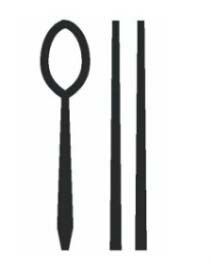
Market Access for imported FCM products
While the standard is being amended, the authority has also strengthened product inspection. On 28th March, 2016, AQSIQ Announcement No. 31 “Inspection and Supervision Measure for Import Food Contact Product”. The filing procedure is no longer a mandatory requirement, but filing with AQSIQ prior to market entry may facilitate quarantine clearance.
According to the measure, imported FCM products can file with AQSIQ prior to export by providing a DoC, traceability document, product specifications, and approval certificate for new FCM substances. Representative samples should be sent to qualified labs to conduct compliance testing. Only after the applicant’s criteria, application documentation and test results all pass the review, will AQSIQ issue an Import Food Contact Product Filing Certificate. The certificate will be required by CIQs for quarantine clearance. For those that have filed with AQSIQ prior to export, the CIQ will mainly check the conformity of product and clearance documentations and the testing rate will be no less than 5% of total imported batches. For those that don’t have a file with AQSIQ, CIQ will check every batch of goods and testing rates will be no less than 30%. On condition that first-time imported FCM products must undertake compliance testing.
On the whole, with the new FCM standard system, China will upgrade its food safety system considerably. Overseas FCM manufacturer should pay attention to the permitted additive used in FCM, specific product quality requirements, DoC and the new marking requirements. ChemLinked will keep on monitoring GB 9685, product standards and DoC guidance.