

 Request a Demo
About Titanium Dioxide
Titanium Dioxide (TiO2, CAS number: 13463-67-7) is the most widely used white pigment in the world. It is used in many types of products, including paints, coatings, plastics, paper, inks, fibers, foods, pharmaceuticals, and cosmetics, because of its high brightness, high refractive index, and UV light resistance properties.
Classification – Carcinogenic?
Different forms of Titanium Dioxide are used for the various industries that are mentioned above. For example, in the production of pigments, Titanium Dioxide is usually used at the micron scale; and in other products where it is used for its UV light resistance properties, it is often used in nanoparticle forms. As we know, the hazardous properties of a chemical can vary dramatically in different forms, especially in nanoparticle forms. Titanium Dioxide began to be used in nanoparticle forms since the 1990s and much of the debate around its safety is associated with titanium dioxide in nanoparticle form,.
Currently, under the Regulation (EC) No 1272/2008 on classification, labelling and packaging of substances and mixtures, which is also known as the CLP Regulation, Titanium Dioxide has not been assigned any hazard classifications (https://echa.europa.eu/substance-information/-/substanceinfo/100.033.327). But in 2006, the International Agency for Research on Cancer (IARC) classified Titanium Dioxide in group 2B, which means it is "possibly carcinogenic to humans".
In 2016 the safety fears revolving around Titanium Dioxide intensified when French agency “Agence nationale de sécurité sanitaire de l’alimentation, de l’environnement et du travail” (ANSES) submitted a proposal to the European Chemicals Agency (ECHA) and stated that Titanium Dioxide should be classified as Category 1B carcinogen by inhalation. The ANSES report showed evidence that Titanium Dioxide could cause malignant tumors in rats following exposure by inhalation. For humans, the available experimental data in the epidemiological studies is limited. Some reports have demonstrated that when exposed to Titanium Dioxide at a certain level of concentration by the respiratory route, it may cause lung overload and lead to an inflammatory reactions.
The ANSES proposal was submitted for public consultation on the ECHA website on May 31st 2016. The proposal to classify Titanium Dioxide as Category 1B carcinogen stirred huge turmoil in the Titanium Dioxide manufacture industry. The manufacturers expressed their concerns and why they consider the ANSES proposal is inappropriate. Their main arguments include the following points:
No increased incidence of lung cancer has been observed in connection with the exposure at the workplace.
Animal studies cannot be correlated to human beings unconditionally. The ANSES report was based on the studies on rats; and the exposure concentration for those rats was extremely high, which was inappropriate to be compared with the exposure concentration at the workplace.
The experiment data of ANSES report applied for every other indissolvable substance, not only Titanium Dioxide.
The workplace safety requirements raised by existing regulations can already ensure sufficient protection on workers.
No appropriate alternative materials have been found to replace Titanium Dioxide.
However, despite the vigorous debates, ECHA published on its website on Jun 9th 2017 that the Committee for Risk Assessment (RAC) concluded that the available scientific evidence met the criteria in the CLP Regulation to classify Titanium Dioxide as a substance suspected of causing cancer through the inhalation route. The committee believed that Titanium Dioxide should be classified as Category 2 carcinogenic, instead of Category 1B which was originally proposed by ANSES. The opinion will be sent to the European Commission for the final decision making. However, it should be noted that the RAC’s opinion is solely based on the hazardous properties of the substance. RAC does not take the exposure probability into account.
The Titanium Dioxide Manufacturers Association (TDMA) expressed its disappointment to RAC’s opinion. “There are no grounds for classifying Titanium Dioxide as carcinogenic for humans by inhalation. Also, classification would do nothing to increase the level of protection of human health and the environment, which is the whole point of the labelling and classification system” , Dr. Robert Bird, Chairman of TDMA said, “We are confident that European regulators will confirm the continued safe use of Titanium Dioxide in all applications.”
Regulation in China
China is one of the biggest consumers and manufacturers of Titanium Dioxide. Usually enterprises don’t report GHS classifications for their Titanium Dioxide products. And Titanium Dioxide is not included in Chinese Inventory of Hazardous Chemicals (ChemLinked Database: https://chemical.chemlinked.com/regulatory-database/china-inventory-hazardous-chemicals-2015).
The management of chemical substances in China is based on many inventories. Sometimes it could be confusing for enterprises that in which inventories and lists their chemicals are included. ChemLinked Chemicals Inventory Toolbox (https://tx.chemlinked.com/?lang=en_us&site=chemical) can be of help in such situations. The search interface is as follow:
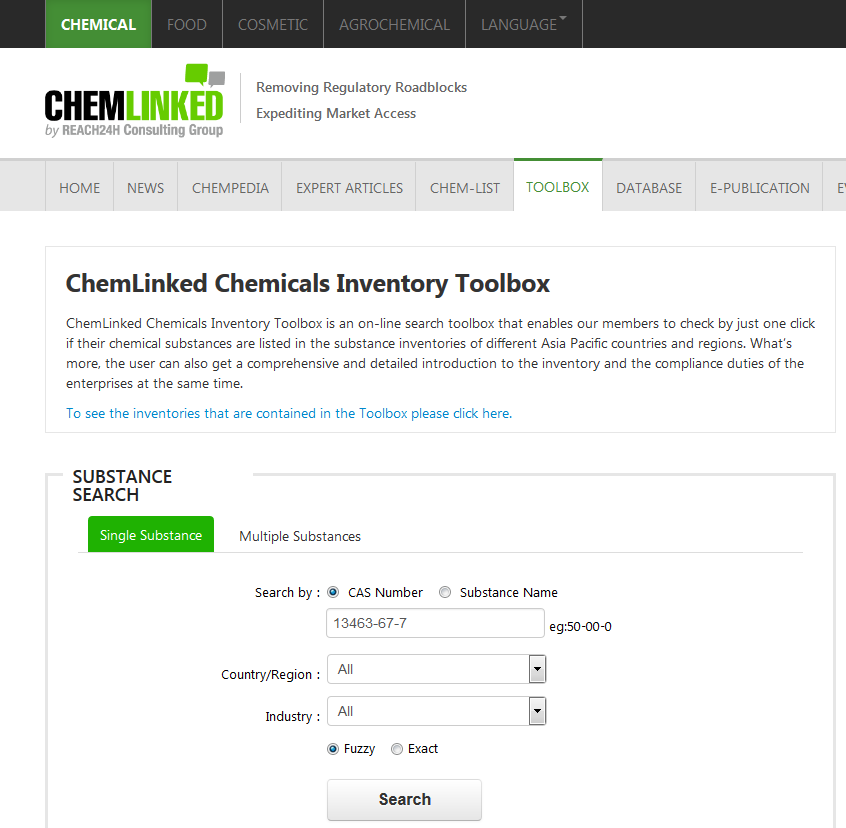
When searching the CAS number of Titanium Dioxide (13463-67-7), the toolbox gives back the search result as follow:
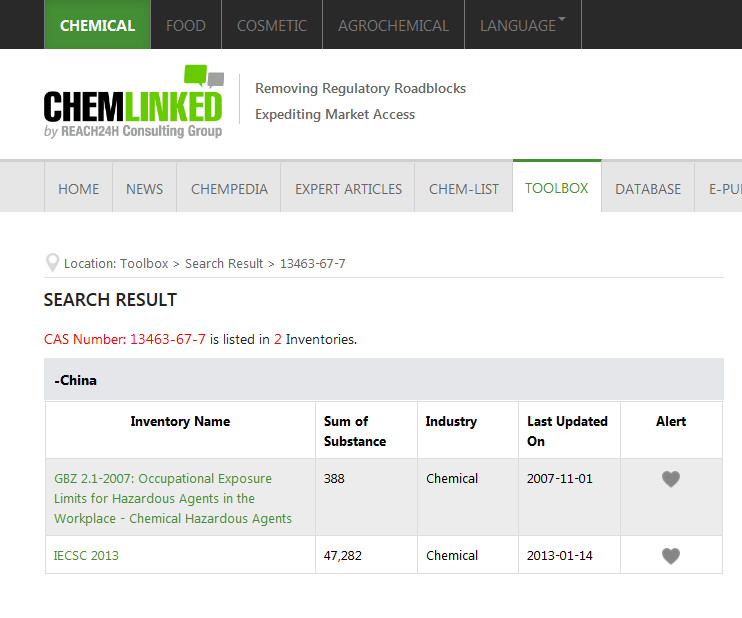
This means Titanium Dioxide is included in 2 inventories in China. The first one is a national standard (ChemLinked Database: GBZ 2.1-2007: Occupational Exposure Limits for Hazardous Agents in the Workplace - Chemical Hazardous Agents) which was issued by the Ministry of Health (MOH) in 2007. This national standard sets occupational exposure limits for 337 hazardous chemicals, 47 kinds of dusts and 2 biological agents. Titanium Dioxide is listed among the 47 kinds of dusts and the total concentration limit is set as 8 mg/m3.
The other inventory that contains Titanium Dioxide is the Inventory of Existing Chemical Substances in China (IECSC) which was published by the Ministry of Environmental Protection (MEP) in 2013. As an existing chemical substance, Titanium Dioxide is not subject to many regulatory obligations.
Although Titanium Dioxide itself is not regulated as a hazardous chemical by Chinese authorities, nanomaterials have drawn great attention from the regulators. In China, a nanomaterial is defined as the material which has a structure in the three-dimensional space in at least one dimension in the nanometer scale (from 1 nm to 100 nm) range of geometric dimensions, or constituted by the nano-structure unit and a material with special properties (GB/T 19619-2004: Terminology for nano-materials (纳米材料术语), published by AQSIQ and effective on Apr 1st 2005). The Administration of Quality Inspection, Supervision and Quarantine (AQSIQ) and Chinese Administration of Standardization (SAC) jointly issued 7 national standards on nano-materials in 2004, which marked the start of the regulation on nanomaterials from the authorities. In 2010, a national committee for nanoscience and nanotechnology was established. A lot of national standards on nano-materials were issued afterwards.
GB/T 19591: Nano-Titanium Dioxide was issued in 2004 among the first nano-material standards. However, the standard was mainly about the test methods on Nano-Titanium Dioxide and only proposed a few requirements on the labelling, package and transport of Nano-Titanium Dioxide. What’s more, the standard is only a recommended national standard instead of a compulsory one and does not possess much enforcement power on enterprises.
So we can see that there haven’t been much specific regulatory requirements on Titanium Dioxide in China. But the news that ECHA is going to classify Titanium Dioxide as carcinogenic will undoubtedly impact Chinese market and manufacturers. Currently, people have to wait for ECHA to list Titanium Dioxide into different inventories to know how exactly this classification will change the game. But other countries including China will definitely re-think its management policies on Titanium Dioxide and conduct more research on the health hazards identification and classification.




