
 Request a Demo
In light of the popularization of electric vehicles, battery waste has attracted attention from the authority and the industry in India. The Ministry of Environment, Forest and Climate Change, Government of India made public the Battery Waste Management Rules, 2022 (hereinafter referred to as the 2022 Rules) in the Official Gazette on August 24, 2022, which came into force immediately.
Background
In India, the earliest legislation regarding battery waste handling and management, named Batteries (Management and Handling) Rules, 2001, was released in 2001. In 2020, the authority decided to revise the rules to keep pace with the changing electric vehicle landscape and advancements in battery technologies. Accordingly, the Battery Waste Management Rules, 2020 (Draft) was issued for public consultation. After considering all the objections and suggestions received from the stakeholders, the Central Government published the 2022 Rules.
Who shall comply?
Producers, dealers, consumers and entities that are involved in the collection, segregation, transportation, refurbishment and recycling of battery waste.
Application scope
The 2022 Rules apply to all types of batteries regardless of chemistry, shape, volume, weight, material composition (not limited to lead batteries) and uses, i.e,
Automotive battery - any battery used only for automotive starter, lighting or ignition power;
Electric vehicle battery - any battery specifically designed to provide traction to hybrid and electric vehicles for road transport;
Industrial battery - any battery designed for industrial uses, excluding portable battery, electric vehicle battery and automotive battery. These may include sealed battery (excluding potable battery), unsealed battery (excluding automotive battery) and energy storage system battery; and
Portable battery - battery that is sealed, less than five kilograms, not made for industrial purposes, electric vehicle or to be used as an automotive battery.
Recycling and recovery targets
The producers are obliged to use domestically recycled materials in batteries. The requirements for minimum use of the recycled materials out of the total dry weight of a battery are illustrated in TABLE 1 below. This rule may improve the circular economy and push investments and deployment of the most advanced technologies used in waste extraction.
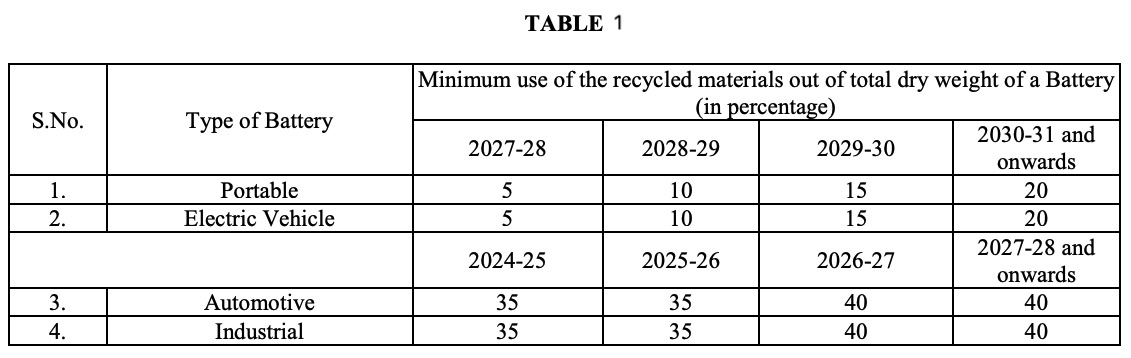 Source: Battery Waste Management Rules, 2022
According to the 2022 Rules, the recovery of minimum percentage target is the percentage of the total weight of all recovered materials out of the dry weight of the Battery. Recyclers shall follow the minimum recovery percentage of battery materials (%) as mentioned in TABEL 2.
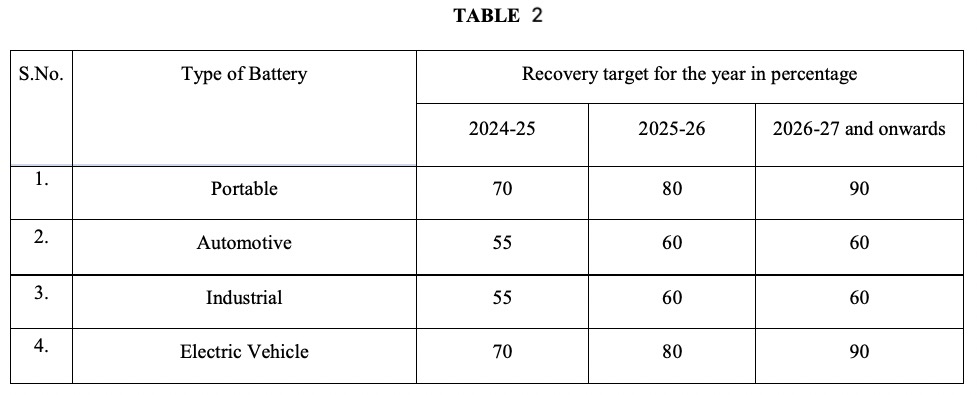 Source: Battery Waste Management Rules, 2022
Labeling requirements
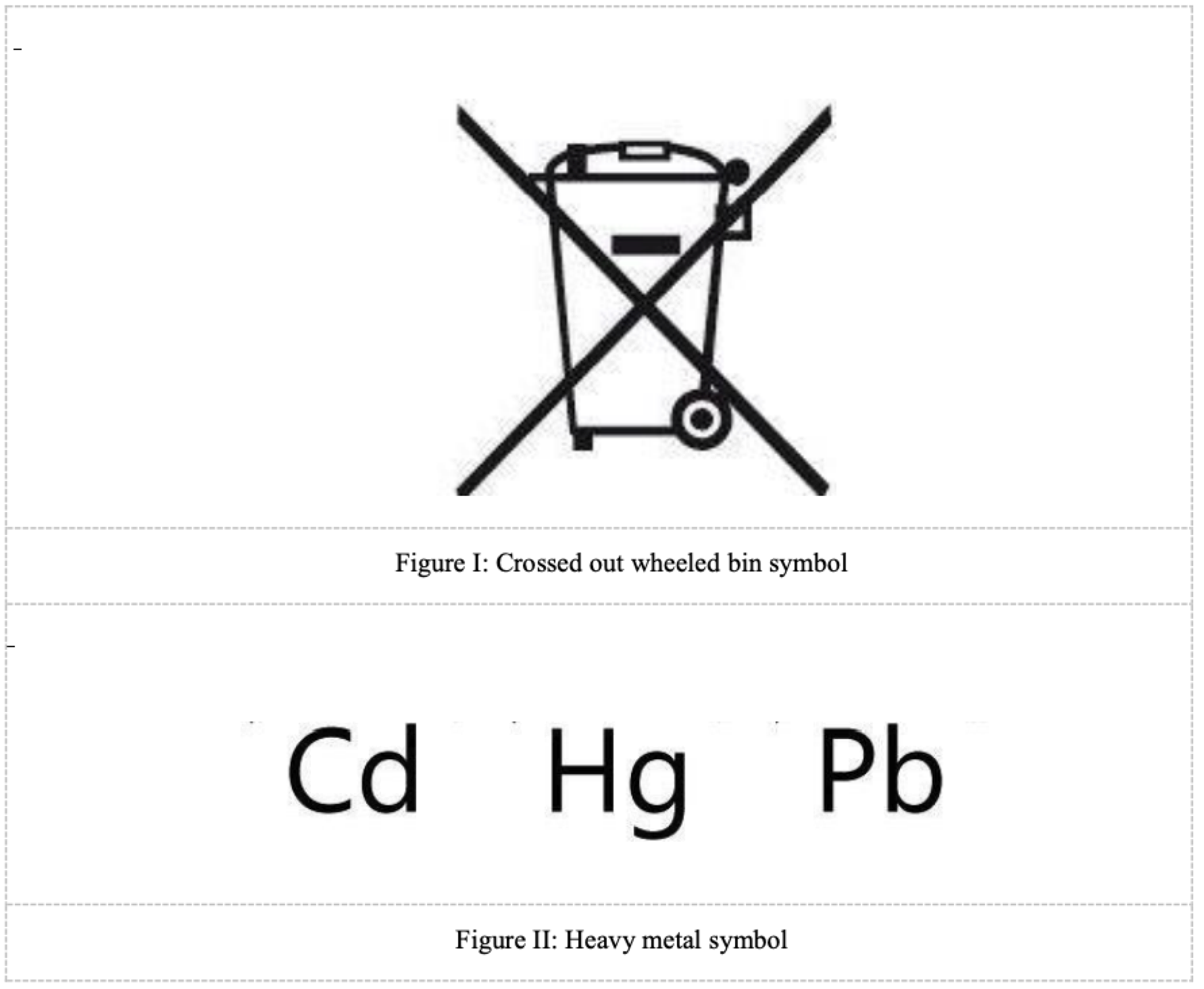
No person shall place on the market a battery or a button cell containing mercury, cadmium or lead unless it is marked with the respective chemical symbol "Hg", "Cd" or "Pb". The symbol of the heavy metal (see Figure II) shall be printed beneath the symbol shown in Figure I and cover an area of at least one-quarter the size of the crossed-out wheeled bin symbol as indicated below.
 Source: Battery Waste Management Rules, 2022
Other updates in the 2022 Rules
Extended Producer Responsibility (EPR) refers to the responsibility of any producer of batteries for environmentally sound management of battery waste. Producers shall have the obligation of the EPR for the battery that they introduce in the market to ensure the attainment of the recycling or refurbishing obligations.
An online portal should be established for the registration and filling of returns by producers, recyclers and refurbishes of battery waste within 6 months after the implementation of the 2022 Rules. A mechanism for the exchange of the EPR certificates shall be developed.
The EPR certificates are exchangeable and tradable for fulfilling the EPR targets. The producers may operate schemes such as a deposit refund system or buyback or any other model to fulfill EPR obligations.
The provisions of Producer Responsibility Organization in the 2020 draft have been deleted in the 2022 Rules. However, the 2022 Rules allow the producers to engage or authorize any other entity for the collection and recycling of battery waste. Notably, the EPR targets shall remain with the producer only.
Violations of the 2022 Rules will be punished in accordance with the provisions of Section 15 of the Environment (Protection) Act, 1986, e.g., suspension or canceling of the registration, paying for Environmental Compensation charges, etc.
More details about the 2022 Rules can be accessed here.