Request a Demo
1. Project Background of Textile Industry Air Pollutant Emission Standard
It’s very important to deal with air pollution effectively and enhance discharge standards for industries releasing air pollutants as PM2.5 has become a more and more serious problem in China. Half of the PM2.5 volume is released directly into the air, while the rest is formed through physio-chemical reactions. As one of the original compositions of PM2.5, VOCs produce nitrate, sulphate, secondary organic aerosols etc. through chemical reactions induced by sunlight and heat, which are all contributors of PM2.5 volume. As the textile and dyeing industry generated VOCs accounted for a great proportion of industrial VOCs discharge amount, the development of the Textile Industry Air Pollutant Emission Standard is initiated in line with the newly released Air Quality Standard (GB 3095-2012).
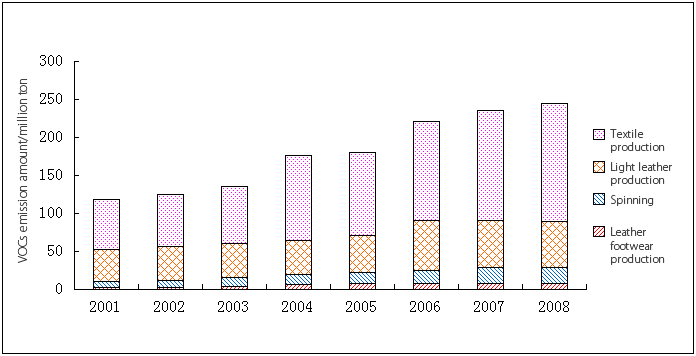
According to the statistical analyses for spinning, leather and shoemaking industries disclosed by the Inventory Analysis and Prediction Report about Unconventional Controlled Pollutant Emission from 2011 to 2020 published by China Environmental Science Press, a large amount of VOCs were released by textile and leather footwear industries. In 2001, VOCs emission attributed to textile and leather footwear industries was about 1 million ton, and the statistic has doubled now reaching 2 million tons for 2008.
Most of the VOCs volume came from the textile industry, for which VOCs emission grew from 1 million tons to 1.56 million tons from 2004 to 2008, which accounted for 63.7% of the total emission from textile and leather footwear industries as a whole. The statistics of VOCs emission from 2001 to 2008 is shown in Figure 1.
Figure 1 Textile and leather footwear VOCs emissions
VOCs emissions from textile products have seriously polluted the atmosphere. According to the incomplete statistical data specified in the Inventory Analysis and the prediction report on Unconventional Controlled Pollutant Emission from 2011 to 2020, VOCs emission (including benzene, halohydrocarbon and aldehyde etc ) relating to textile production accounted for around 30% of the overall industrial emission amount and its proportion amount the overall emission amount generated from different VOCs emission sources amount is 8.8%.
VOC waste gas is only one of the main air pollutions produced by the textile industry, the industry also involved in unorganic waste gas and particulate emission.
2. Domestic and Foreign Regulations and Standards
(1) United States
“National Emission Standards for Hazardous Air Pollutants: Printing, Coating, and Dyeing of Fabrics and Other Textiles” is the existing air pollutants emission standard issued by the U.S. Environmental Protection Agency (EPA) targeting the textile industry. The standard estimates that the printing, coating , dyeing and finishing industries involve about 135 kinds of major installations that will produce pollutants including the key air polluting factors toluene, methyl ethyl ketone (MEK),methanol, xylenes, methyl isobutyl ketone (MIBK), methylene chloride, trichloroethylene, n-hexane, glycol ethers (ethylene glycol), and formaldehyde. The final rule will reduce nationwide organic hazardous air pollution (HAP) emissions from major sources by approximately 4,100 tons per year equaling 60% from the current national baseline emissions. The sector-specific textile industry organic HAP emission limits are shown in Table 1.
Table 1 HAP EMISSION LIMITS FOR DYEING OR FINISHING INDUSTRIES FOR NEW, RECONSTRUCTED AND EXISTING TEXTILE ENTERPRISES.
Source categories | Pollutants producing process | Emission limits |
New,reconstructed and existing dyeing and finishing enterprises. | Dyeing operations only | You must limit organic HAP emissions to the atmosphere to no more than 0.016 kg of organic HAP per kg of dyeing materials applied. |
Finishing operations only | You must limit organic HAP emissions to the atmosphere to no more than 0.0003 kg of organic HAP per kg of finishing materials applied. | |
Both dyeing and finishing operations | You must limit organic HAP emissions to the atmosphere to no more than 0.016 kg of organic HAP per kg of dyeing and finishing materials applied. |
In addition to the emission limits specified in the table above, the standard also specifies that the dyeing and finishing process of the total annual emissions of organic HAP shall not exceed 10 tons.
As can been seen from the above information, the standard stipulates in its provisions the HAP emission limits for dyeing and new, reconstructed or existing dyeing finishing installations. The emission limits were determined by both the provisions of dye usage and after the amount of finishing fabric.
(2) EU
EU environmental standards, mostly in the form of directives,elaborate general and industrial instructions. The instructions related to VOCs are: Organic Solvents Using Directive 1999/13/EC,Paint Directive 2004/42/CE, Petrol Storage And Distribution Directive 94/63/EC, Integrated Pollution Prevention And Control Directive 96/61/EC, 2008/1/EC. There are no directives specifically for VOCs control in the textile printing and dyeing industries.
Regarding emission limits, the "Concil Directive (1999/13/EC) on the Limitation of Emissions of Volatile Organic Compounds due to the Use of Organic Solvents in Certain Ativities and Installations provides different types of pollutant emissions limits. The required emission concentration limits are as follows:
- For substances with carcinogenic, mutagenic , reproductive toxicity, and those that might be carcinogenic upon inhalation in addition to potentially causing genetic mutations or impair fertility or the fetus), if the VOCs emission rate greater than or equal to 10 g / h, then upper total emission concentration limit is 2 mg/m3.
- For the halide-relevant VOCs emission rate greater than or equal to 100 g / h, the upper emission limit for the total concentration is 20 mg/m3.
(3) Japan
In 2004, the Japanese government revised "Atmospheric Pollution Prevention Act"and newly adding a chapter for "VOCs emissions regulations" . Moreover, the promulgated orders , implementing rules and VOCs method were released in 2005. Since April 1, 2006, the Japanese government has continuously implemented VOCs emission control technology on chemical manufacturing, painting , industrial cleaning , bonding , printing , VOCs substances storage source category 6 of 9 kinds of key industrial facilities . In addition , the Japanese government has implemented regulations for air pollutants, and defined benzene , trichlorethylene , tetrachlorethylene as three kinds of toxic VOCs substances and characterized them as the priority controlled toxicants.(PCT). The PCTs will be categorized as existing or new sources respectively, to further distinguish emissions limits.
In addition, the "Japanese Factories and Enterprises Atmospheric Pollutant Emission control Measures and Control Program" ( Last Modified: April 10, 1998 ) stipulates specific emission control measures for various the atmospheric pollutants . The main categories are dust, priority controlled pollutants and hazardous air pollutant. The control criterion for harmful air pollutants are shown in Table 2 .
Table 2 Harmful air pollutants
Pollutant name | Source of Origin | Summary of Standard |
Harmful Air Pollutants (substances thateven at low concentration levels, long-term inhalation will lead to health hazards ) | 234 kinds of substances, of which 22 types are priority pollutants | On-spot control rules: responsible parties should actively take measures to reduce pollutant dispersion, and the local government should control the pollution trends |
Specified pollutants benzene | Benzene Drying Equipment | Control criteria for Each device / level: New Source: 50-600mg/Nm3 Existing Source: 100-1500mg/Nm3 |
Specified contaminants: trichlorethylene | cleaning equipment using trichloroethylene | Control criteria for Each device / level: New Source: 150-300mg/Nm3 Existing Source: 300-1500mg/Nm3 |
Specified pollutants: tetrachlorethylene | Cleaning equipment using tetrachloroethene | Control criteria for Each device / level: New Source: 150-300mg/Nm3 Existing Source: 300-1500mg/Nm3 |
Specified contaminants: dioxins | Steel refining furnace and living waste incinerator | Control criteria for Each device / level: New Source: 0.1-5ng-TEQ/Nm3 Existing Source: 1.0-10ng-TEQ/Nm3 |
Note: * For soot, ingredients and harmful pollutants, local government may establish more stringent national emission standards.
* With the development of pollutant control technology and industrial structure changes, the above criteria should be revised and improved .over time
As Japanese textile printing and dyeing production scale is relatively small, there are no specific standards targeting the waste gas issues in this particular industry. Among the table 2 listed gases, benzene gas is the only relatively common air pollutants involving in the textile printing and dyeing industry. China's textile and dyeing industry is enormous, therefore for the domestic textile industry, aromatic gas emission limits will vary from the above criteria, and the specific values should be determined in consideration of the textile industry status quo in China.
(4) China
In China, the VOCs emissions volume is enormous and involves a broad range of industries. In addition, regionalized pollution is very serious and the emission violations are widespread. All of these create huge challenge in monitoring VOCs. From the situation observed from Beijing, Shanghai and other major cities, automobile exhaust and organic solvents (including paint coatings) are the major contributors of VOCs volume. The current pollution control work for VOCs in China is still in its infancy. At present, the "Air Pollutant Emission Standards " (GB16297-1996) and other national-level policy documents have established emission limits for certain VOCs. Moreover, Guangdong Province promulgated in 2010 a series of regulations for VOC emission, the "Furniture Manufacturing Industry VOC Emission Standards" (DB44/814-2010), Printing Industry VOC Emission Standard" (DB44/815-2010), "VOC Emission Standard for Surface Paint Coating (car manufacturing)" (DB44/816-2010)," VOC Emission Standard for Shoemaking Industry" (DB44/817-2010) Some local environment policy and environmental protection standards also concerns certain VOC substances. However, a more comprehensive and systematic VOCs pollution prevention policy is yet to be established.
Regarding air pollutants emission control for textile industry, the lack of uniform emission standards has resulted in insufficient consciousness among most of the companies regarding the serious pollution emission issue. Moreover, there gas are few waste gas treatment plants or emission reduction technology. In addition, due to insufficient air pollutant monitoring techniques, air pollutants emission produced by the textile industry are not effectively controlled. All of these factors, grouping with the absence of air pollutant emission standards for the textile industry, air pollutants generated during manufacturing are discharged directly to the atmosphere, generally regulated by the "Air Pollutant Emission Standard", and "Odor Pollutant Emission Standard".
Taking into account China’s textile rapid industrial development, adopting the general air pollutant emission standards for the textile industry are subject to certain limitations. To obtain more scientific and effective control of textile printing and dyeing industrial emissions, specific air pollutant emission standards for the textile industry are needed. These standards will help to improve the severe pollution caused by the textile, printing and dyeing industry.
Technology and Standard of Environmental Protection Research Professional Committee of All-China Environment Federation
June 9, 2013