Request a Demo
Introduction
In the seventies the Food and Drug Administration (FDA) of the United States of America (USA) detected some cases of fraud involving data generated by toxicology labs which was submitted to the FDA by pharmaceutical companies. In a certain laboratory thousands of safety tests for chemical manufacturers were falsely claimed to have been performed or were of such poor quality that police investigators could not piece together what work had been done(1). The most important deficiencies encountered were:
Study plan insufficiently detailed
Operating conditions (e.g. calibration of equipment) were not correctly followed and documented
Inaccurate and incomplete registration of data
Inconsistent report (Results did not conform with the raw data generated.)
These issues led to the FDA’s publication of Proposed Regulations on GLP in 1976, with establishment of the Final Rule in June 1979 (21 CFR 58).
The Environmental Protection Agency (EPA) had also encountered similar problems, and issued its own draft GLP regulations in 1979 and 1980, publishing the Final Rules in two separate parts (40 CFR 160 and 40 CFR 792) in 1983.(2)
Acceptance of the OECD Principles of GLP
The GLP regulations for non-clinical laboratory studies published by the US Food and Drug Administration provided the basis for the work of the Expert Group to develop the OECD Principles of GLP (3). Those Principles of GLP were formally recommended for use in Member countries by the OECD Council in 1981. They were an integral part of the Council Decision on Mutual Acceptance of Data (MAD) in the Assessment of Chemicals, which states that “data generated in the testing of chemicals in an OECD Member country in accordance with OECD Test Guidelines and OECD Principles of Good Laboratory Practice shall be accepted in other Member countries for purposes of assessment and other uses relating to the protection of man and the environment ” [C(81)30(Final)].
In line with the MAD decision the Council Decision-Recommendation on Compliance with Principles of Good Laboratory Practice [C(89)87(Final)] decided that Member countries in which testing of chemicals are carried out pursuant to principles of good laboratory practice that are consistent with the OECD Principles of Good Laboratory Practice shall establish national procedures for monitoring compliance with GLP Principles, based on laboratory inspections and study audits.
Taking into account the abovementioned OECD Council Decision-Recommendations it is important for countries to become OECD Member. With respect to the GLP regulations an OECD Membership includes:
Multilateral agreement with the other OECD economies with regard to data of studies performed in compliance with the OECD Principles of GLP
Performance of GLP studies according to the same OECD GLP quality standard
Avoiding duplicate work and reduce financial costs on government, industry and test facilities
Facilitating the exchange of information and prevent the emergence of non-tariff barriers to trade
The mechanism of the multilateral agreement can be clarified by the following mechanism:
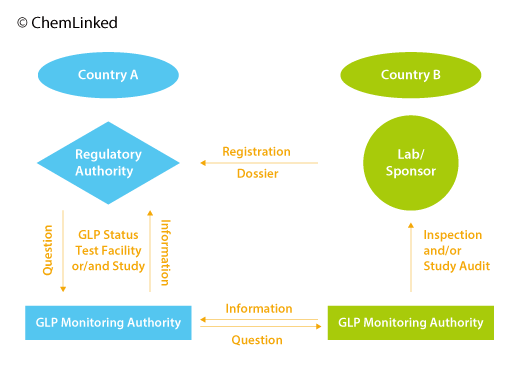
Fig.1 Mechanism of multilateral agreement based on adoption of OECD Principles of GLP
Three mechanisms are possible:
Countries A and B are OECD Member countries: in accordance with MAD, raw data of test facilities of country B are accepted by country A and vice versa (including other OECD Member countries).
Country A is an OECD Member country and country B is a non OECD Member country. The raw data of the test facilities of country B can only be accepted by country A if an inspection by the Monitoring Authority (MA) is performed to verify if the data have been obtained according to the OECD Principles of GLP (bilateral agreement). However, if these data are accepted by one country it doesn’t mean that they will be accepted by the other OECD Member countries automatically. There is a potential risk for the test facilities in country B that their studies will be audited by the Monitoring Authority of the OECD Member country each time the sponsor submit the data of the studies to the Regulatory Authorities of an OECD Member country.
Country A and B are not OECD Member countries: bilateral agreement. The data of the studies performed in both countries are not accepted by the OECD Member countries
Application of the OECD Principles of GLP
Before the test facility starts to develop an OECD GLP quality system it is important that training courses are given and followed up by an experienced GLP Expert.
Level 1 : Training course concerning the explanation and understanding of the OECD Principles of GLP. It is recommended that this training course explains the pitfalls of the OECD GLP Principles. In addition the course should ensure a variety of exercises and case studies are programmede. To be efficient it is important that this training course is attended by a group containing a maximum of 20 persons.
At the end of the training course a schedule should be prepared outlining the GLP development, and implementation timeline. During this phase the test facility should organize management and QA meetings to discuss the problems and to take corrective actions, where necessary.
Level 2: training course concerning the evaluation of the progress of the development and implementation of the OECD Principles of GLP in the test facility. During this training, a mock inspection and study audits should be carried out to evaluate the degree of understanding and correct implementation of the OECD Principles of GLP. In this context, the training course should be focused on the efficacy and efficiency of the GLP capacity building measures already carried out in the test facility in accordance with the timeline. This training course should be organized within one year after the first training course depending on the progress of the implementation of the OECD Principles of GLP.
Level 3 : training course and consultancy concerning the preparation, assistance and follow up of a GLP inspection.
Level 4 : yearly evaluation of the QA Program by an experienced GLP expert to verify the working program and reporting of the QA Staff and the corrective actions taken by test facility management and study directors with regard to the deficiencies reported during the inspections and study audits.
Conclusion
It is important for the Chinese government, industry and test facilities that China becomes an OECD member country and member of the OECD GLP Working Group. Therefore, it is necessary that the country installs a GLP monitoring authority with a GLP compliance monitoring program that is peer reviewed by an OECD evaluation team. If the result of this evaluation is positive and accepted by the OECD GLP Working Group, data generated by Chinese test facilities will be mutually accepted. Once China is a full OECD Member the GLP monitoring authorities can function independently. Sponsors can submit their dossiers to the receiving authorities of all the OECD Member countries for scientific evaluation. Inspections conducted abroad are not necessarily based on the mechanism of multilateral acceptance. This allows China to build up credibility of their GLP monitoring system and also reduce financial costs (inspections by other OECD Member countries).
Finally, it is recommended that test facilities pay a lot of attention to internal and external training courses to ensure that their GLP quality system is continuously in compliance with the OECD Principles of GLP. The level and standards of the GLP quality system is the main tool for assessing the credibility of test facilities and establishing confidence that they meet the required standards.
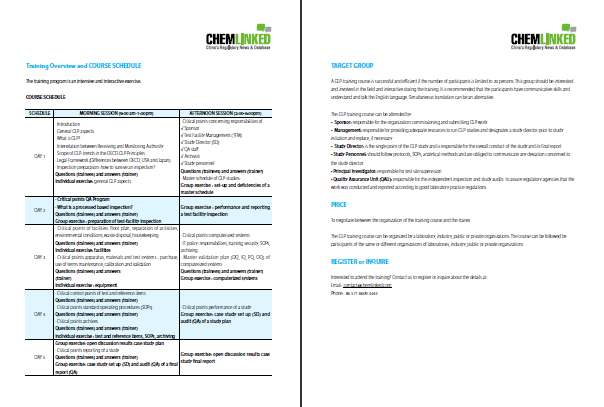
Annex: GLP Training in China (Syllabus)
About the Author
 Mr. Hedwig Beernaert is the quintessential GLP expert, author or coauthor of some 100 peer reviewed publications, Chairman of the EU’s mutual joint visit program steering group, organizer and developer of multiple GLP courses and vice president of Belgium’s GLP accreditation board are just a taste of the accolades that decorate his outstanding career.
During his 20 year tenure, Mr. Beernaert racked up an impressive list of achievements specifically relating to implementation of OECD principles of GLP, and personally was involved in more than 200 OECD sanctioned inspections. Globally reknowned as an expert in the field of OECD GLP, Mr. Beernaert started his own consultancy firm “EuroQAM” in 2009, providing quality and dependable advice and consultancy on all things GLP.
Learn more about Mr. Beernaert's profile.