Request a Demo
Chemicals are a major part of our daily life. The use of chemicals in absence of sound management will pose significant risks to human health and the environment. This article reviews important concepts that are essential for understanding the mainstream approach to sound management of chemicals.
1. Basic Content of Sound Management of Chemicals
The United Nations Development Programme (UNDP) promotes the sound management of chemicals and advocates for integrating rigorous chemicals management schemes into national development policies and plans. UNDP defined “sound management of chemicals” as “apply managerial best practices to chemicals throughout their life cycle to prevent, and, where this is not possible, to reduce or minimize the potential for exposure of people and the environment to toxic and hazardous chemicals.”[1]
As far back as 1992, Chapter 19 of Agenda 21[2], which is agreed at the United Nations Conference on Environment and Development (UNCED) introduced basic elements for sound management of chemicals, including: (a) adequate legislation, (b) information gathering and dissemination, (c) capacity for risk assessment and interpretation, (d) establishment of risk management policy, (e) capacity for implementation and enforcement, (f) capacity for rehabilitation of contaminated sites and poisoned persons, (g) effective education programmes and (h) capacity to respond to emergencies.
According to the Key Elements of a National Programme for Chemicals Management and Safety[3] issued by the Inter-Organization Programme for the Sound Management of Chemicals (IOMC) in 1998, “Countries around the world have recognized, through their endorsement of Agenda 21's Chapter 19 and in the context of various international fora, the importance of the sound management of chemicals as a key component of sustainable development. Achieving sound chemicals management entails a comprehensive approach aimed at reducing risks and preventing adverse impacts throughout all stages of the chemical life cycle, from production or import through processing, storage, transportation, distribution, use and disposal. With chemicals touching nearly every aspect of our lives, achieving the sound management of chemicals is a process which must involve a wide range of actors including government, industry, the agricultural sector, workers, research institutes and academia, public interest groups and individual citizens.”
2. Aims for A National Program for Chemicals Management
Sound management of chemicals aims to protect human health and avoid adverse impacts on the environment. A detailed list of possible aims of a national program for chemicals management and safety is provided as Box 1 (see below) in the Key Elements of a National Program for Chemicals Management and Safety.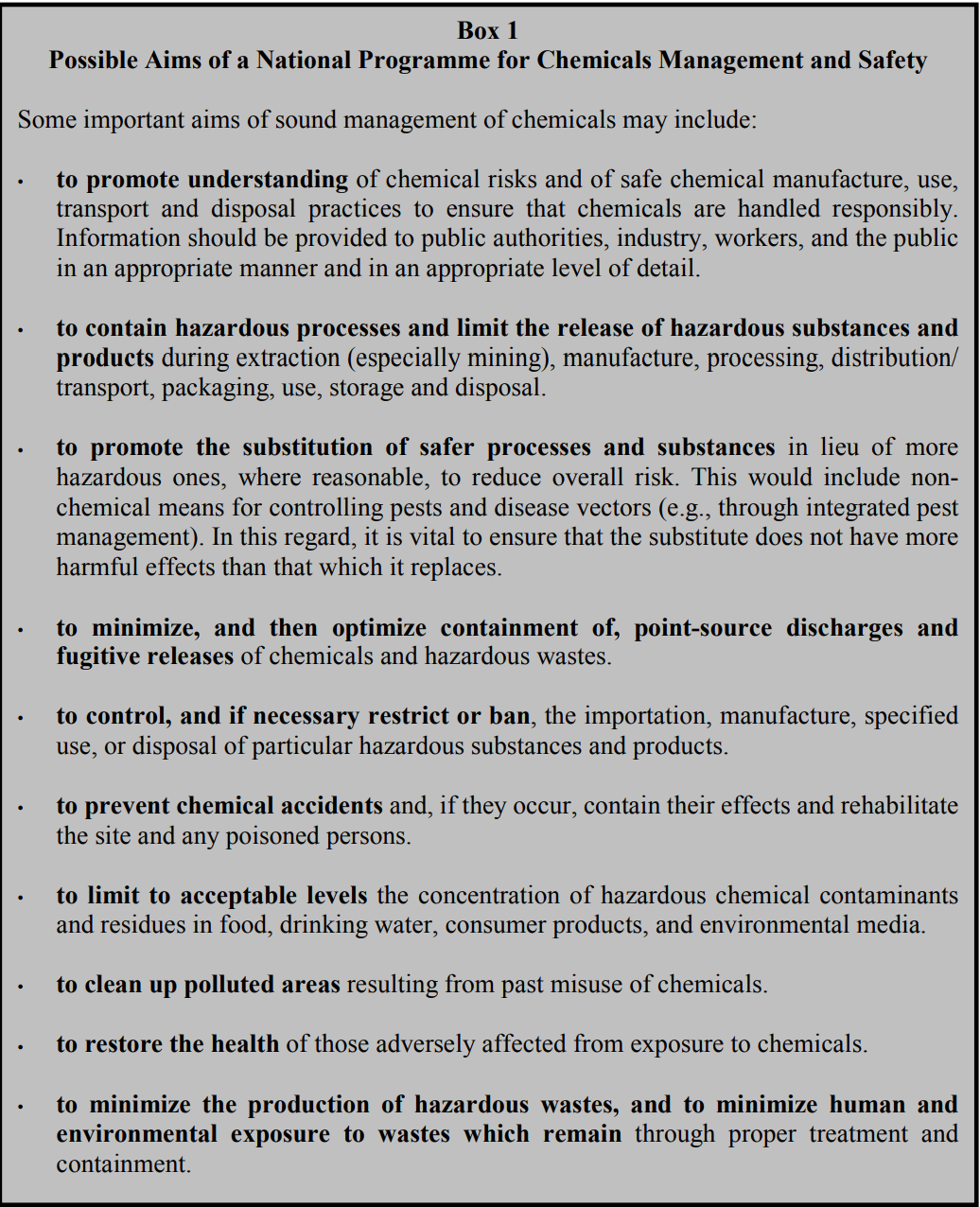
3. Guiding Principles for Sound Management of Chemicals
The United Nations related organizations as well as competent authorities in developed countries have put forward a series of implication, basic tasks and guiding principles on the sound management of chemicals in recent years. These guiding principles are very important for guidance of the prevention and control of chemical risks in various countries and realization of chemical sound management. The guiding principles on sound chemical management include:
Realize chemical lifecycle management
Prevention and Precautionary approach/principle
Subject substances for the focalized management
Set focal items for priority management
Targets for reducing the risk of chemicals
The responsibility for chemical safety should be shared by all sectors of society
The public's right to know and stakeholder participation
The importance of science in environmental decision–making
The polluter pays; Extend the responsibility of producers
The duty of care principle
Green chemistry; Sustainable chemistry principles
We should recognize sound chemicals management as a development issue. When formulating, updating or implementing chemical management policies and plans, the above mentioned concepts or principles should be followed.
4. An Issue across Borders and Sectors
Sound chemical management is a global responsibility, with activities taking place not only at the international level, but at the national and regional levels as well. Chemical management, its efficiency and success requires multi-sectoral collaboration and stakeholder participation. National chemical management policies and plans should be developed in consultation with all sectors, including business circles, academic circles, non-governmental organizations and the public. In fact, sound management of chemicals is essential for the sustainable development of any country. As general rules, the policies and plans should be established based on the best available data and scientific risk assessments, taking into account local economic, legal, cultural, social and political factors.
It is well recognized that countries have limited resources to address chemical risk issues with regards to human health and environmental protection. Countries should, therefore, establish priorities based on risks and problems targeted and take step-wise implementation of chemical management policies and plans In accordance with those priorities. The preparation of a country profile report, which involves a systematic assessment of the country's existing chemical management infrastructure to identify key issues and areas of concern, can provide a good starting point for determination of priorities.
In addition, with the development of regional economies, cooperation among countries and regions on chemical management issues has become increasingly important. Regional cooperation not only shares the burden of information collection, testing, assessment and risk management, but also creates opportunities for improved trade and economic development.