Request a Demo
The freight volume of dangerous goods imported and exported has soared in recent years, bringing with it the numerous pitfalls and potential risk. It has however provided a key impetus for China's Government to update or reformulate related regulations and standards in line with international codes.
Last 1 Dec, China AQSIQ and SAC implemented the following four DG standards:
GB 6944-2012 Classification and Code of Dangerous Goods
GB 12268-2012 List of Dangerous Goods
GB 28644.1-2012 Excepted Quantities and Packing Requirements for Dangerous Goods
List of excepted quantities of dangerous goods
Packaging
Tests for packages
Marking and documentation
Exemption
GB 28644.2-2012 Limited Quantities and Packing Requirement for Dangerous Goods
List of limited quantities of dangerous goods
Packaging
Documentation
Marking
Exemption
The first two were revised to replace their 2005 editions (see Chemlinked news on 1 Dec 2012) while the last two were newly formulated, in a bid to blend in the international trend and enhance the safety of transport. All of them take references from UN Recommendations on the Transport of Dangerous Goods (16 Rev.)
GB 28644.1-2012 Excepted Quantities
The excepted quantity indicates the maximum quantity per inner and outer packaging for transporting dangerous goods.
Only dangerous goods that are listed in the GB 28644.1-2012, packed according to Chapter 7 and whose packages are tested in line with Chapter 8 of this Standard are permitted to be carried in excepted quantities and will be exempt from any other requirements for dangerous goods.
Preview of list of excepted quantities of dangerous goods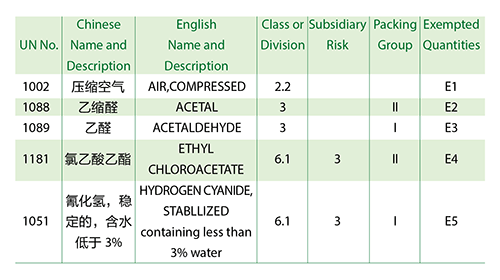
The code E1-E5 represents maximum net quantity per inner and outer packaging
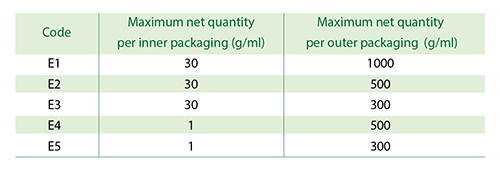
If dangerous goods with different codes are packed together, the total quantity per outer packaging must be subject to the most restrictive code. The number of packages in any freight vehicle, railway fright wagon or multi-modal freight container should not exceed 1000.
Dangerous goods are not allowed to be packed together in the same outer packaging or in large packaging, if they react with other dangerous or ordinary goods and cause:
Combustion and/or evolution of considerable heat;
Evolution of flammable, toxic and saphyxiant gases;
The formulation of corrosive and unstable substances
The inner and outer packaging of dangerous goods in excepted quantities are required to bear the mark below:
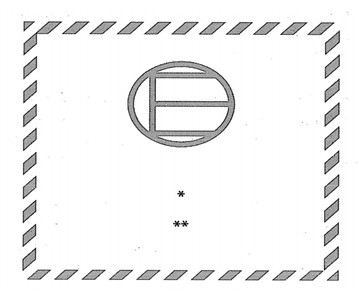
The hatching and symbol are with the same color, black or red.
* displays the Class or, when assigned, the Division number(s)
** indicates the name of the consignor or consignee
GB 28644.2-2012 Limited Quantities
The limited quantity indicates the maximum quantity per inner packaging or article for transporting dangerous goods, to avoid massive amount of goods with strong risks to be piled up together or allow goods with relatively small risks exempt from most of complex transportation requirements if packed accordingly.
Only dangerous goods that are included in the GB 28644.2-2012, packed and marked in conformity with this Standard can be carried in limited quantities and enjoy certain exemption rules. For instance, dangerous goods packed in limited quantities within a vehicle or freight container need not be subject to any segregation requirements.
Except for air transport, packages containing dangerous goods in limited quantities need not be labeled nor marked with the proper shipping name or UN number of the contents, but should bear the marking shown in Figure 1 below:
For air transport, packages containing dangerous goods in limited quantities should bear the marking shown in Figure 2 below.
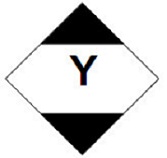
Minimum dimensions of both marks is100 mm x100 mm. The dimension maybe reduced due to the packaging size, but no less than 50 mm x 50 mm.
The two compulsory standards manifest that China makes great progress in reducing the risks during transportation of dangerous goods in small packaging.