Request a Demo
The follow-up management of registered new chemicals plays an essential role in ensuring the overall implementation of new chemical management under MEE Order No. 12. Enterprises handling new chemicals assume primary responsibilities in this regard. They are obligated to fulfill certain post-registration obligations in accordance with MEE Order No. 12 and the Transitional Arrangements for Environmental Registration of New Chemical Substances (a.k.a. Transitional Arrangements). Table 1 below summarizes the major post-registration obligations, application scope, and to whom they apply.
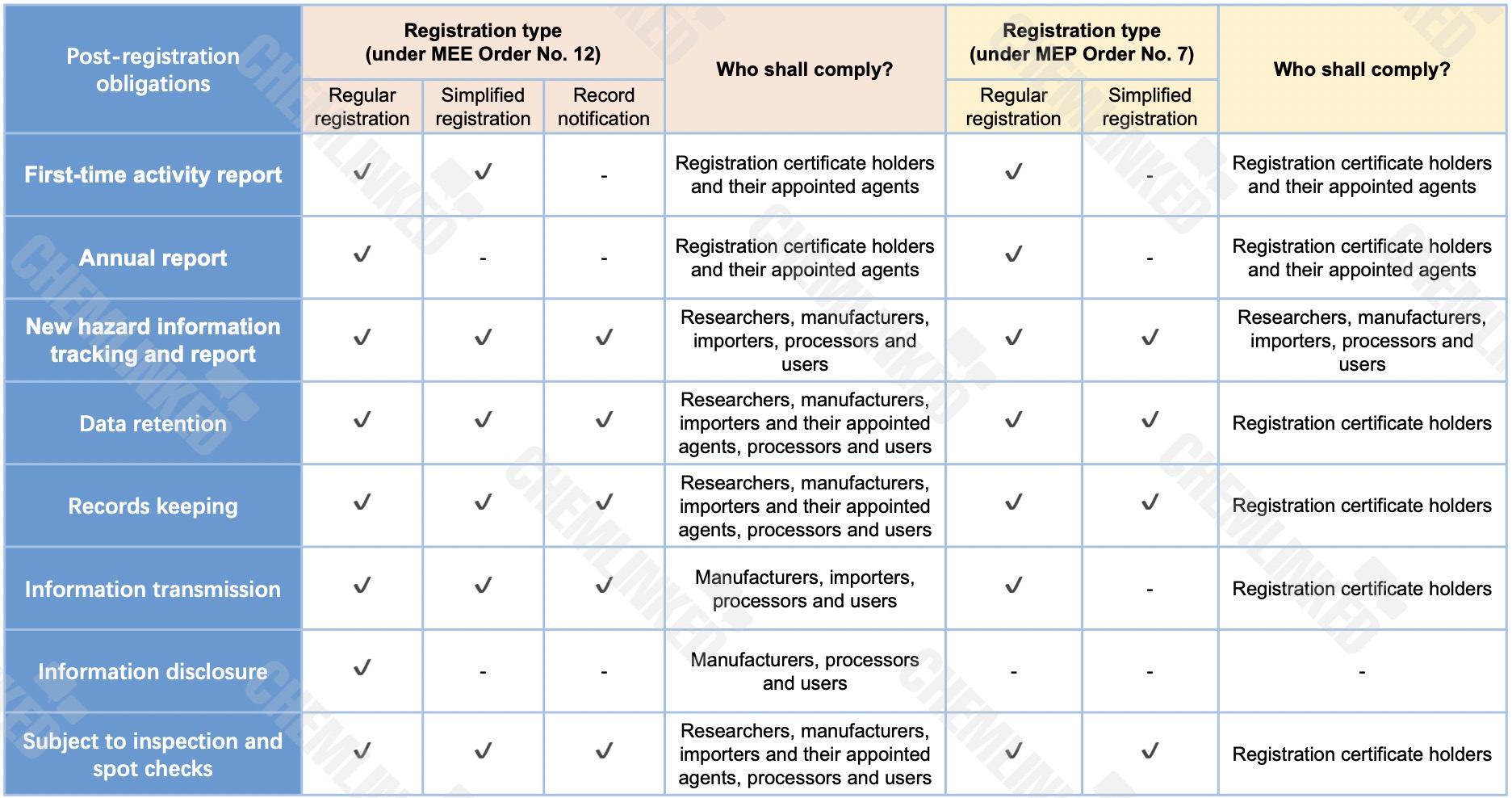 Table 1
Below are the insights into each type of post-registration obligations.
Activity Reporting
Activity reporting is one of the major post-registration obligations under MEE Order No. 12, including first-time activity report, annual report, and new hazard information report. Table 2 illustrates who shall submit these reports, reporting requirements, submission deadline, etc.
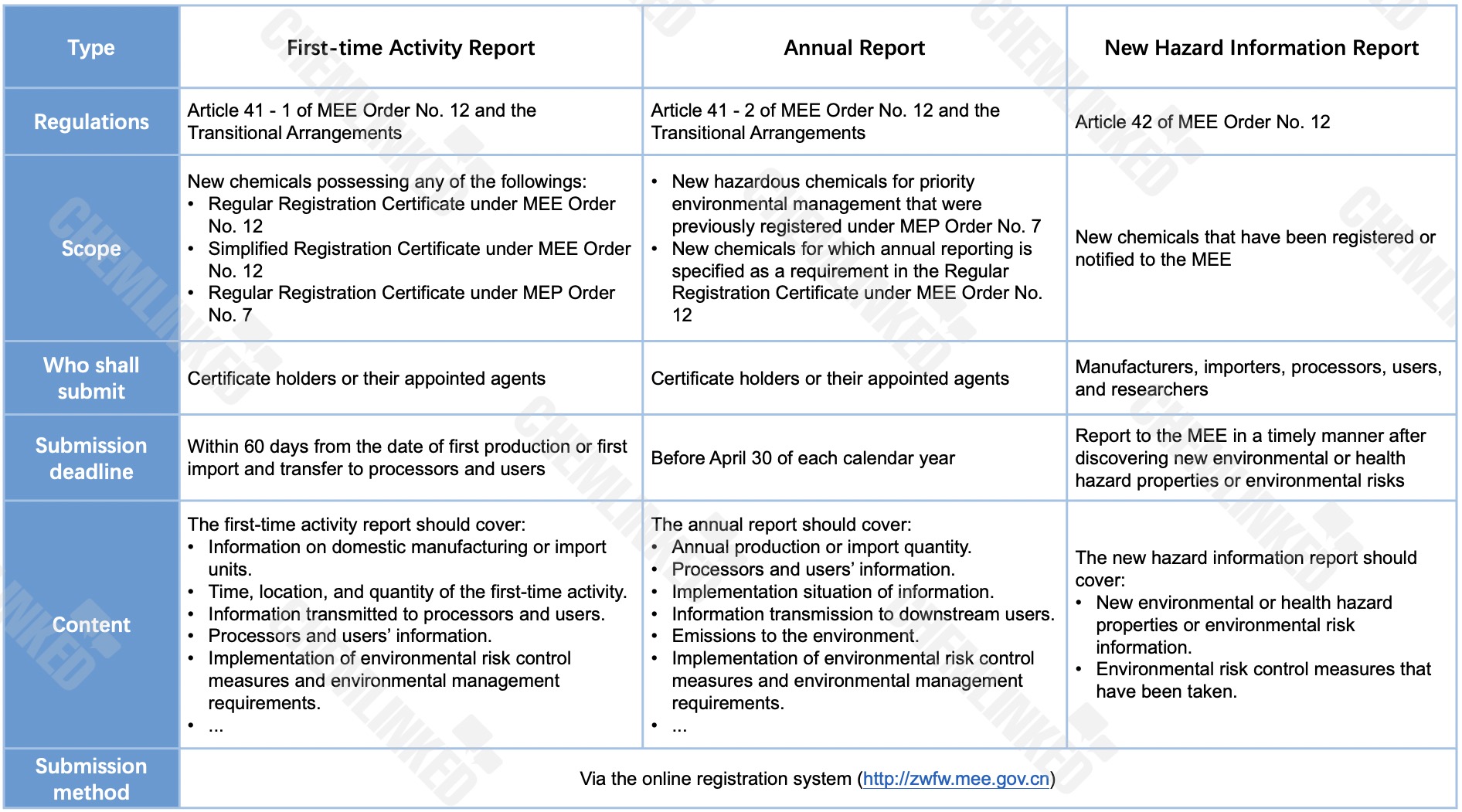 Table 2
Activity reporting targets new chemicals that have been registered or notified to the authority. Before preparing activity reports, it’s essential to check against the Inventory of Existing Chemical Substances in China (IECSC) to confirm whether it’s still considered a new chemical. Because IECSC serves as the basis to judge whether a substance is identified as a new chemical substance subject to registration requirements.
Information Transmission
After new chemical registration is completed, the manufacturers, importers, processors, and users shall transmit the following information to downstream users:
The new chemical registration certificate number or the record notification receipt number.
Registered uses of the new chemical.
Environmental and health hazard properties of the new chemical, and the corresponding environmental risk control measures.
Environmental management requirements specified on the new chemical registration certificate.
Information transmission may be carried out in the electronic or written form.Enterprises can display the abovementioned information on the SDS and deliver it to the downstream users, or they can prepare an information transmission notice to indicate such information and transmit it accompanied by the transfer of the new chemical substance (downstream users shall send back the receipt). However, regardless of the information transmission method, the relevant transmission records shall be properly archived for future reference. In addition, any changes to the abovementioned information should be transmitted to the downstream users in a timely manner.
Records Keeping & Data Retention
MEE Order No. 12 requires researchers, manufacturers, importers, processors and users of new chemicals to establish a record system for new chemical activities, and truthfully record the activity time, quantity, actual uses, and implementation of risk control measures and requirements. The activities of different new chemicals shall be recorded respectively. As required, the corresponding records and materials shall be kept for certain years. Table 3 sorts out what should be kept and the retention periods.
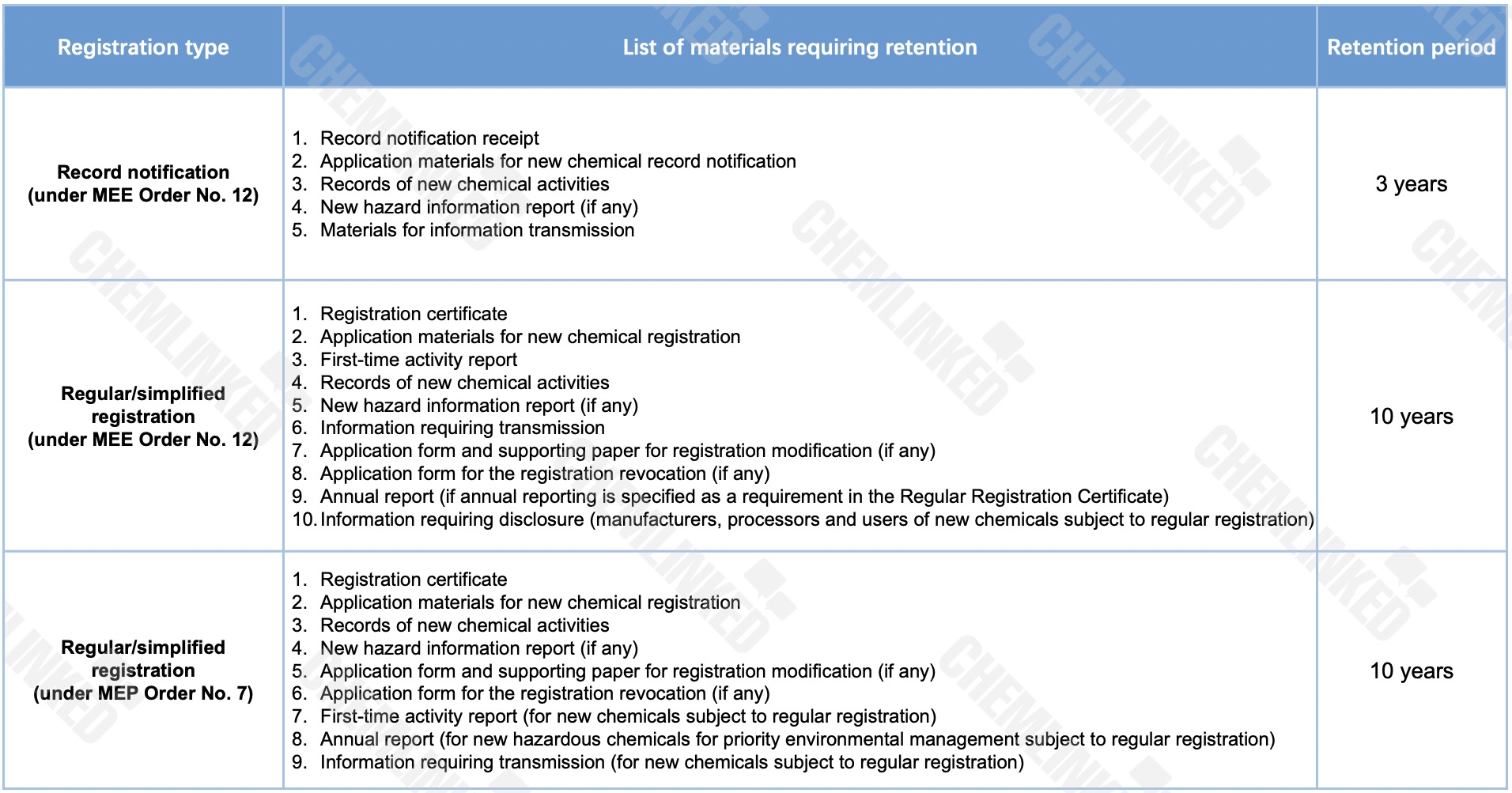 Table 3
Information Disclosure
Manufacturers, processors, and users of new chemical substances subject to regular registration under MEE Order No. 12, after submitting the first-time activity, shall disclose the implementation details of the environmental risk control measures on their official websites or via other means that are convenient for the public to know, and update them on time. The methods and content of the disclosure must be properly archived for future reference.
Supervision and Spot Checks
The authorities will conduct supervision and spot checks, focusing on:
whether the stakeholders have completed the new chemical registration as required;
whether the information on the registration certificate is consistent with the truth; and
whether the specified risk control measures and requirements are implemented.
Researchers, producers, importers, processors, and users of new chemical substances shall provide relevant materials truthfully. Punishments will apply if there’s any violation.