Request a Demo
Since Measures on the Environmental Management of New Chemical Substances in China (hereinafter ‘China REACH’) was enacted in 2010 and is currently being enforced, the manufacturers and importers of new substances are obliged to submit notifications. Notification of new chemical substances can be classified into regular notification, simplified notification and scientific research record notification(SRRN).
For the regular notification of new substance under China REACH, in accordance with the national standards on hazardous property determination and classification, the dossier (risk assessment report) preparer shall determine the hazard category or justify why no classification is given for a hazard class. The reasons for “no classification” can be chosen among “classification is not possible”, “not applicable” or “not classified”. Similarly, the objective of CLP Regulation is to determine which properties of substances/mixtures would lead to its classification as hazardous, and as for non-hazardous substances/mixtures, the reasons why no classification is given for a hazard class should also be provided. The reasons can be listed as “data lacking”, “inconclusive”, or “conclusive although insufficient for classification” under CLP.
Under China REACH,
- “Classification is not possible” should be selected if no data or no adequate data for classification is available, e.g. the hazard classification of flammable liquids is based on the value of boiling point and flash point. However, the missing of either data will lead to no classification. There is another situation in which all the testing method is not applicable to the notified substance;
“Not applicable” should be selected if the hazard of a substance is not applicable to standard classification procedures for some reasons, e.g. the solid or liquid does not meet the applicable scope of the hazard classification of flammable gases. Besides, the lack of explosive or oxidizing group can conclude no classification of corresponding hazard;
- “Not classified” should be selected if there is sufficiently reliable information available to prove that a substance is not hazardous or of low hazard (referring to the hazard data being under the threshold of the lowest hazard classification criteria), e.g. for the substance with flash point above 93 °C, the conclusion of hazard classification of flammable liquid should be “not classified” according to the classification criteria, which is not higher than 93 °C.
“Data lacking” should be selected if you do not have relevant data or other adequate and reliable information which can be compared with the classification criteria;
- “Inconclusive” should be selected if you have data or other information but they are not reliable (e.g. data of poor quality) or if you have several equivocal study results or information. The available data/information cannot be regarded as a firm basis for classification;
- “Conclusive although insufficient for classification” should be selected in cases where a substance is tested with the appropriate high-quality study or where other reliable information is available, and based on that, it is concluded that the classification criteria are not fulfilled.
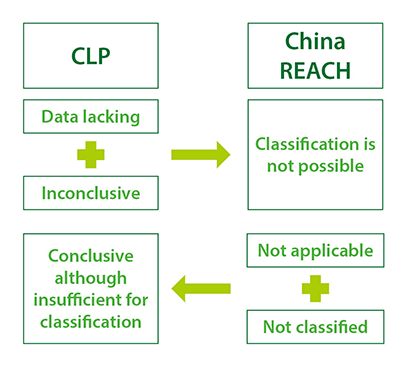
The following examples illustrate the differences of the reasons for no classification under China REACH from those under CLP Regulation. Under China REACH, the reason why no hazard classification of flammable gases is given for should be “not applicable” and the reason for no classification based on the sufficiently testing data should be “not classified”, while under CLP Regulation, in these two situations, “conclusive although insufficient for classification” should be selected. Meanwhile, the reason “Classification is not possible” under China Reach covers the applicable scope of both “Data lacking” and “Inconclusive” under CLP Regulation.