Request a Demo
For the general case of simplified notification, excepting Melting Point, Water Solubility and n-Octanol/Water Partition Coefficient tests, there are at most 3 eco-toxicological tests needed: ready biodegradability, acute aquatic organism toxicity and acute terrestrial organism toxicity. Compared with regular notification, the time investment required for simplified notification is greatly reduced. However, despite reduced requirements there are nonetheless a variety of potential problems which can delay notification.
1. Data waving
Data waiving should be determined using the following procedure.
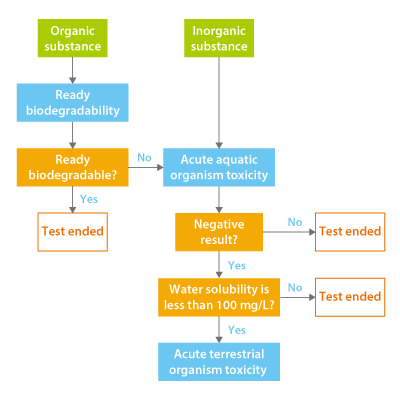
Fig 1. Data Waving Procedure for Eco-toxicological Tests under Simplified Notification (General Case)
It is a mandatory regulatory requirement that the eco-toxicological tests listed in the figure above (ready biodegradability, acute aquatic organism toxicity, acute terrestrial organism toxicity) are conducted in governmentally accredited Chinese test institutions using indigenous Chinese test organisms. Currently there are only 10 qualified testing institutions sanctioned by the Ministry of Environmental Protection. Demand for testing vastly outweighs the culminative capacities of these testing institutes and as a consequence there is unavoidable waiting period averaging three months for the completion of a single test. If complement of tests is required, a time duration of 9 months may be necessary (if conducted one after another) before issuance of final reports. The total cost for these three tests is approximately 17,000 USD. The testing cost could be miniscule in comparison to the business opportunity costs consumed with extended waiting of tests completion and issuance of the testing report. Therefore,unless the tests can be waived through data gap analysis from the outset, it is advisable to begin all the three tests at the same time.
2. Customs clearance
For foreign companies that have designated a specific testing institute to conduct their tests and have signed the testing contract, they need to send test samples. Samples shouldn’t be sent directly to test institutions, since testing institutes lack “Import and Export Rights” and cannot help with customs clearance. Physicochemical changes to the substance (degradation, oxidization, etc.) could arise due to inappropriate storage at port if substances are held awaiting customs clearance. It is advisable to deliver the sample to a Chinese subsidiary or failing that to nominate a reliable intermediary to interact with customs.
3. Sample info.
Test institutions use different templates for their clients to document the test sample attributes. This also serves as the primary reference for safe handling during the test project. However the fundamental information required is standardized and should include the information including sample name, CAS number, structure, appearance, purity, expiry date and Lot number. Regarding sample purity, if the sample is a UVCB (Substance of Unknown or Variable composition, Complex reaction products or Biological materials), the proportion of known impurities should be listed, or else it will be treated as a 100% pure substance. If the sample is a mixture, a list detailing the relative proportions of each substance should be provided. A COA (certificate of analysis) will be required to substantiate these claims.
4. Physico/chemical endpoints
For simplified notification, Melting Point, Water Solubility and n-Octanol/Water Partition Coefficient data are required, which, however, does not necessitate a testing report. Testing results for these three endpoints can be obtained from any laboratories even though an estimated value could also be acceptable. However, for Water Solubility, estimated values can sometimes differ dramatically from actual test results provided through the aquatic toxicity study. To illustrate we can consider a case study where water solubility is estimated as 2g/L. In this instance the terrestrial toxicity test can be waived. However, after a preliminary aquatic toxicity test, it was found that once added into water, test substances became floccules rendering them extremely insoluble. In that case, a formal test for water solubility might be required.
With these problems solved, the testing period for simplified notification can be usually reduced below 4 months. The whole project, from the initiation of preparatory work to the final certification, can ideally be completed within 6 months. In conclusion, simplified notification can be expedited by adhering to the key principles mentioned during this article relating to data waving, customs clearance, sample delivery and testing requirements.