

 Request a Demo
In Taiwan chemicals are regulated under both the TCSCA and OSHA, both of which have been fully implemented. Although many of the previous ambiguities have been cleared up there are still some meaningful questions to be answered which are worthy of further discussion. CBI (Confidential Business Information) is an issue of the major concern and has been one of the most frequently asked questions by overseas exporters.
To protect the public’s ‘right-to-know’, necessary information should be open to the public. Freedom of information laws and consumer rights measures means that requirements on publication of information is generally an accepted practice used in many countries including the US, Europe, Korea and mainland China. Similarly, as regulated under Taiwan TCSCA/OSHA, certain chemical substance information granted must be made public.
However offsetting this need for openness is the chemical and related industry’s need to protect their investments and ensure their competitiveness in the open markets. Chemical substance information pertaining to production processes and full molecular profiling in regards to chemical structure, conformation etc. has always been the most important intellectual property of chemical companies and is regarded as the core strengths of many R&D orientated companies. If this information is made public it provides and obvious disincentive for R&D and innovation within the industry and rewards ‘me-too” and generic production orientated companies. The substitution of hazardous chemicals and other chemicals of high risk relies heavily on R&D activities and any need for public dissemination of proprietary knowledge must be carefully considered so as not to stifle innovation within the industry. In the following sections we will see how Taiwan finds a balance between protecting freedom of information while ensuring continued innovation within the industry.
What kinds of information should be made public in a general chemical registration case?
In a general case, the information disclosed is as follows:
Chemical substance name
Manufacture or import conditions
Hazard classification and labeling
Safe use information
Physical and chemical properties
Toxicological and eco-toxicological information
Hazard assessment
Exposure assessment.
The content above that shall be made public through the Internet.
What kind of information can be claimed as confidentiality?
For those information determined to be business secret, the following chemical information registered shall be protected and kept secret.
Identification of chemical substance
Information on manufacture or import
Use of chemical substance
What kinds of conditions should be met if we determine to claim for the confidentiality?
The aforementioned three business secret shall conform with the following conditions. If the data applying for protection fails to meet the following three criteria, the authority reserves the right to reject the application.
The information is proprietary and not widely known
The substance has economic value ( actual or potential) that would be diminished by public release of information
Its owner has taken reasonable measures to maintain its secrecy.
How to prove that a CBI application meets eligibility conditions?
The registrant applying for data protection needs to complete a form of basic information firstly; the basic information table is shown as follows:
Registrant Information | |||
Registrant Name |
| ||
Unified Business No. |
| Registered Factory Certificate No. |
|
Contact Person’s Name |
| Contact Person’s Phone Number |
|
Chemical Substance Information | |||
CAS No. |
| Other names |
|
Chemical name in Chinese |
| Chemical name in English |
|
Generic name in Chinese |
| Generic name in English |
|
Manufacture/Import Information | |||
Manufacture/Import | □Manufacture □Import □Manufacture and import □Others | ||
Tonnage/year | □ ≧1000(tons/ year) □ 100~1000(tons/ year), include 100 tons □ 10~100(tons/ year), include 10 tons □ 1~10(tons/ year), include 1 tons □ 100~1000(tons/ year), include 100 kg □<100(tons/ year) | ||
The registrant should also answer the following several questions:
| 1. Has the chemical substance received data protection in other countries? | □ | Y | □ | N |
| 2. Does it cause any effect on the registrant’s commercial interests to disclose the name and CAS No. of the chemical substance? | □ | Y | □ | N |
| 3. Is it possible to access the chemical substance information through the analysis of the production process of chemical substance product on the market? | □ | Y | □ | N |
| 4. Has the registrant taken action and will he/she continue to maintain the confidentiality of data? | □ | Y | □ | N |
| 5. Has the registrant taken any action to avert the disclosure of chemical substance data due to the release of its wastes? | □ | Y | □ | N |
| 6. Has the chemical substance been identified as hazardous to the environment or harmful to human health and creatures by the local or overseas government authorities? | □ | Y | □ | N |
| Has the chemical substance received data protection in other countries? Has the chemical substance been received as a new chemical substance or existing chemical substance in these countries? Please provide copy(s) of information with details and explain in this section. |
| Describe the substantial adverse effects to competitive advantages if the chemical substance name were made public or published in the inventory? In your answer, explain the relevance between the disclosure of substance name and any loss or damage to your commercial benefits, even there is no direction connection between chemical substance name and registrant in the inventory. Please explain |
| Describe any measures taken or undergone to avoid manufacture or import information outflow. Are your competitors aware of that the chemical substance is commercially available in Taiwan? Please explain. |
| Has the information claimed for data protection appeared or been referred to in any of the following: a. Professional or trade publications or any governmental agency publication; b. (Material) safety data sheets (MSDS/SDS) or other similar documents (such as technical data sheets) for the substance; or c. Any other media or publications available to the public or to your competitors. Please explain. |
| Describe your purpose(s) of manufacturing or importing this chemical substance in Taiwan? Please explain. |
| Has the chemical substance been patented in Taiwan? If so, has the patent been transferred to other company? Has the chemical name been disclosed in the process of applying for patent? Please explain. |
| Describe what measure has been taken in your company /unit for data protection. If anyone outside your company/unit (supply chain) has access to any of the claimed confidential business information. Is this information restricted by any confidentiality agreement(s) with your business partner(s) or in the supply chain(s). If so, please explain. |
When the registrant completes the preparation of the above information and materials, he/she should have the above materials signed and submitted to the central authority accompanied with the registration dossier for final check. If the information provided is not sufficient, the authority will ask the registrant to provide further information.
What application procedures should overseas company follow to protect proprietary information and CBI?
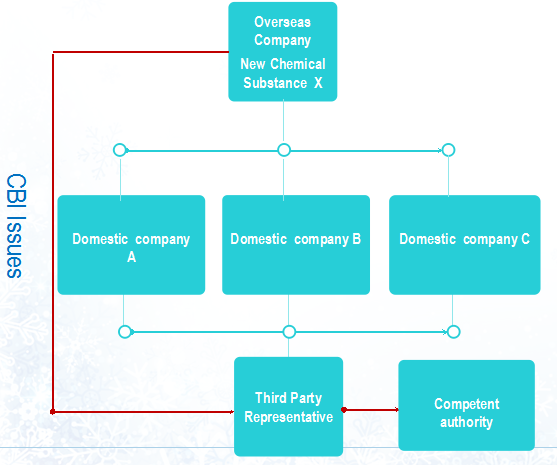
Suppose an overseas company want to export a new chemical substance X to three domestic downstream users A, B and C respectively.
The overseas company does not wish to disclose any information about the new substance to any of the downstream users, so the overseas company can chose to appoint a third party representative and forward the relevant registration materials to them. The TPR will prepare the registration materials for the downstream users. In this circumstance, the three importers will not get any confidential information from the dossier materials.
Meanwhile, the TPR will apply for CBI with the help of support from the overseas company A, in this way, the importers will not get any confidential information from public information sources.
In the end, it is worth mentioning that a reliable and professional TPR is very important to ensure CBI protection. If you have got any questions regarding the CBI protection, feel free to contact REACH24H Consulting Group.




