Request a Demo
China’s new chemical substance notification system (China NCSN, a.k.a China REACH), has some of the most stringent chemical regulatory requirements in the globe especially in its requirements of eco-toxicity test data. Both Chinese domestic testing institutes and overseas testing institutes can produce data for China NCSN with some qualification conditions. However, some of the eco-toxicity tests are mandatorily required to be conducted on Chinese test organisms in accredited MEP-approved Chinese laboratories (so far 13 in total).
1. Applicable Notification Types
There are three types of notification under NCSN, depending on the purpose of manufacturing/export/import and the quantities, namely Scientific Research Record Notification, Simplified Notification and General Notification. For Simplified Notification, it is divided as General Case and Special Case. Only Notifiers of General Case of Simplified Notification and Regular Notification are required to submit the domestically generated ecotoxicological testing data in their dossier.
1.1 General Case of Simplified Notification:
In this case, if the new chemical substance is organic, biodegradability testing of the substance is required. If the substance is not readily biodegradable, an acute aquatic organism toxicity test (fish preferred) is required.
If the substance is an inorganic substance, an acute aquatic organism toxicity test (fish preferred) is required.
If the solubility of a new chemical substance in water is less than 100mg/L, and the substance is toxic to aquatic organisms under saturated conditions, the LC50 and LE50 values are required. If the substance is not toxic to aquatic organisms under saturated conditions, an acute terrestrial organism toxicity test report (earthworm preferred) is required.
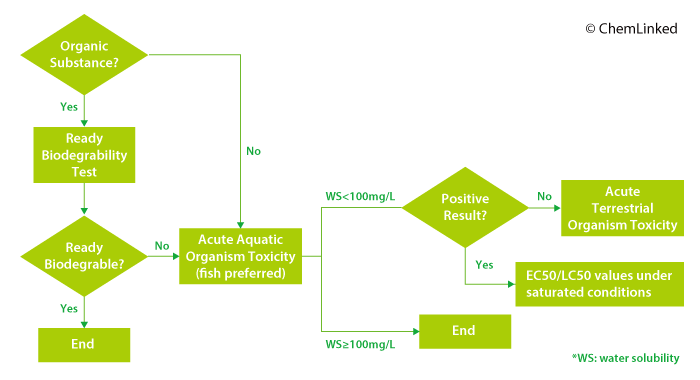
1.2 Regular Notification
For regular notification, four tonnage bands apply. More testing data required as the tonnage band increase. For detailed ecotoxicological testing data requirements, please see Table 1 below or refer to China NCSN Chempedia.
Table 1. Eco-toxicological testing data (based on the specific tonnage band):
Minimum data requirements |
Band 1 1-10 t/y |
Band 2 1-10 t/y |
Band 3 1-10 t/y |
Band 4 1000+ t/y |
| Algae growth inhibition study | X | X | X | X |
| Acute toxicity testing on Daphnia magna | X | X | X | X |
| Fish, Acute toxicity testing | X | X | X | X |
| Activated sludge respiration inhibition testing | X | X | X | X |
| Adsorption/desorption | X | X | X | X |
| Degradation | X | X | X | X |
| Earthworm, Acute toxicity testing | X | X | X | X |
| Fish, Prolonged toxicity testing (14-day study) | X | |||
| Daphnia magna reproductive testing | X | X | X | |
| Bioaccumulation | X | X | X | |
| Fish, Chronic toxicity testing | X | X | ||
| Seed Germination & Root Elongation Toxicity Test | X | X | ||
| Note: 'Q' standards for the notified quantities. | ||||
The special data requirement for ecotoxicological data required to be generated in China involves aquatic organism toxicity data, bio-degradation data and terrestrial organism toxicity data.
For aquatic organism toxicity data, Band 1 Regular Notification requires at least one aquatic organism toxicity test (fish preferred) conducted on Chinese test organisms in accredited MEP-approved Chinese laboratories. From Band 2 upwards, for each tonnage band increase, at least one additional aquatic organism toxicity test from the increased tonnage band data requirements should be picked out and conducted in China. By this logic, the minimum number of aquatic organism toxicity data required to be generated in China is, one test for Band 1, two tests for Band 2, three tests for Band 3 and four tests for Band 4. However, considering that for Band 3 and 4, the corresponding minimum ecotoxicological data requirements are the same (see table 1 above), which means there is no “increased tonnage band data requirements” for Band 4.
So far, only one new chemical substance has been registered under Band 4 of Regular Notification. Most enterprise never encounters Band 4 regular notification issues. According to the China NCSN FAQ newly updated by the Solid Waste and Chemicals Management Center under the Ministry of Environment (SCC-MEP, formerly the CRC-MEP) on 9 Mar 2015, the authority clarified that Band 4 notifications require submission of at least four aquatic organism toxicity tests carried out in China. In addition to the three tests required for Band 3 regular notification, the other test can be picked out from the minimum ecotoxicological data requirements for Band 1, 2 and 3 Regular Notification. In addition, it is clarified that the increased data requirements for tonnage band from Band 2 upwards include bioaccumulation data, which means the bioaccumulation testing is also accepted as aquatic organism toxicity testing in China.
According to the updated requirements, the eco-toxicity tests need to be conducted on Chinese test organisms in accredited MEP-approved Chinese laboratories are summarized as below:
Ecotoxicological testing to be performed within the territory of China | Band 1 | Band 2 | Band 3 | Band 4 |
Bio-degradation data | Ready bio-degradability test data is preferred. If this data is already available overseas, either the ready bio-degradability test data or inherent bio-degradability test data is acceptable. If the ready bio-degradability test has already been performed overseas and the results demonstrate the substance is not readily bio-degradable, the inherent bio-degrability test data should be used. | |||
aquatic organism toxicity data | Algae growth inhibition study, acute toxicity testing on daphnia magna, fish acute toxicity testing (one from the three tests, fish preferred) | Algae growth inhibition study, acute toxicity testing on daphnia magna, fish acute toxicity testing (one from the three tests, fish preferred) + Fish prolonged toxicity testing (14-day study), daphnia magna reproductive testing, bioaccumulation (one from the three tests) | Algae growth inhibition study, acute toxicity testing on daphnia magna, fish acute toxicity testing (one from the three tests, fish preferred) + Daphnia magna reproductive testing, bioaccumulation (one from the two tests) + Fish chronic toxicity testing | Plan A: Algae growth inhibition study, acute toxicity testing on daphnia magna, fish acute toxicity testing (two from the three tests, fish preferred) + Daphnia magna reproductive testing, bioaccumulation (one from the two tests) + Fish chronic toxicity testing |
Plan B: Algae growth inhibition study, acute toxicity testing on daphnia magna, fish acute toxicity testing (one from the three tests, fish preferred) + Fish prolonged toxicity testing (14-day study), daphnia magna reproductive testing, bioaccumulation (two from the three tests) + Fish chronic toxicity testing | ||||
Terrestrial organism toxicity data | For insoluble compounds, if aquatic toxicity test(s) has/have already been performed overseas in accordance with the notified tonnage band, terrestrial organism toxicity data generated within the territory of China can be submitted instead. | |||
The data requirements of aquatic organism toxicity and bio-degradation have been specified in the table above in detail. The requirements for terrestrial organism toxicity testing are comparatively more complicated.
In practice the acute earthworm toxicity testing is a minimum ecotoxicological data requirement for Band 1 and 2 Regular Notification only when the solubility of the new chemical in water is
For short-term toxicity, the earthworm acute toxicity testing data obtained in China MEP accredited labs can be submitted in the notification dossier in cases where aquatic toxicity testing data has already been obtained overseas. However, for long-term toxicity, it is not clarified which terrestrial organism toxicity is adequate to fulfill regulatory requirements.
2. Summary
Data gap analysis for ecotoxicological testing data is crucial to potential notifiers since some data should be generated in China MEP accredited labs. For the General Case of Simplified Notification, the data requirements are clear, as well as the exemptions and procedures for data waving. For the Regular Notification, any combination of ecotoxicological data for 4 tonnage bands is Ok as specified in the table above.
In consideration of the increasing costs charged by MEP-approved ecotoxicological testing institutes for generation of ecotoxicological testing data acceptable for China NCSN dossier, potential notifiers should make rational notification strategy. Some ecotoxicological testing data available from overseas accredited labs may be used in China in order to comply with China NCSN while other tests will have to be performed locally.
Compared with the ecotoxicological testing fee charged by international OECD testing institutions, the quotations of Chinese domestic testing institutions are still comparatively low. However, China is not an OECD member country and the ecotoxicological testing data produced by MEP-approved testing institutions will not be accepted for chemical regulations in other countries, i.e. EU REACH, USA TSCA, etc. For K-REACH, the Korean authority has yet to decide to accept test data generated from non-OECD member countries, even if test institute is GLP certified. However, Taiwan TCSCA seems have a relatively open policy towards data acceptance. The data generated by the MEP-approved testing institutions (so far 13) for testing items within a scope officially approved by the MEP for China NCSN is also acceptable for Taiwan TCSCA. From the perspective of mutliframework global regulatory compliance, the cross compatibility of data should also be considered when developing a notification strategy.