Request a Demo
Polymer registration is always of crucial concern for the chemical industry. They are generally regarded as representing a low safety concern and can benefit from exemption or reduced registration requirements under some circumstances. New polymers are assigned special provisions in the Measures for the Environmental Management Registration of New Chemical Substances (MEE Order No.12) which is set to take effect on January 1st next year and its draft Guidance on Environmental Management Registration of New Chemical Substances (hereafter referred to as the draft Guidance). This article provides details concerning special rules and related requirements for polymers to help enterprises better cope with the polymer registration under MEE Order No.12.
Special Rules on Record Filing of Polymers
Record filing is required for polymers containing less than 2% monomers or reactants which are new chemical substances (“2% Rule”), or polymers of low concern (PLC), regardless of their annual volumes (It should be noted that, simplified notification is required for such polymers under MEP Order No. 7, to be replaced by MEE Order No.12 from next year.).
To better address these differences, ChemLinked has compared the Guidance of MEP Order No.7 (hereafter referred to as the current Guidance) with the draft Guidance in this aspect, and the details are shown in the table below.
Current Guidance of MEP Order No.7 | Draft Guidance of MEE Order No.12 | |
Definition | 3 criteria, see Chapter 5 of the Guidance | The same |
Naming Rules | 1)Naming based on the exact Molecular Structure; 2)2% Naming rule | The same |
Polymer meeting 2% Rule | 1) The polymer itself is not included in the IECSC, but all monomers/reactants (w/w) which are new chemical substances are with a content less than or equal to 2% in the polymer; 2) The polymer itself is not included in the IECSC, but all monomers/reactants of the polymer are included in the IECSC | The same |
PLC | 1) The polymer’s average molecular weight is between 1,000 and 10,000 daltons. The content of oligomers in the polymer with molecular weight<500 daltons is less than 10% (w/w) and the content of oligomers with molecular weight <1000 daltons is less than 25% (w/w). At same time, the polymers must not contain functional groups of high concern or high reactivity, such as heavy metals, cyano, acrylate, aziridine, isocyanate, thio-isocyanate, vinyl sulfone, etc. | 1) The polymer’s number-average molecular weight (Mn) is between 1,000 and 10,000 daltons. The content of oligomers in the polymer with molecular weight <500 daltons is less than 10% (w/w) and the content of oligomers with molecular weight <1000 daltons is less than 25% (w/w). At same time, the polymers must not contain functional groups of high concern or high reactivity, such as heavy metals, cyano, acrylate, aziridine, isocyanate, thio-isocyanate, vinyl sulfone, alkoxy silane (methyl or ethyl), amine, helicene amine, halogenosilane, hydrazine, α/β-lactone, methacrylic acid (ester) groups, etc. |
2) The polymer’s average molecular weight is ≥10,000 dalton. The content of oligomers in the polymer with molecular weight<500 daltons are less than 2% (w/w) and the content of oligomers with molecular weight of <1,000 daltons are less than 5% (w/w). | 2) The polymer’s number-average molecular weight (Mn) is ≥10,000 dalton. The content of oligomers in the polymer with molecular weight<500 daltons are less than 2% (w/w) and the content of oligomers with molecular weight of <1,000 daltons are less than 5% (w/w). | |
3) The polymer is a polyester polymers that contains at least two carboxylic ester bonds and at least one of which is joined to a core monomer. | 3) The polymer is a polyester polymers, whose main chain is the monomers bonded by ester bonds or whose main chain exhibits the characteristics of ester bonds. |
*The differences are highlighted in bold.
In addition to the criteria for determining PLC, there is no revision made in the draft Guidance in regards of the definition, naming rules and the criteria of 2% rule of polymers.
As illustrated in the table, the potential changes on PLC criteria involves three aspects:
(1) Modify the average molecular weight to the number average molecular weight (Mn), that is, the Mn shall prevail in the determination of the polymer molecular weight in the future;
(2) Add more functional groups of high concern or high reactivity;
(3) Modify the definition of polyester polymers.
Regarding point (1), it actually fills in the loopholes left open by the undefined criteria for the determination of the molecular weight of PLC in the current Guidance. There are several ways to quantify the molecular weight of polymers, such as number average molecular weight (Mn), weight average molecular weight (Mw), Z average molecular weight (Mz), and viscosity average molecular weight (Mη). The value differs greatly in these types of molecular weight average, and some are even different in magnitude. In current practice, the enterprises prefer to take advantage of the loophole by choosing an average of the molecular weight which is conducive for defining the polymer as a PLC. However, the loophole will be sealed by the upcoming new MEE Order 12 Guidance, which is consistent with the determination standard of other countries or regions in the world.
Regarding point (2), the draft Guidance has added more high-concern reactive functional groups, some of which are controversial in the industry. These functional groups are mainly derived from the section 4.4.1 of the Polymer Exemption Guidance Manual under the U.S. TSCA. However, the criteria for PLC under the TSCA also includes that for polymers containing medium-concern or high-concern reactive functional groups listed by regulations, it is necessary to further calculate the functional group equivalent weight (FGEW) based on the structure of the polymer.
For example, if the polymer includes high-concern reactive functional groups as stipulated in the Polymer Exemption Guidance Manual, its FGEW must be at least 5,000 g/mol to meet the PLC criteria for high-concern reactive functional groups. However, such supporting rules haven’t been adopted in the draft Guidance. Many enterprises have questioned China’s “one size fits all” approach and recommended the MEE to modify the criteria or delete the functional groups which are of relatively low hazards.
Regarding point (3), according to the current Guidance the polyester compounds include not only polymers covalently linked by ester bonds on the main chain, but also graft polymers in which only side chains are covalently linked by ester bonds. The latter, strictly speaking, does not have the low-hazard characteristics of polyester polymers, and should not be equated with polyester polymers of low-hazards. Therefore, the draft Guidance amended the definition of polyester polymers to rationalize the scope of polyester polymers. It is also worth noting that for polyester polymers, other countries or regions will impose certain restrictions on the monomers/reactants of the polymerization reaction. For example, the United States, Australia, and Taiwan all stipulate that polyester polymers must be made from the prescribed monomer/reactants. However, there are restrictions or regulations on monomers/reactants for polyester polymers in neither the current Guidance nor the draft Guidance. A polymer can be regarded as a PLC as long as it meets the definition of polyester polymers, which is a loosening of PLC criteria.
Exclusions for Record Filing of Polymers
In addition to the above mentioned special rules, the exclusions for record filing should be taken into concern. If a polymer that meets the 2% Rule or a PLC meets any of the following criteria and the polymer exceeds 1 ton/a, it is not eligible for record filing and can only apply for simplified or regular registration. Below are the 5 types of exclusions stipulated in the draft Guidance for record filing.
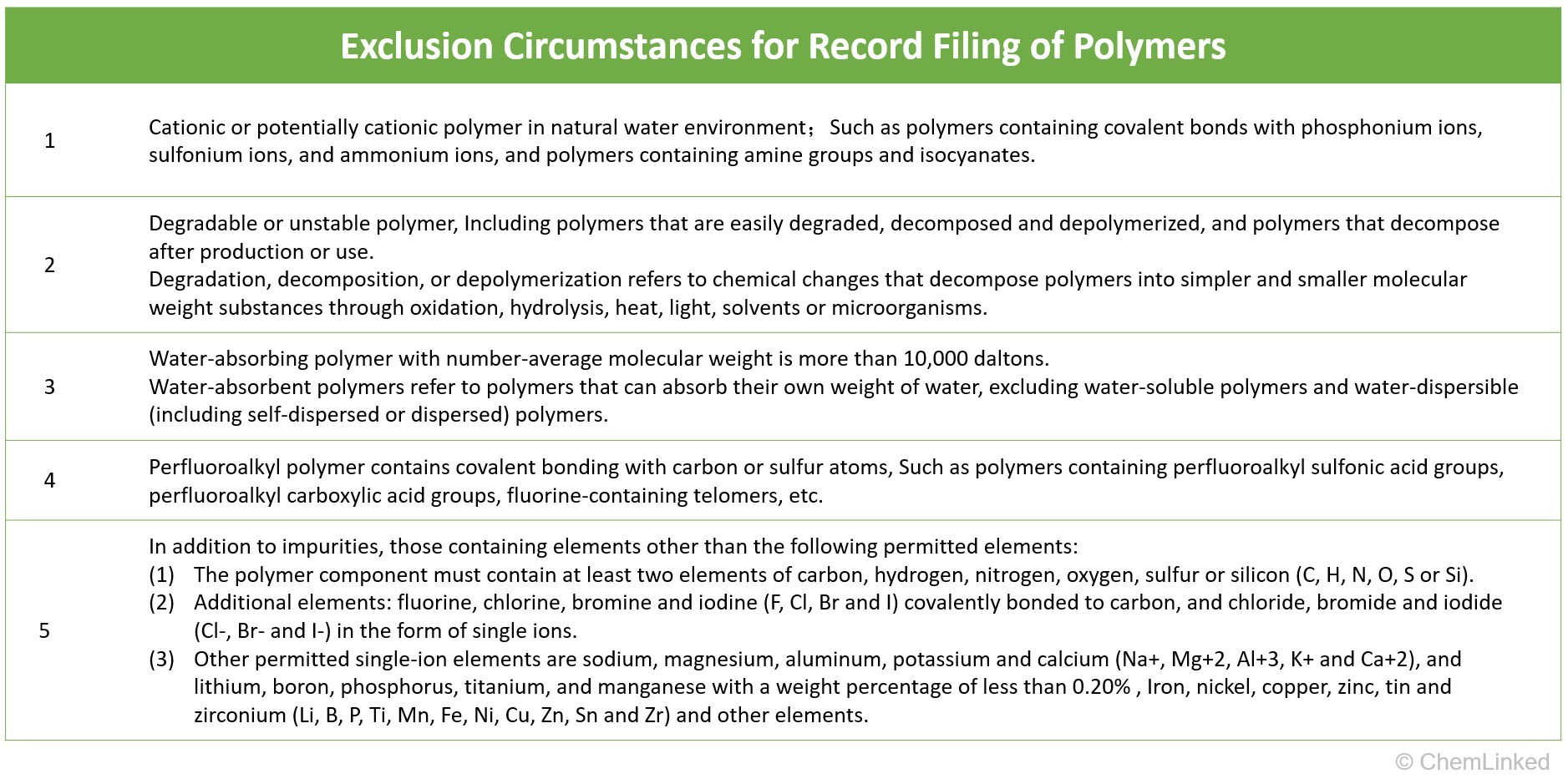
The above exclusions for record filing are also derived from the Polymer Exemption Guidance Manual under the U.S. TSCA. Regarding the cationic or potentially cationic polymers, there are actually two types that are not excluded from the exemption under TSCA, including:
Cationic or potentially cationic polymers that are solids, are neither water soluble nor dispersible in water, are only to be used in the solid phase, or
Cationic or potentially cationic polymers with low cationic density.
However, the draft Guidance didn’t adopt the above two types. It’s uncertain if the relevant content will be updated after consulting the industry.
For the second point in the table, degradable or unstable polymers means polymers that are easily to degrade, decompose, or depolymerize, including those polymers that could substantially decompose after manufacture and use, and they will eventually breaks down into simpler, smaller weight substances. Therefore, for some polymers that are prone to cross-linking or other reactions to produce higher weight substances, ChemLinked doesn’t think they are unstable polymers as specified in the guidance.
Regarding the water-absorbing polymers, many enterprises wondered why water-absorbing polymers with Mn≥10,000 should be excluded from the record filing. In fact, the United States did some in vivo animal experiments on this type of polymer in 1995 (TSCA 8(e)-1795), and data shows that cancer was observed in a two-year inhalation study in rats on a high molecular weight water-absorbing polyacrylate polymer. Therefore, expert judgment is required case by case for such polymers rather than a direct record filing or exemptions.
As for the exclusions for elemental criteria, it should be noted that for polymers that meet the record filing conditions, fluorine (F) can only exist in the form of covalent bonds, and the fluoride ions (F-) is not permitted. Allowed at less than 0.2% weight percent total (in any combination) are the atomic elements lithium, boron, phosphorous, titanium, manganese, iron, nickel, copper, zinc, tin and zirconium (Li, B, P, Ti, Mn, Fe, Ni, Cu, Zn, Sn and Zr).
Materials Required for Record Filing of Polymers
The application materials for record filing shall include the application form, legal person certificate or business license, representation contract or agreement, authorization letter, etc., list of monomers/reactants, plot of molecular weight distribution, mechanism of polymerization, materials illustrating that the polymer in question does not fall under the five exclusion circumstances (illustrated one by one in the form of an attachment), explanatory materials for necessity of information protection, and other information already obtained by the applicant on the environmental and health hazard properties and environmental risks of the polymer.
In summary, the draft Guidance has introduced more detailed and rational requirements for the record filing of polymers. Notably, there is no approval for record notification and the applicants can start relevant activities immediately after submitting application materials. Although the time cost is reduced, the MEE will pay intensified attention to follow-up management in this regard. Checking the compliance of record notifications of polymers, especially whether such record filing applications are justified will be a key focus. The enterprises should be responsible for the authenticity and rationality of the submitted materials. It is worth mentioning that the requirements for information confidentiality applications will be more complicated under MEE Order No.12. Therefore, the enterprises should make a comprehensive judgment on whether to hurry up to apply for a simplified notification (special case) in the remaining three months according to MEP Order No.7 or wait till next year to fulfil a record filing under MEE Order No.12.
Special Rules on Simplified Registration and Regular Registration of Polymers
For polymers that do not meet the record filing conditions, they are subject to simplified or regular registration. According to the draft Guidance, polymers can be exempted from submitting health toxicology, ecotoxicology data and the environmental risk assessment report when applying for simplified or regular registration if they meet all the following three conditions.
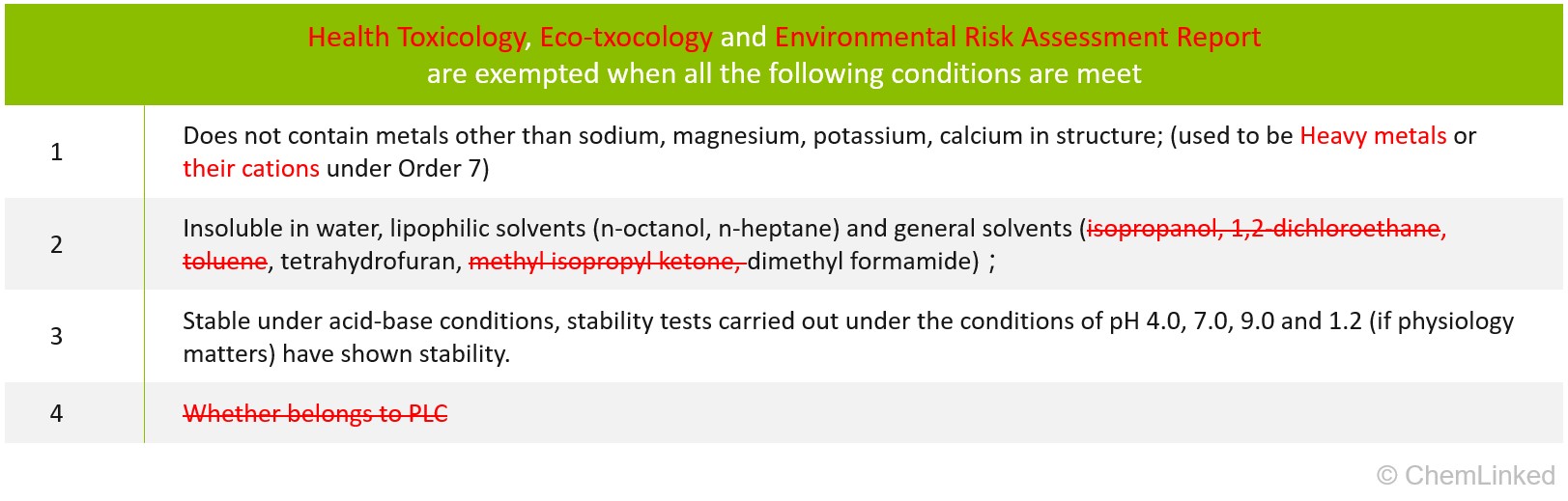
The amendments compared to the current Guidance in this regard are illustrated in red in the table.
Under the current Guidance, there is no need to submit an environmental risk assessment report for the regular notification of polymers and the health toxicology and ecotoxicology data can be exempted if all the conditions are met. However, for the draft Guidance, it is necessary to submit health toxicology, ecotoxicology data and environmental risk assessment report if the polymer fails to meet any of the conditions. In addition, the draft Guidance deleted the condition of “Whether belongs to PLC”, which expands the scope of applicable polymers.
For the materials required for simplified or regular registration of polymers, in addition to the following basic materials, the applicant shall also submit the identification information on the polymers, the monomer residues after polymerization reaction, the metals or theirs cations contained.
Document requirements | Simplified registration (1-10 t/a) | Regular registration (≥10t/a) |
Simplified registration application form | Regular registration application form | |
Legal person’s certificate or business license, agency contract or agreement, letter of attorney | Legal person’s certificate or business license, agency contract or agreement, letter of attorney | |
Test reports or materials | Test reports or materials | |
The conclusion and basis for deciding the persistence, bioaccumulation and toxicity of the substance | Environmental risk assessment report | |
Explanatory materials for necessity of information protection | Socioeconomic benefit analysis report (for highly hazardous new chemical substances) | |
Letter of commitment to implementing and passing on environmental risk control measures | Explanatory materials for necessity of information protection | |
Accreditation certification of testing institutes | Letter of commitment to implementing and passing on environmental risk control measures and environmental management requirements | |
Other information already obtained by the applicant on the environmental and health hazard properties and environmental risks of the substance | Accreditation certification of testing institutes | |
Other information already obtained by the applicant on the environmental and health hazard properties and environmental risks of the substance. |
*The differences are highlighted in bold.
Advice
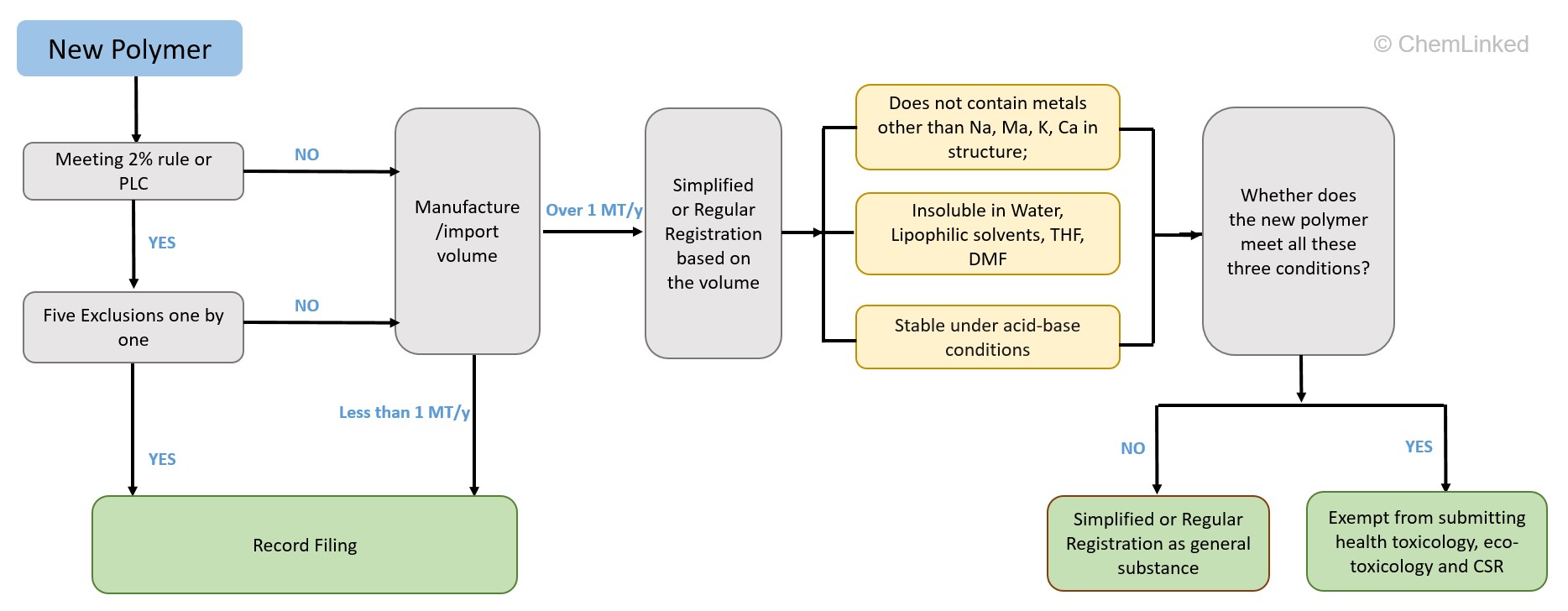
To aid in developing strategies and plans for polymer registration under MEE Order No.12. ChemLinked has summarized the flowchart for your reference. Enterprises are recommended to understand polymer information as much as possible before manufacture or import, determine if it is a PLC or meeting the 2% Rule and set about preparing their registration accordingly.