Request a Demo
Tankers are subject to strict inspections before being approved for use on the road. Tankers designated for transport of specific categories of dangerous goods are also subject to additional screening depending on the category of dangerous goods.
Inspection system
The inspection system for tanks of atmospheric tank vehicles is detailed in the Measures for Safety Administration of Road Transport of Dangerous Goods [1]. As specified in Article 38 of the Measures, “inspection agencies should strictly follow national standards, industry standards, and inspection business rules released by the State to inspect tanks of atmospheric tank vehicles for carrying liquid, dangerous goods, and issue inspection certificates to those meeting requirements”. The inspection certificates should state information such as the loading capacity, volume, and approved product list of tanks and the date of the next inspection. The list of inspection agencies and inspection business rules should be jointly released by the market regulation administration and the transport administration under the State Council.
Article 38 implies that:
For the inspection of the tanks of atmospheric tank vehicles, it is required to comply with national industry standards, and the tanks must be qualified and issued with a certificate of conformity before leaving the factory for use.
The outline of the content in the inspection certificate is standardized, and the content requirements of the certificate are detailed;
Currently, the qualified inspection agencies and inspection business rules are designated and issued jointly by the market regulation administration and transport administration, and there is a clear list.
Here are two special circumstances that deserve attention.
Vehicle tanks, which have undergone major maintenance or modification, need to be inspected again even if its certificate of compliance is still valid, and it can be reused after passing the inspection. The requirement is specified in Article 41 of the Measures: major repairs and modifications of tanks of atmospheric tank vehicles for loading dangerous goods should be entrusted to enterprises that have obtained licenses for tank production. Repaired or modified tanks should be put into use again only after being inspected and certified by specialized inspection agencies.
For reusable tanks, even if a certificate of conformity has been obtained, a pre-use inspection is required before each use. This requirement is stipulated in the latest national standard GB 18564.1-2019 [2] Road tanker for dangerous liquid goods transportation—Part1: Technical requirements of atmospheric pressure metal tank, which entered into effect on January 1, 2020. According to the standard, reused tanks need to be inspected before each use. Inspections should include appearance inspection, safety accessories, instrument and loading, and unloading accessories inspection, and inspection of protective equipment on board.
The checklist
As specified in GB 18564.1-2019, the appearance inspection of tanks shall include the following essential factors:
The signs, identifications, nameplates, etc. of the tank should be clear and complete;
The outer surface of the tank should be free of cracks, local deformation, mechanical damage, paint peeling, etc.;
There should be no trace of leaks on each sealing surface;
There should be no defect in escalators, operating platforms, protective devices, etc.
The standard also requires that the safety accessories, instrument and loading, and unloading accessories shall be checked whether they are complete and intact. And the onboard protective equipment, special tools, and spare parts for inspection, maintenance, and repair shall be fully equipped and intact.
Dangerous goods in the tank
Previously, one kind of dangerous goods can only be transported by one kind of tank. After the issuance of JT/T 617 Regulations concerning Road Transportation of Dangerous Goods, one kind of tank could be used to transport several kinds of dangerous goods now. For the selection of tanks, enterprises can refer to column 12 of Table A.1 “Dangerous Goods List” in JT/T 617.3. Figure 1 shows part of the table, with the tank code for different dangerous goods.
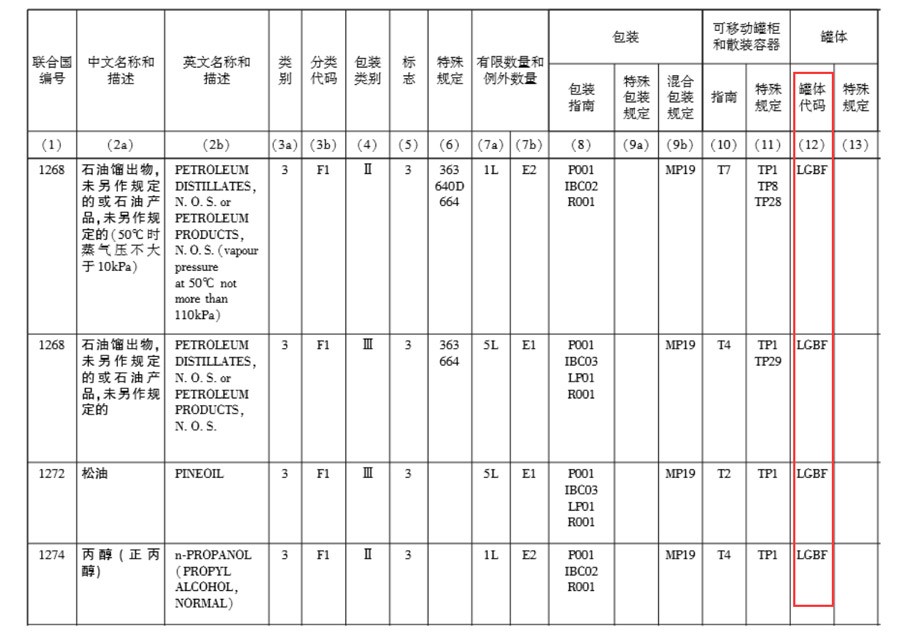
Figure 1. Sample of Table A.1 “List of Road Transport Dangerous Goods”
This column indicates whether this kind of dangerous goods can be transported by tank vehicle and shows the code of the tank applicable. In this way, enterprises can find out whether there is a tank code corresponding to the dangerous goods by checking the table with the UN number of dangerous goods. In other words, if there is a tank code in column 12, it means the corresponding tank can transport this kind of dangerous goods. While if there is no tank code, it means this kind of dangerous goods cannot be transported by tank vehicle yet.
The meaning of the characters in the tank code can be found in Section 6.5.1 in JT/T 617.7, as shown below in Figure 2.
Part | Code name | Code meaning and hierarchical relationship |
1 | Tank Type | L = tank for liquid substances |
2 | Calculated pressure | G or value. G is determined according to requirements in 6.5.3.2; when the values are 1.5, 2.65, 4, 10, 15, 21, respectively, they represent the minimum calculated pressure (x0.1MPa). The calculated pressure should meet the requirements of 6.5.3.1 and 6.5.3.3. The hierarchical relationship is from low to high: G→1.5→2.65→4→10→15→21. |
3 | Opening | A = a tank with filling and unloading opening at the bottom as well as two closed pots; B = a tank with filling or unloading opening at the bottom as well as three closed devices; C = a tank with only the cleaning port at the lower part of the liquid surface and filling or unloading opening at the upper part; D = a tank with no opening under the liquid surface and filling or unloading opening at the upper part. Hierarchical relationship from low to high: A→B→C→D. |
4 | Safety relief device | V = with emergency relief device, no flame arrester; F = with emergency venting device and equipped with flame arrester; N = a tank with no emergency relief device but a safety valve; H = a tightly closed tank; the calculated pressure is not less than 0.4 MPa, tightly closed for any of the following cases: a) no safety valves, rupture discs, other safety devices or vacuum relief valves are installed; b) no safety valves, rupture discs or other safety devices, but with vacuum relief valves; c) with the series combination of the rupture disc and the safety valve, but without the vacuum relief valve; d) with the vacuum relief valve as well as the series combination of the rupture disc and the safety valve. The hierarchical relationship from low to high is V→F→N→H. |
At last, we would like to offer the following compliance tips:
Do not forget to pay attention to the special provisions for the selection of tanks. The special provisions can be found in Column 13 of the Dangerous Goods List in JT/T 617.3-2018, and they shall be fulfilled before transport. The specific special regulations for tank vehicles can be found in Appendix F in JT/T 617.4. To understand the special regulations, please read our previous article [3].
For specific dangerous goods, in addition to selecting the tank corresponding to the code in the table, enterprises can also select tanks with a higher safety level. For example, for the goods corresponding to tank code L4BN, enterprises can choose tanks with a higher safety level, such as those corresponding to L4BH, L4DH, L10BH, etc. to transport.
Reference: