Request a Demo
Consignors play a crucial role in ensuring safe road transport of dangerous goods. They refer to businesses or any other units which entrust a transport company to transport goods. Thus they are usually owners of goods, including businesses engaging in the manufacture, operations, or even transport of goods. It should be noted that a transport company is not necessarily a carrier: if it subcontracts goods to subcontractors, it will become a consignor.
According to the Measures for Safety Administration of Road Transport of Dangerous Goods, consignors should shoulder responsibilities with regard to the following four aspects:
1. Entrust goods to qualified carriers
Article 9 The consignor of dangerous goods shall entrust an enterprise with the required road transport qualification to transport dangerous goods. The consignor of civil explosives and fireworks and firecrackers shall entrust an enterprise with qualifications as required for shipping Class I explosives or corresponding divisions under Class I explosives.
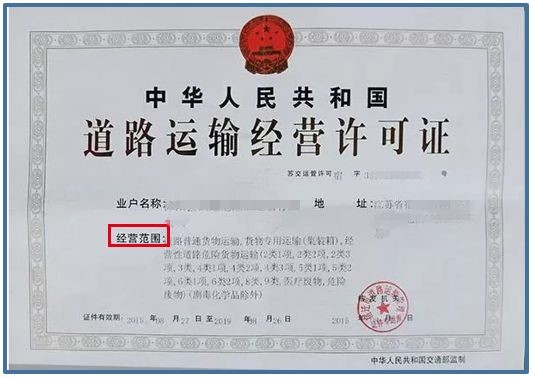
As stipulated above, consignors should entrust goods to enterprises with required qualifications, and ensure that the dangerous goods to be transported are within the approved business scope of carriers. Below is a road transport business permit, and consignors should carefully check whether their goods are included in the business scope specified on it.
2. Ensure compliance of hazard information of dangerous goods
Article 10 The consignor shall identify the dangerous goods class and division, product name, and identification number of the dangerous goods in accordance with the Regulations concerning Road Transport of Dangerous Goods (JT/T 617) and abide by relevant special provisions and requirements. Where it is necessary to add inhibitors or stabilizers, the consignor shall do so in accordance with provisions and inform the carrier of the relevant information.
Where consignors have problems in identifying hazard information on dangerous goods, they should provide technical reports for the identification of dangerous goods, which meet relevant requirements for carriers.
Meanwhile, consignors should also comply with special provisions concerning dangerous goods. It should be noted that special provisions specify some circumstances in which dangerous goods can be transported as general ones, which can hugely reduce the burden of relevant businesses (ChemLinked Article on Special Provisions).
3. Ensure compliance of the packaging of dangerous goods
Article 12 The consignor shall properly package dangerous goods in line with the Regulations concerning Road Transport of Dangerous Goods (JT/T 617), and put up indications of dangerous goods on the outer packaging.
Dangerous goods should be packaged in line with requirements provided in JT/T 617.4. Consignors should choose appropriate packaging for their dangerous goods and make sure that packages can pass relevant performance tests if necessary.
Besides the packaging requirements, there are also rules for marking of packages. Consignors should refer to JT/T 617.5 to make sure that the outer packaging of dangerous goods is marked as prescribed.
4. Enhance the transmission of hazard information on dangerous goods
Consignors, as the party initiating the transport process, are obliged to transmit the hazard information of dangerous goods to both internal and external personnel.
Article 13 The consignor shall provide the carrier with a consignment inventory of dangerous goods in either paper or electronic form.
According to the Measures, the consignment inventory of dangerous goods should state the following information:
Information of the consignor, carrier, consignee, loader, place of departure and destination of dangerous goods
Dangerous goods, class and division, product name, identification number, packing specifications, quantity, and 24/7 emergency telephone number, etc.
Other information including hazards of dangerous goods, consignment notes, first-aid measures, firefighting measures, accidental release measures, secondary environmental pollution disposal measures, etc.
Consignors should prepare the consignment inventory of dangerous goods and provide it for carriers, but carriers are not required to carry the inventory onboard their vehicles. Meanwhile, consignors should well preserve the inventory for no less than 12 months thereafter.
Additionally, it is also noted in the Measures that consignors of highly toxic chemicals, civil explosives, fireworks, and firecrackers or radioactive materials shall provide carriers with corresponding documents as required by laws and regulations, such as manifest forms for transferring hazardous wastes.
To enable effective transmission of hazard information on dangerous goods, consignors should provide pre-post safety education/training and regular safety education for relevant employees. The employees shall only be allowed to start their job after passing relevant examinations.
In addition to the Measures, the Provisions on the Administration of the Road Transport of Dangerous Goods also states some responsibilities of consignors, majorly including the following two points:
Where consignors are to entrust a company to transport hazardous chemicals, they should provide safety data sheets and labels that are consistent with the said hazardous chemicals.
The mixed stowage of dangerous goods (except those packed in LQ or EQ) and general goods is prohibited.