Request a Demo
In the Measures for Safety Administration of Road Transport of Dangerous Goods (ChemLinked Translation), the authorities state that dangerous goods packed in excepted quantities (EQ) in line with relevant requirements (the number of packages on a transport vehicle ≤ 1,000) “can be transported as general goods." The new rule is certainly encouraging for businesses in the dangerous goods industry. Below are several frequently asked questions concerning EQ stipulated in the Measures as well as the Regulations Concerning Road Transportation of Dangerous Goods (JT/T617; ChemLinked Translation).
Q1: What is EQ?
Essentially, both EQ and limited quantities (LQ) are exemptions granted to goods packed in relatively small quantities and posing fewer hazards, with certain regulatory requirements eased.
For goods packed in EQ, they are still subject to the following regulatory requirements:
Requirements for goods packed in EQ, as stipulated in JT/T 617.3 – 2018;
Requirements for training sessions organized by various parties, as stipulated in JT/T 617.1 – 2018;
Requirements for classification of dangerous goods, as stipulated in JT/T 617.2 – 2018; and
The requirement that the packaging should be capable of protecting goods and guarding against risks, as stipulated in Articles 4.1.1, 4.1.2, 4.1.4, and 4.1.7 of JT/T 617.4 – 2018.
Q2: How can I know whether or not my goods can be granted with EQ exemption?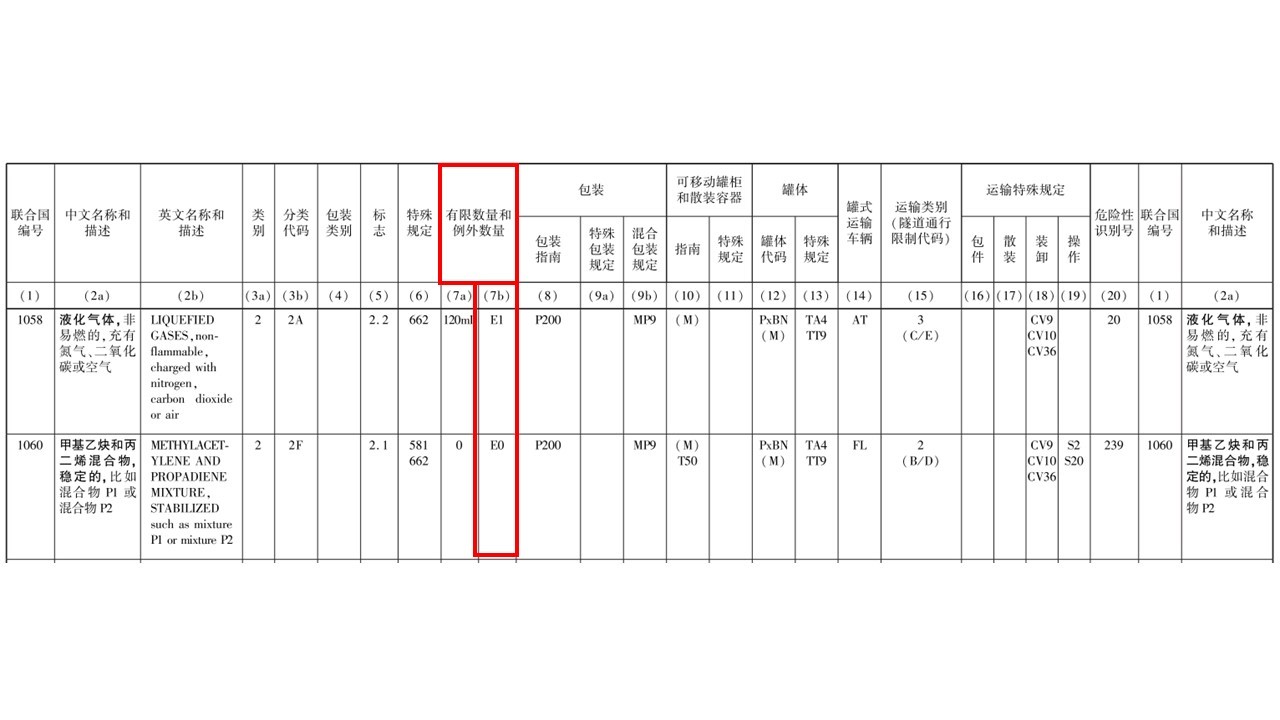
(Figure 1)
You can determine whether your goods can be granted with EQ exemption following the steps below:
Check the “List of Dangerous Goods in Road Transport” in JT/T 617.3-2018 with the UN number of your goods
Check the column "7b."
If your goods are marked with “E0”, they cannot be granted with EQ exemption (like “UN 1060” in Figure 1); otherwise, they can be granted with EQ exemption as long as the quantity limit is met
Q3: What are rules concerning the quantity limit for EQ exemption?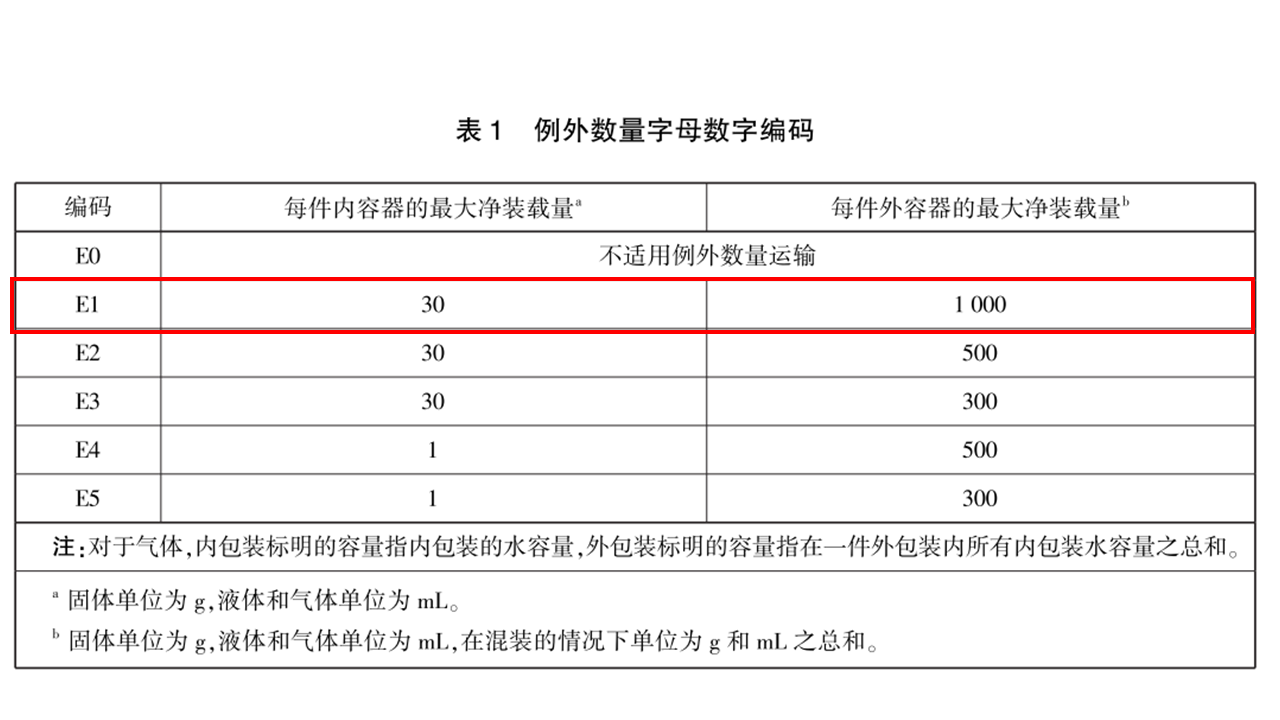
(Figure 2)
Let’s take the dangerous goods coded as UN 1058 as an example. Figure 1 indicates that the goods are marked with “E1” in the “7b” column. Therefore, according to Figure 2, the goods packed in each inner packaging should not exceed 30ml (for liquid or gas) or 30g (for solid), and the goods packed in each outer packaging should not exceed 1,000ml or 1,000g.
In some cases, goods marked with different EQ codes need to be packed together. For instance, where goods marked with E1 are mixed with those marked with E5, the lower of the quantity limits should be met: the goods packed in each inner packaging should not exceed 1ml or 1g, and the goods packed in each outer packaging should not exceed 300ml or 300g.
Q4: Are there any special requirements for packaging?
The requirements for the packaging of goods packed in EQ are quite stringent, as evidenced by the summary below:
Goods must be packed using three layers of packaging, namely inner packaging, intermediate packaging, and outer packaging. Each type of packaging should be tested accordingly (Articles 8.2 and 8.3 in JT/T 617.3 – 2018)
Complete packages for transport should be, at least, capable of passing a drop test and a stacking test (Article 8.3 in JT/T 617.3 – 2018)
Q5: Are there any special requirements for marking of packages?
Packages containing dangerous goods in EQ shall bear the mark shown in Figure 3:
(Figure 3)
Q6: Are there any other points to bear in mind when transporting dangerous goods packed in EQ?
Consignors should provide carriers with written declarations, which state that the packaging meets requirements in JT/T 617, and carriers should require vehicle drivers to carry such declarations along with them.
The dangerous goods consignment inventory offered by consignors should include an indication of dangerous goods packed in EQ and the number of EQ packages.
The number of packages on each transport vehicle should be no more than 1,000.
It is allowable to place dangerous goods packed in EQ and the other dangerous goods/general goods in an overpack.
The mixed stowage of dangerous goods packed in EQ and the other dangerous goods/general goods is allowed.
ChemLinked will release a series of articles detailing the responsibilities of various parties in the transport of dangerous goods. Please stay tuned.