Request a Demo
On November 10, 2019, the long-awaited the Measures for Safety Administration of Road Transport of Dangerous Goods was introduced and set to take effect on January 1, 2020. It officially grants exemption to dangerous goods packed in limited quantities (LQ) and excepted quantities (EQ), by stating that “dangerous goods can be transported as general goods if the number of packages of dangerous goods packed in EQ does not exceed 1000, or the gross mass (packages included) of dangerous goods packed in LQ carried does not exceed 8 tons per transport unit”.
In late 2020, the Guidelines for Road Transport of Dangerous Goods Packed in Excepted Quantities and Limited Quantities was published to facilitate the implementation of the Measures. The Guidelines is aimed at helping all parties concerned to have a better understanding of the exemption system and facilitating the road transport of dangerous goods with low hazards and in small quantities. ChemLinked has summarized its major highlights:
I. Scope of Dangerous Goods Qualifying for Carriage as EQ and LQ
According to the Guidelines, where the dangerous goods to be carried are highly toxic chemicals, civil explosives, fireworks and firecrackers or radioactive substances, they do not qualify for carriage as EQ or LE in road transport, considering that these goods need to be handled following the regulations of corresponding authorities. Take highly toxic chemicals as an example, businesses will need to comply with the Administrative Measures on the Purchase of and Road Transport License for Highly Toxic Chemicals, which was published by the Ministry of Public Security.
II. Requirements for Package Test of Dangerous Goods Packed in EQ and LQ
For dangerous goods packed in EQ, it is made explicit that relevant performance tests shall be conducted on their packages before carriage. At least two package tests shall be performed for the time being, namely a 1.8m drop test and a 24 hour stacking test at a stacking height of 3m. The packages shall pass the tests as long as there is no breakage or leakage of any inner packaging.
For dangerous goods packed in LQ, performance tests of their packages shall be conducted before the first-time use or transport. As with those packed in EQ, the consignors can perform the tests themselves or entrust a third-party testing agency to test the packaging, and the package performance test reports shall be issued afterwards. At present, the Ministry of Transport (MOT) has not provided a list of qualified third-party testing agencies, and enterprises need to look for agencies with relevant capacities on their own.
It should be particularly noted that for package performance tests of dangerous goods in LQ, test items shall be determined based on the packing group and the type of outer packaging adopted as required in Table D.1 of the Safety Code for Inspection of Packaging of Dangerous Goods Transported by Road (GB 19269-2009), and tests shall be conducted according to the test requirements specified in 7.2 of GB 19269-2009.
III. Transport Documents for Dangerous Goods Packed in EQ and LQ
According to the Guidelines, the consignors need to provide a consignment inventory of dangerous goods packed in EQ or LQ for the carriers. There is no specific format requirement for such inventories, but they need to contain some necessary information, such as name and address of the consignor and the carrier, number and total mass of packages of dangerous goods packed in LQ, number of packages of dangerous goods packed in EQ, etc.
In addition to the inventory, the consignors shall also provide the statement on use of packages of dangerous goods packed in EQ or LQ for the carriers, and the latter are required to carry the statement onboard the vehicle. Templates are provided in the Guidelines for the statement. Meanwhile, the consignors can also present the performance test report of packages of dangerous goods packed in EQ or LQ instead of the statement.
IV. Marking of Packages of Dangerous Goods Packed in EQ and LQ
The packages of dangerous goods packed in EQ or LQ shall be marked as below:
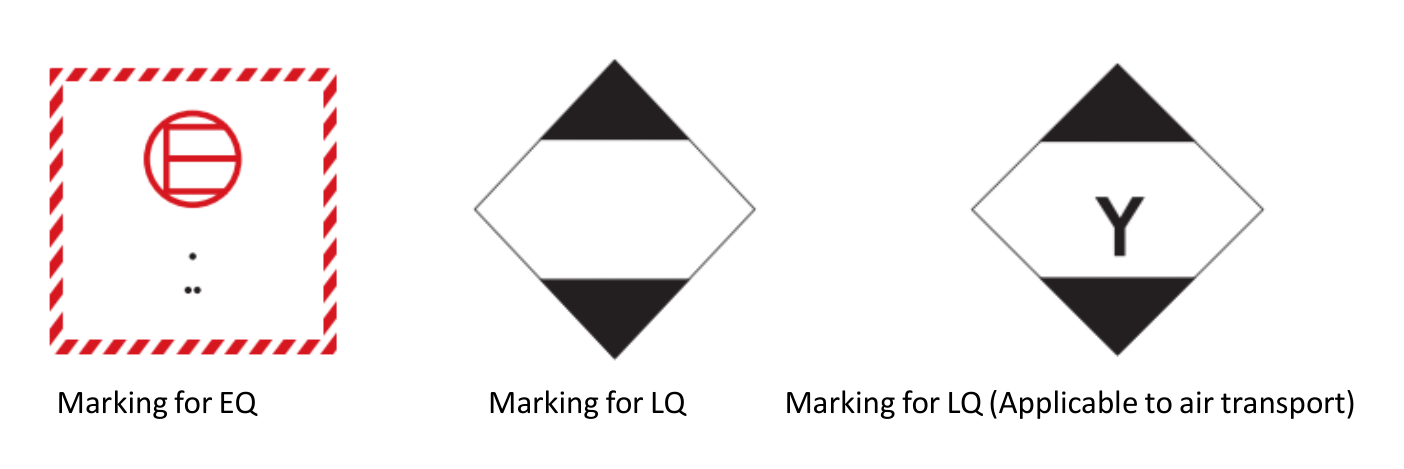
Notably, there is a special marking requirement for dangerous goods packed in LQ, namely marking of gross weight. According to the Guidelines, the side affixed with the mark for packages of dangerous goods packed in LQ outside each package shall be affixed with the mark of gross weight, which shall be readily visible and durable, as shown in the figure below. This is a new addition compared to JT/T 617-2018.
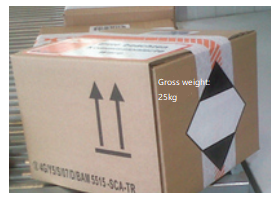
Example of mark of gross weight
V. Training Requirements for Road Transport of Dangerous Goods Packed in EQ and LQ
Even though dangerous goods packed in LQ and EQ can be transported as general goods, relevant training requirements are not exempted. The Guidelines explicitly provides training requirements for relevant personnel of consignors and carriers, which involves both pre-job safety education and training and regular safety education and training. Businesses shall organize relevant employees to receive the training related to their responsibilities and obligations, including proficient knowledge of the Guidelines and knowledge of relevant requirements concerning EQ and LQ in regulations and standards. In addition, the consignors and carriers shall also properly preserve the records of safety education and training and relevant examinations.