Request a Demo
The transport of dangerous goods with low hazards and in small quantities, such as aerosols and disinfectants, has always been a topic of heated discussion in the industry. If such goods can be transported using reliable and durable packages or following certain conditions, they will pose much fewer dangers.
A highlight in the Measures for Safety Administration of Road Transport of Dangerous Goods (ChemLinked Translation) is the introduction of the small-quantity exemption system. According to the Measures, dangerous goods can be transported as general goods if the gross mass (packaging included) of dangerous goods packed in limited quantities (LQ) carried does not exceed 8 tonnes per transport unit. Then how to determine whether or not your goods can be granted with LQ exemption?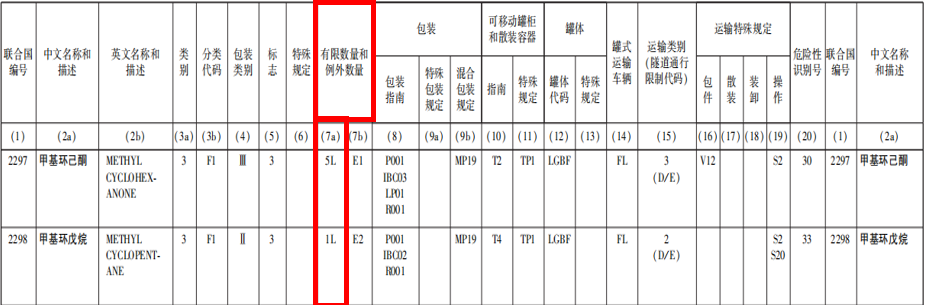
Figure 1
You can determine whether your goods can be granted with LQ exemption following the steps below:
Check Table A.1 “List of Dangerous Goods in Road Transport” in JT/T 617.3-2018 with the UN number of your goods
Check Column (7a) which specifies the quantity limit regarding dangerous goods packed in LQ
If your goods are marked with a number other than “0”, they can be granted with LQ exemption as long as relevant requirements are met
At present, dangerous goods packed in LQ can be transported following the special requirements for LQ, as stipulated in JT/T 617.3-2018, which majorly involves three aspects.
I. The requirement for a quantity limit
As noted above, the quantity limit is specified in Column (7a) of Table A.1 “List of Dangerous Goods in Road Transport” in JT/T 617.3-2018, referring to the maximum quantity per inner packaging for carrying dangerous goods as LQ. In Figure 1, for instance, as the dangerous goods coded as UN2297 are marked with “5L” in Column (7a), the maximum quantity per inner packaging for carrying such goods should be 5L.
Businesses may wonder if they can place as many such inner packaging as possible in one complete package. The answer is certainly no. It should be noted that for a complete package containing dangerous goods packed in LQ, its gross mass (packaging included) shall not exceed 30kg. Meanwhile, inner packaging made of glass, stoneware, certain plastics, porcelain, and other materials that are liable to break or be easily punctured shall be placed in intermediate packaging meeting relevant provisions and the total gross mass (packaging included) of the package shall not exceed 20 kg.
II. Requirement for packaging
JT/T 617.3-2018 lays out detailed requirements for the packaging of dangerous goods packed in LQ, as illustrated below:
Dangerous goods shall be packed only in inner packaging placed in a suitable outer packaging. Intermediate packaging may be used. The use of inner packaging is not necessary for the carriage of articles such as aerosols or small receptacles containing gas.
Except for explosives of Division 1.4S, shrink-wrapped or stretch-wrapped trays that meet the given conditions are acceptable as outer packaging for articles. Inner packaging that is liable to break or be easily punctured, such as those made of glass, porcelain, stoneware, or certain plastics, shall be placed in suitable intermediate packaging which meets relevant provisions.
Liquid, corrosive goods of Class 8 (packing group II) in glass, porcelain, or stoneware inner packaging shall be enclosed in a compatible and rigid intermediate packaging.
In summary, LQ dangerous goods should be carried in combination packaging, in which inner and outer packaging are necessary, and intermediate packaging should be used as appropriate. Meanwhile, there is no mandatory requirement for testing of packaging for dangerous goods packed in LQ, which is different from the case with those packed in EQ (ChemLinked Expert Article).
III. The requirement for marking of packages

Figure 2 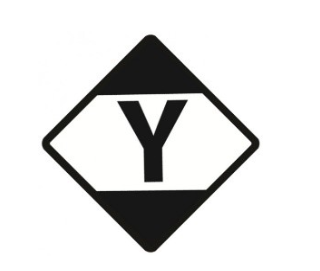
Figure 3
For the carriage of dangerous goods packed in LQ by road or sea, packages shall bear the mark shown in Figure 2; for those transported by air, packages shall bear the mark shown in Figure 3.
The mark shall be readily visible, legible, and durable. It shall be in the form of a square set at an angle of 45° (diamond-shaped). The minimum dimensions shall be 100 mm x 100 mm, and the minimum width of the line forming the diamond shall be 2 mm. If the size of the package so requires, the minimum outer dimensions may be reduced to be not less than 50 mm x 50 mm, and the minimum width of the line forming the diamond may be reduced to a minimum of 1 mm.
As long as the requirements above are met, and the gross mass (packaging included) of dangerous goods packed in LQ carried does not exceed 8 tonnes per transport unit, such dangerous goods can be transported as general ones.
Additionally, there are some other points to bear in mind when transporting dangerous goods packed in LQ:
Consignors should provide carriers with packaging performance test reports or written declarations, which state that the packaging meets requirements in JT/T 617, and carriers should require vehicle drivers to carry such declarations along with them.
The dangerous goods consignment inventory offered by consignors should include an indication of dangerous goods packed in LQ, and the number and the gross mass (packaging included) of LQ packages.
The gross mass (packaging included) of dangerous goods packed in LQ carried does not exceed 8 tonnes per transport unit.
It is allowable to place dangerous goods packed in LQ in an overpack, and the mixed loading of dangerous goods packed in LQ and the other dangerous goods/general goods is allowed.