Request a Demo
Coauthored by Nadine He
 Since the issuance of the CRC-MEP notice on the 23rd of July 2013, a total of 406 feedbacks numbering approximately 58,000 words have been collected from industry and relevant stakeholders. The feedback and suggestions include problems encountered by industry during the environmental management of China new chemical substance notification (China NCSN, aka China REACH)
The feedback provided by industry can be broadly categorized into four sections which provides an outline of the commonplace issues encountered with NCSN,
Issues relating to the notification forms (37 feedbacks)
Issues relating to the interpretation and implementation of the ambiguous provisions detailed in the supporting guidance documents(159 feedbacks)
Issues relating to chemical identification and testing, physicochemical properties, ecotoxicology, toxicology and health, chemical safety and environmental protection, risk assessment and control, etc.) (116 feedbacks)
Rational proposals for management procedures and the different management chains. (94 feedbacks)
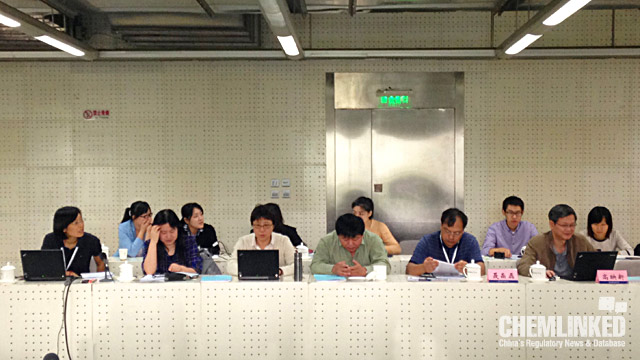
Based on the feedbacks, the Seminar on the Environmental Management of New Chemical Substances was held in Beijing on 26 and 27 Sep 2013. The seminar afforded the staff of the CRC-MEP, other experts and industry representatives a chance to work on improving NCSN’s supporting guidance materials and present proposals for better environmental management on China new chemical substances.
The Measures for the Environmental Management of New Chemical Substances (MEP Order 7) has been effective since 15 Oct 2010. Since its enactment there have been numerous problems which have hindered the smooth progress of China NCSN. In an effort to dynamically improve the regulatory system, authorities have actively solicited opinions from industry. The authority has a twofold task in that it must ensure that regulations are designed to prioritize human and environmental health whilst at the same time ensuring over regulation doesn’t smother innovation within the industry.
This seminar was hosted by the Working Committee on Collaboration & Promotion of Industry, College and Institute under Chinese Chemical Society, and strongly supported and promoted by authorities. Whilst a revision of MEP Order 7 is not expected in the near future, the Seminar aimed to collect enough feedbacks to guide a revision of the guidance and other supporting documents. Some of the findings of this seminar will be reflected in the FAQ pages on the CRC-MEP website. In the next section, the main issues encountered by industry will be dealt with.
1. Management of the Inventory of Existing Chemical Substances in China (IECSC)
A notified general new chemical substance will be automatically listed into the IECSC at least 5 years from the first date of its manufacturing or import. Companies should pay attention to the submission of the first-time activity report, so as to clearly define the actual activity date and facilitate the follow-up automatic inclusion into the IECSC. However, for the hazardous or hazardous of priority environmental concern, the corresponding certificate holders are required to report to the CRC-MEP 6 months before the end of the five-year period from the first date of their manufacturing or import. A revaluation on the substance hazard information will be conducted by the evaluation committee to decide whether to incorporate the substance into IECSC. For this reason companies should take the submission of the first-time activity report and the annual report seriously, to avoid unnecessarily excluding the substance from the IECSC. For new chemical substances notified under SEPA Order 17, the certificate holder should report to the CRC-MEP within a month after the 5th year of the first date of actual manufacturing or import activity to include the substances into IECSC. However, the detailed procedures for this aspect of IECSC inclusion are still pending.
MEP Order 7 requires examination on new chemical substances every five years according to Article 42 of MEP Order 7. Theoretically for the substances produced or imported legally within the boundary of the People's Republic of China before October 15, 2003, the MEP will add the substances into IECSC. However, the national environmental investigation on chemical production launched in the first half of 2013 actually was not the examination required under MEP Order 7 .It is still unclear whether substances that missed the IECSC Supplementation deadline will have another chance to be listed into the IECSC. The analysis of the investigation data conducted by relevant regional authorities is still ongoing. By next March, the MEP will summarize the data and produce the report for the national investigation. Whether the results of this national investigation will impact the future management of chemicals in China, and how, is expected to be known by the middle or latter half of 2014.
The IECSC should be the fundamental chemical inventory in China. However, in fact there are cases where the IECSC does not conform to inventories managed by other Chinese authorities. Discrepancies of substance information are relatively common but more alarmingly there are also instances in which substances listed in specific ministerial inventories are excluded from the IECSC.
Since the notified new chemical substances will have a chance to be listed into the IECSC after five years from the first activity, there is an interesting regulatory loophole that allows notifiers to obtain certification through a low-tonnage-band notification. After 5 years when the substance is included into the IECSC and no longer subject to the extended testing demands and monetary cost of higher tonnage notification, the notifier can then produce the substance and circumvent the inherent regulatory burden. In reality, it is only when the new chemical substance is listed into other existing inventories according to its hazard and risk properties that it is supervised according to certain categories of China’s existing chemical management regime. Once the subject is included into the IECSC, all chemicals are treated similarly irrespective of hazard or risk, therefore until they are added to other inventories there maybe potential for serious environmental damage or damage to human health. A solution is to specify the risk control measures when the new substances are listed into IECSC.
2. IECSC search
Since the date when the notified new chemical substances can be officially announced as being listed into the IECSC is uncertain, and the potential notifiers can only get such information through public announcement (some substance information may be confidential), it may result in a circumstance that the new notifiers waste time and money to comply with China NCSN before finally finding their new chemical substance (the previous IECSC search result shows that it’s new) has been added into the IECSC. To avoid unnecessary notifications, the authority has a lot of things to do. We’d like to suggest the following ways,
Regularly update the IECSC. The MEP should regularly update and publish the IECSC, communicate confidential substance information (name, CAS, etc.) when it becomes public.
Establish a database of comprehensive inquiries made to the CRC-MEP based on new substance searches. When the result is “new”, link up the substance and the companies having made this search inquiry. When company A apply for the IECSC inclusion of substance B, the authority should search the database and check whether there are any other companies have made the search inquiry to the CRC-MEP, namely to find out any potential notifiers. If so, the authority should inform these companies that the new substance has been listed into the IECSC and exempted from China NCSN obligations.
We suggest the CRC-MEP to verify the search inquiry made before the IECSC is updated. If the previous result is “not a new chemical substance”, then the CRC-MEP should inform the companies having made the search inquiry that the result is changed. It is also suggested that the CRC-MEP check whether the new chemical substance is notified (being notified) or not. If the previous notifier agrees to share his contact information to the subsequent notifier of the same new substance, the information should be addressed to the company along with the inquiry result.
For the suggestion 1, the authority is improving the procedure for IECSC update. However, the authority made it clear that the suggestion 2 and 3 won’t be accepted since it undermines CBI.
3. Management of Intermediates
According to the Guidance, the non-isolated intermediates can be exempted from China NCSN, while other intermediates, if new, should be notified. Many representatives raised questions that unlike the general substances the intermediates (isolated or transported) have limited functions and will be consumed in the next reaction step. With standard production process and well-trained operators, this type of substances have limited exposure to humans and environment, negating the necessity for tight regulation. Therefore we propose to refer to some other chemical management systems in the world (such as EU REACH), to reduce the data requirements for the strictly controlled intermediates. The authority will carefully consider such management issues concerning the intermediates.
4. Data required for regular notification
It is suggested that in the assessment of data exemption, factors like actual exposure and uses should be taken into consideration to determine whether it is necessary to conduct certain toxicity tests. For example, the necessity of carrying out toxicokinetic test and the aspects to be tested is decided after a comprehensive study of the chemical, including its category, intended use, expected human contact, physical and chemical properties, as well as toxicology and toxicological characteristics. As to acute inhalation toxicity, some representatives hold the opinion that if a solid substance contained in liquid preparation is imported into China and circulates in the market, the solid substance should be exempted from acute inhalation toxicity test.
The authority was vague in its response to these suggestions. Final decisions will be made after further study of the chemical management regulations of other countries and internal discussions. Expert reviews place high value on inherent chemical properties and attempt to gather as much knowledge on a substances chemical, physical, toxicological and ecotoxicological properties. The exposure information and notified uses are less valued in its assessment.
Approved new chemical substances will be incorporated into the Inventory of Existing Chemical Substances in China after a minimum of five years. Unless the registered substance is considered to be of priority environmental concern regulated under MEP Order 22, there will be no constraint imposed to its market circulation, tonnage, etc. If a new substance is exempted from part of the toxicity test as judged by its exposure information and uses, it is not guaranteed that unforeseen severe damages to both human body and the environment will not arise as the exposure scenarios increase. This may underpin the authority’s rationale for adoption a precautionary approach and mandating comprehensive toxicity testing.
The notification of substances with higher tonnage bands demands testing data including reproductive and developmental toxicity, chronic toxicity, toxicokinetics, carcinogenicity as well as chronic toxicity to aquatic creatures, bioaccumulation and so on. The mandated time required to conduct some of these tests are relatively long and costly. Due to the insufficient amount of accredited laboratories competent in conducting these tests, it takes at least 2 years to fulfill the data acquisition for a band 2 regular notification. Industry has expressed grave concerns associated with these time constraints. Industry representatives have suggested that the testing plan from the commissioned laboratory and the signed contract be acceptable. If the available data shows low risks, the production or operation of the substance is permitted. The dossier should be appended and revised as soon as all the tests are finished.
The authority points out that China’s chemical management pattern is different from some of its foreign counterparts, EPA TSCA and EU REACH for instance: Going through the notification process is not enough and permissions must be obtained for new substances. The competent ministry will issue a registration certificate and grant market access permission only when the submitted data of the notified substance is in compliance with the regulation and is approved by the expert panel.
5. Supervision
Most of the approved notifiers are foreign-based or foreign-funded enterprises, indicating that indigenous enterprises are either no longer innovating or are simply not abiding by the regulatory framework for new chemical substance notification. This is probably due to the following reasons: 1) Enterprises are not fully aware of their obligations under MEP Order 7. 2) Supervisory loopholes and lack of firm local authority regulatory enforcement have led some enterprises to ignore the notification requirements of China NCSN.
Delegates from industries have put forward that stricter supervision over production, importing and exporting are necessary and punitive measures should be more severe. If a new substance is not notified, MEP can cooperate with administrations of work safety to deny new application, change or renewals of HazChems Safety Production/Use/Operation Permit; cooperate with customs and commodity inspection departments to reject issuing clearance license for exit and entry; cooperate with ministries of commerce to revoke the license of illegal operators; reject relative HazChems environmental management registration; cooperate with local ministries of environmental protection to reject issuing production permit for those without registration certificate. However for the time being, these measures are unachievable since the specifics of inter-ministerial communications have yet to be figured out.
6. Future development and revision
(1) The review
Expert panel: Currently, the panel consists mostly of academic scholars rather than industry specialists, possibly leading to limited recognition of the hazards of a substance and the risk management. The review of new chemical substances is conducted with limited information. The panel is empowered to ask for amendment of dossiers, but the use of the power should be guided by prudent policies.
Review approaches: The review parameter is often assessed using only isolated inherent characteristics of the chemical and doesn’t reflect the practical uses of this substance. A far better approach would be to conduct a systematic assessment, e.g. a comparative analysis of approved or other substances under review. Though the latter methodology is not yet established, it is more favorable to look at a substance from a comprehensive perspective that is closer to the situation in practice. Also, the existing simplified notification mechanism puts a heavy workload on the registration center. In short, the review approaches needs amendment.
Delivery of expert opinions: Some attendees of the conference mentioned that notifiers are compelled to supplement or revise their dossiers in accordance with expert’s opinions which in many cases lack detail. To ensure the notification and review work proceed smoothly, notifiers should be encouraged to establish interactions with the reviewers via emails, phone calls or face-to-face communication. On the other hand, to avoid any interference or undermine the impartiality of the review work, the authority tends to maintain the existing writing communication. After several rounds of discussion, a combined proposal was put forward that in some controversial matters direct communication channel between notifiers and expert panel members can be set up mainly through email or teleconference. The feasibility of this proposal is currently being assessed.
(2) Transference of registration certificate
The registration certificate is not allowed to be transferred. A registration certificate could be regarded as an intangible asset to its owner. To some extent, the prohibition discourages enterprises from notifying new substances. It is stipulated in the guidance of MEP Order 7, if the previous notifier has exported and then re-imported the new chemical substance after processing and preparation, the post notifier (also the importer of the preparation) may conduct the new substance notification excluding the re-imported tonnage from the accumulative tonnage quantity. Although there is no need to accumulate the tonnage band, any notification is not rational because in essence it is simply a duplicate notification.
(3) Online submission system for Regular Notification
Online submission is a necessity for the scientific research record notification and simplified notification. For regular notification, the online submission system is almost finished and the test version will be available in one or two months.
(4) Management of “Only Representative”-like agent (hereafter referred to as “OR”)
In this seminar, Miss Zang, the director of the Department of Pollution Prevention and Control, MEP and Mr Nie, director of The Department of New Chemical Substance of the CRC-MEP and some other officials have mentioned that in the future there will be more quality requirements for the ORs and the authority will strengthen supervision of these agents.
7. Regulatory updates
(1) Supporting documents for MEP Order 7
China NCSN involves many industries. We cannot stop at the knowledge of the substance; it is necessary to know the uses and exposure information for better risk control. The draft proposals of the Guidelines for Risk Assessment of Chemicals and the Guidelines for Hazard Identification of New Chemical Substances in support of the implementation of MEP Order 7 have been released for public consultation in Sep and Oct 2011. However until now, they have not been published. It is said that the MEP is handling these publication issues and will be published soon.
(2) Guidelines for the Testing of Chemicals (2nd ver)
The Guidelines for the Testing of Chemicals (2nd ver) consists of four volumes. Volume 1 was published on 1 Jun 2013, followed by the other three volumes in Sep. The 2nd version, covering 165 testing items and 186 testing methods has improved a lot when compared with the 1st version which only covered 90 testing items and 101 testing methods. Animal welfare concerns are also addressed and have seen 6 alternative animal testing methods adopted. Some problems concerning testing endpoints which existed in the 1st version Guidelines have been addressed in the 2nd version.
(3) Substance identification
The existing Chinese nomenclature mainly refers to the Nomenclature of Organic Substances (1980 ver.) published by the Chinese Chemical Society. At present the 2010 draft proposal is released for public consultation. Officials stated that the lack of uniform standard for naming of chemicals and the diverse views shared by review experts are a major stumbling block in the review of new chemicals. To deal with the problem, the CRC-MEP has especially formulated the Technical Specification for Identification. Relevant experts are convened to discuss to uniform standards and minimize the effect of inconsistency in chemical nomenclature. If the experts who review the nomenclature have different opinions, the CRC-MEP will arbitrate until a consensus is reached. The chemical name should also be in line with the Technical Specification for Identification. The official clearly specified that the Chinese nomenclature of chemicals will not uniformly refer to principles of CAS nomenclature, because the latter is mainly used for retrieval purposes. The CAS nomenclature is unfamiliar to Chinese chemical experts and is also different from IUPAC nomenclature. It is recommended that the English naming of chemicals refers to IUPAC nomenclature but for the index name CAS is also acceptable.