Request a Demo
Taiwan’s standard registration for 106 priority existing chemicals (PECs) at or above one tonne a year began on January 1, 2020. According to the amendments of Taiwan's New and Existing Chemical Registration Regulation [1], the standard registration for the PECs should be completed within 2 or 3 years. To aid in the timely preparation of documentation and data, ChemLinked has prepared this article to address industry concerns.
How to determine if standard registration is required?
The phase 1 registration (pre-registration/late pre-registration) for all existing chemical substances manufactured/imported over 100kg is a prerequisite before the phase 2 standard registration. The pre-registration ended on April 1, 2016, after which the late pre-registration applies. Late pre-registration must be applied for within six months of the first import/manufacture and registrants can voluntarily apply for it if existing chemical substances manufactured/imported below 100kg/year.
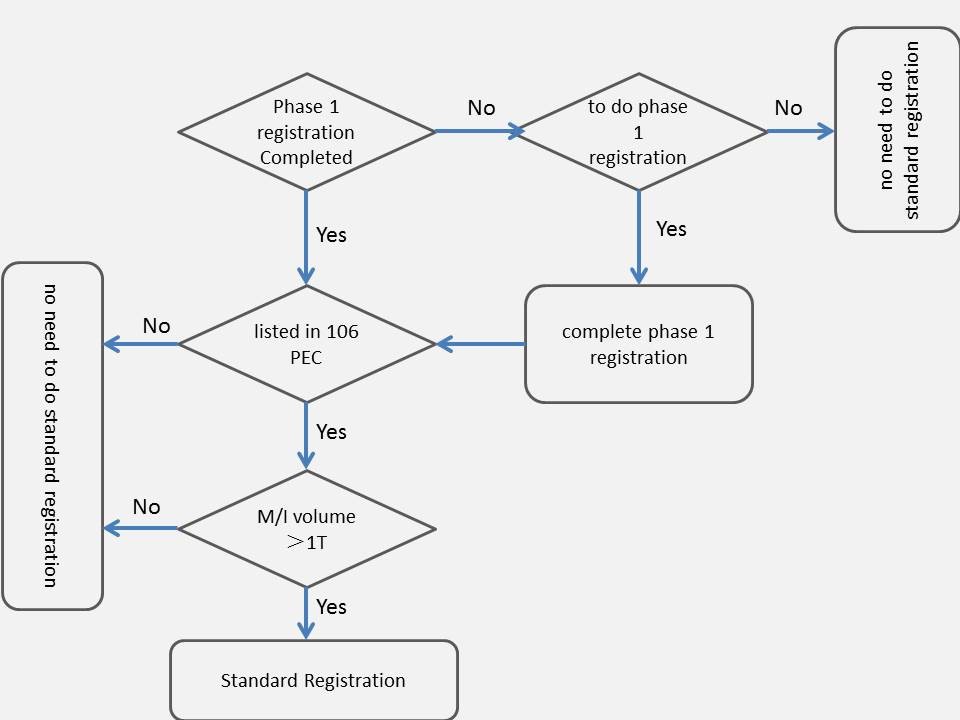
106 PECs were designated subject to phase 2 standard registration. The tonnage threshold is set at 1 tonne per year. The manufactured/imported tonnage data submitted for phase 1 registration is used to determine if standard registration is required (see flowchart below).
Although the trade volume may have decreased in recent years, it is not allowed to update the former phase 1 registration volume. The registrants still need to follow the tonnage band that has been submitted in phase 1 registration to comply with phase 2 registration. Only those that previously submitted an incorrect registration volume can file a formal notice to the authority to update the information if he can supply sufficient evidence.
Registration deadline
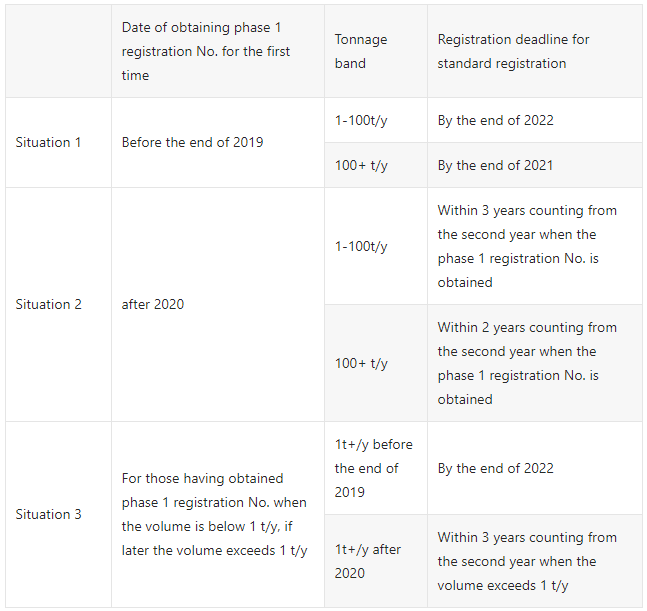
The registration deadline is based on the volume indicated when applying for phase 1 registration (pre-registration/late pre-registration) and the date on which the phase 1 registration number is obtained.
Review period
The review period for the standard registration of PECs is 90 working days. It will be counted all over again if supplementation or correction of information occurs. According to the current situation of review work of new chemicals, most of the applications were approved after two times of supplementation or correction of information. Thus the longest period for dossier review could be:
90 (1st review) +30 (1st supplementation/correction) +90 (2nd review) +30 (2nd supplementation/correction) +90 (3rd review) =330 working days.
For situation 1, the PECs above 100 tonnes per year should be registered within two years. The potential registrants should prepare timely documentation and data and avoid unnecessary delays in supplementation or correction of information.
To what extent can diversified data be accepted?
The existing chemical standard registration allows the submission of diversified data. For physicochemical properties, test reports, systematic literature reviews, QSAR (only for UVCB substances), and international public database data can be accepted. Regarding the international database, the official has recommended ten databases in the draft Guidance for Standard Registration of Priority Existing Chemicals [2](hereafter referred to as the Guidance), including ILO ICSC, IPCS, IARC, etc. For toxicological and eco-toxicological data, the test plan can also be accepted in addition to the above-mentioned types of data.
The test plan should include the testing method, specifications, estimated time and cost. The eligibility criteria are specified for each test endpoint in the Guidance. However, the test plan is not a way to fill the data gap once and for all, and there is still a possibility to conduct the test if deemed necessary by the competent authority after assessing the test plan.
Most of the 106 PECs have been jointly registered under EU REACH. REACH24H Consulting Group has made great efforts to communicate with EU consortiums for issues about purchasing data. However, purchasing data for use in Taiwan chemical registration from EU REACH data owners has not been easy. It is hindered by communication difficulties and a lack of regional cross data sharing standards. Some data owners are still on the sidelines and waiting for the publication of the Guidance.
Data sharing for joint registration
Joint registration is voluntary for standard registration of PECs. The registrant having finished standard registration with higher tonnage levels can let the enterprises of the same level or lower tonnage levels buy the LOA (letter of access) and give them access to the joint submission with a data token. However, the data cannot be passed in the form of a data token from the registrant with a lower tonnage level to higher tonnage levels. The enterprise of higher tonnage levels should purchase data from the data holder and supplement missing data to complete the registration.
Data protection
The data owners or suppliers overseas have a high concern on leakage of raw data, including the full study reports and the robust study summaries. The suggestions would be to entrust an independent third party representative (TPR) to gather the information and prepare the registration dossier. The original data is only provided to TPR, and the importers cannot obtain it. For other joint registrants, as mentioned above, the data will be passed with a data token. This may be a more proper way of being granted the right to have access.
When applying for a data token in the IT system for standard registration, the TPR needs to fill in the enterprise information that is to use the token. The token is specific and cannot be used by other enterprises.