Request a Demo
On December 27, 2025, the Standing Committee of the 14th National People's Congress of China formally voted to pass the Hazardous Chemicals Safety Law. This specialized legislation serves as a fundamental legal framework for the industry and is scheduled to enter into force on May 1, 2026. The law establishes a comprehensive mandate to strengthen safety management, prevent accidents, and formalize legal responsibilities across the entire chemical supply chain.
The enactment of this law marks a transition from regulatory ordinances to a dedicated national law, reflecting the government's "safety first" priority. The legislation addresses historical issues such as management gaps in chemical industrial parks and fragmented oversight. It promotes a shift in public safety governance from reactive disaster relief to proactive prevention, aiming to resolve root causes of industrial accidents.
Lifecycle Management
The law adopts a "full-chain" systematic governance approach. It covers the entire lifecycle of hazardous chemicals, including:
Production
Storage
Usage
Operation/Trading
Transportation
Emergency Rescue
This closed-loop management system is designed to eliminate regulatory blind spots by assigning specific requirements to every stage of handling hazardous materials.
#English Translations
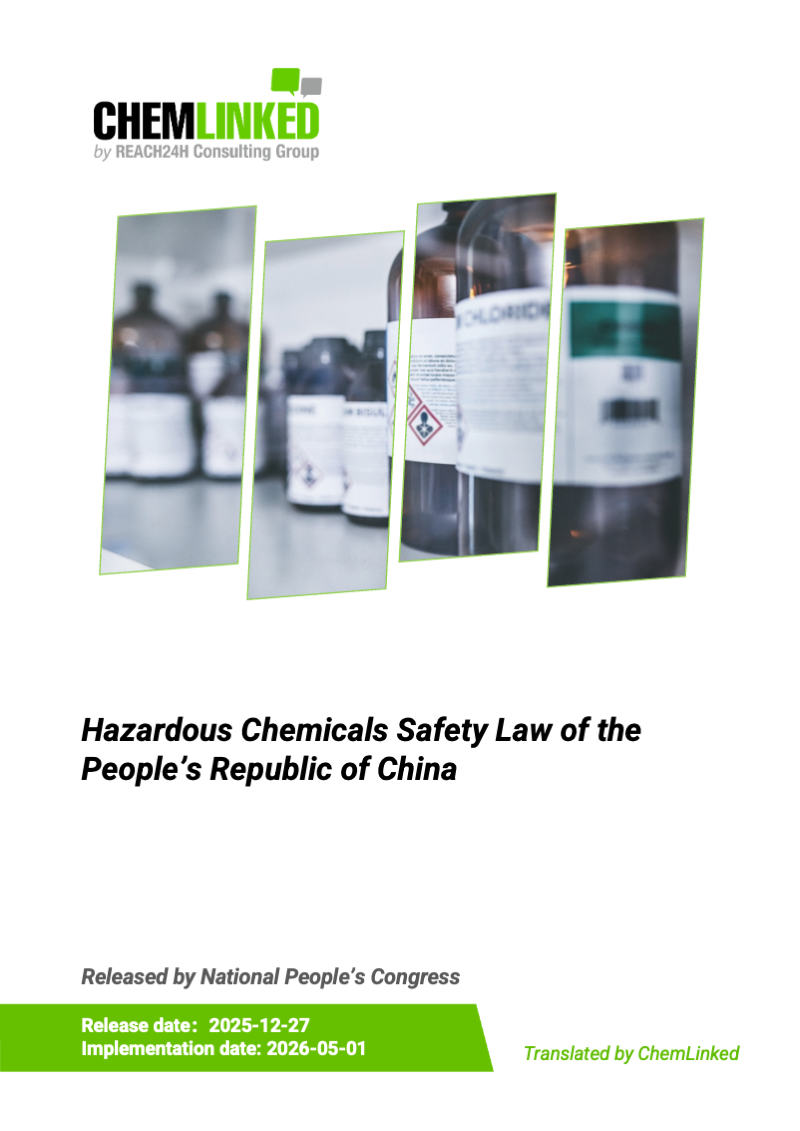
Hazardous Chemicals Safety Law of the People's Republic of ChinaOn December 27, 2025, the Standing Committee of the 14th National People's Congress of China published the Hazardous Chemicals Safety Law. This law establishes a comprehensive legal framework for hazardous chemicals safety management across the full lifecycle, strengthening control of production, storage, use, transport, and liability, and will enter into force on May 1, 2026.Key Compliance Requirements
The law introduces strict obligations for various industry stakeholders:
Safety Access Permits: Strict licensing requirements are codified. Entities involved in the production, use, or operation of hazardous chemicals must obtain the appropriate licenses before commencing activities.
HazChem Registration Exemptions: The law clarifies the exemption criteria for hazardous chemical registration, i.e., hazardous chemicals with low quantity, low release and low exposure during the process of research and development, trial production and trial marketing shall be exempted from registration. Specific provisions in this regard shall be developed by the Ministry of Emergency Management (MEM), Ministry of Industry and Information Technology (MIIT), Ministry of Public Security (MPS), Ministry of Ecology and Environment (MEE) and other related government authorities.
Safety Assessment Reports: The law requires enterprises manufacture or store hazardous chemical to entrust institutions with the qualification conditions prescribed by the state to conduct a safety assessment of their production safety conditions once every three years. The law also stipulates the requirement of making safety assessment reports public to the society.
IT-enabled Safety Management: The law requires involved authorities at or above the county level shall strengthen information-based supervision, implementing electronic labeling of hazardous chemicals and IT-enabled management throughout their lifecycles. Meanwhile, chemical industrial parks shall enhance the information technology infrastructure for hazardous chemicals, achieve information-based safety monitoring, control, and early warning, and establish interoperability with relevant government authorities.
Personnel Qualifications: The law mandates that the primary persons in charge and safety management personnel at production enterprises must undergo assessments to verify their professional knowledge and capabilities.
Chemical Industrial Parks: The law fills a legislative gap regarding chemical parks by stipulating requirements for their official recognition (certification), safety risk grading, and necessary control measures.
Transportation Surveillance: Hazardous chemical road transport enterprises are now legally required to implement real-time monitoring of transport vehicles and driver conduct. Systems must be in place to detect and correct unsafe behaviors, such as speeding, fatigued driving, or deviation from prescribed routes.
Liability and Penalties
A significant aspect of the new law is the enhancement of legal liabilities.
Increased Penalties: The law raises the penalty amounts for violations compared to previous regulations to increase deterrence.
Dual Punishment System: Liability is enforced on both the entity and the individual. In the event of violations, fines will be imposed not only on the company but also on the directly responsible executives and managing personnel. This provision aims to compel corporate leadership to maintain constant vigilance regarding safety protocols.
Implementation Timeline
Enterprises operating within the Chinese market have a transition period of approximately five months to prepare for compliance. The law will take effect on May 1, 2026. Stakeholders are advised to review their safety management systems, personnel certifications, and facility standards to align with the new statutory requirements before the effective date.