Request a Demo
On January 13, 2025, the EU Commission published 3 draft delegated directives to amend the validity dates and areas of application of some widely used lead exemptions from RoHS Directive. The public consultation was concluded on February 10, 2025.
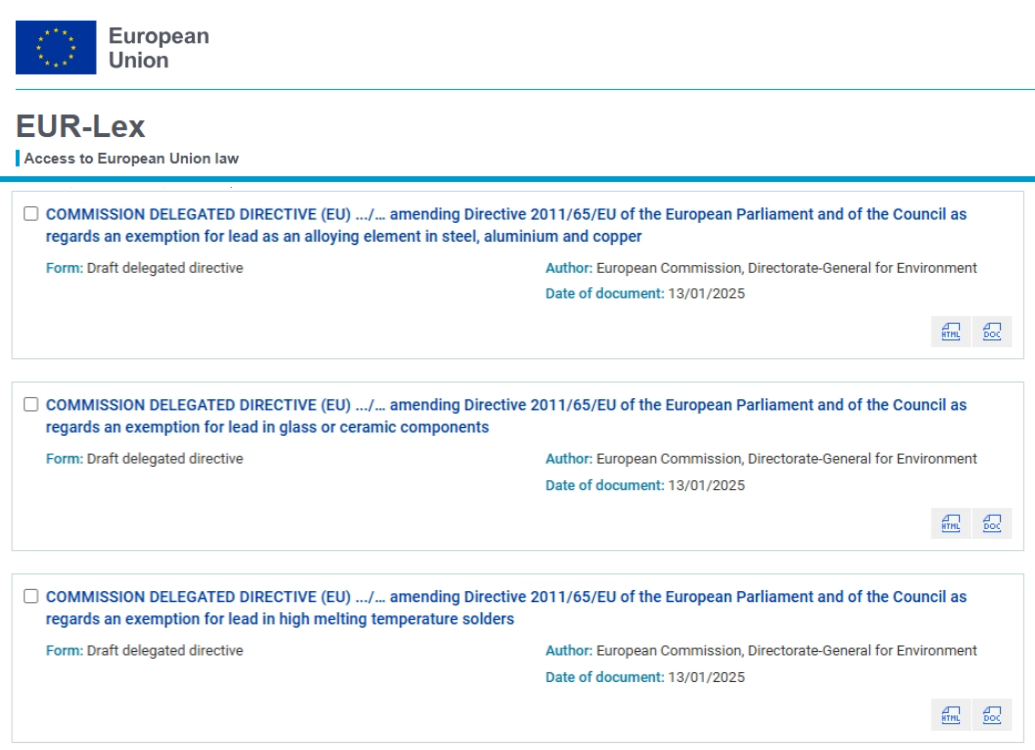 The RoHS Directive established strict restrictions on the use of ten hazardous substances in electrical and electronic equipment (EEE), including lead. Notably, several exemptions related to lead (specifically exemptions 6(a), 7(a), and 7(c)) are set to expire soon. However, European Commission’s technical evaluation of the exemption requests concluded that while some alternatives are available in the market, the performance of lead substitutes are not reliable in some applications.
These draft delegated directives to lead exemptions will address technical and scientific challenges in substituting lead, aiming to balance environmental protection with industrial feasibility.
Below are the proposed main amendments.
Exemption breakdown
The exemption 7(a) will be divided into seven sub-items, 7(a)-I to 7(a)-VII, each specifically addressing applications such as internal circuit connections, chip soldering, sealing materials, and audio converters. This subdivision aims to clearly define the scope of exemptions and prevent misuse and improper applications.
Expiry dates adjustments
Exemption for lead in refractory solders: The exemption 7(a) will be extended until December 31, 2026. The newly added seven sub-items (7(a)-I to 7(a)-VII) will have their exemption validity extended until December 31, 2027.
Exemption for lead contained in electrical or electronic components made of glass or ceramics: The exemptions 7(c)-I and 7(c)-II will be replaced with new entries, extending their validity until December 31, 2026, and December 31, 2027, respectively. Additionally, new exemptions 7(c)-V and 7(c)-VI will be introduced.
Exemption for lead as an alloying element in steel, aluminum, and copper: The exemptions 6(a), 6(a)-I, 6(b), 6(b)-I, 6(b)-II, and 6(c) will be replaced with new entries, with expiry date extending until December 31, 2026, or 12 months after entry into force depending on the specific entry, along with added restrictions.
Scope changes
It is proposed to change the practice of differentiating expiry dates for exemptions by equipment categories (e.g., medical devices, industrial equipment). Instead, all EEE will be subject to the same provision, thereby simplifying regulatory processes and enhancing enforcement efficiency.
It is important to note that exemptions do not apply to EEE that pose a risk of exposure to children. However, exceptions shall apply if the followings are met:
The rate of lead release from such EEE or its accessible parts (whether coated or uncoated) does not exceed 0.05 μg/cm² per hour (equivalent to 0.05 μg/g/h).
For coated articles, the coating is sufficient to ensure that this release rate is not exceed for a period of at least of normal or reasonably foreseeable conditions of use.