Request a Demo
On January 20, 2020, the Japanese Ministry of Economy, Trade, and Industry (METI) released a summary report [1] on statistics concerning the implementation of the Chemical Substances Control Law (CSCL; see ChemLinked chempedia [2]) in 2018.
Throughout the year, the Japanese authorities received a total of 574 notifications of new chemical substances, of which 335 were submitted under general conditions and 239 under low-volume exemptions. See the graph below, in which red bars stand for low-volume notifications and blue bars for general ones.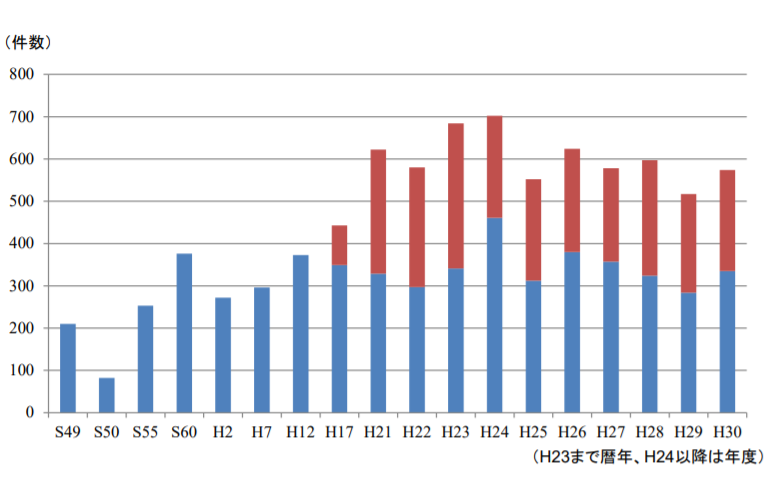
(Source: METI)
It can be seen from the graph that, neither general notifications nor low-volume ones reported any significant growth from 2014 to 2018 (i.e. from H26 to H30). The sluggish increase of low-volume notifications was largely due to the annual limit of 10 tons across Japan.
In response to that, the Japanese authorities had decided to amend the CSCL, introducing a new concept called “environmental release volume” to replace the manufacture or import volume of a substance as a confirmation criterion with regard to small-volume and low-volume notification. This change is favorable for the industry, as more businesses will be able to qualify for the exemption.
The new rule concerning small-volume and low-volume notification came into effect earlier on January 1, 2019. Since its implementation, enterprises will get more quotas for the manufacture or import of chemical substances subject to low-volume or small-volume exemptions. It follows that the number of small-volume and low-volume notifications submitted in 2019 would report a considerable increase from that in 2018.