Request a Demo
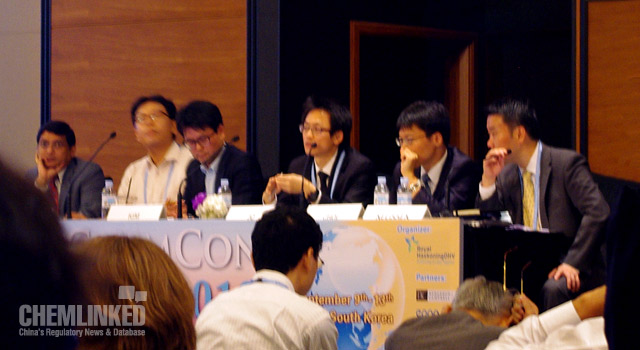 Photo taken by ChemLinked reporter Olivia Sun at ChemCon Asia on 10 Sep, 2013.
ChemCon Asia, the leading chemical regulatory conference with its unique focus on the Asia-Pacific area was initiated on 9 Sep, 2013 in Seoul, Korea.
With the conference venue located in the gangnam district of Seoul and the K-REACH Act being released on Apr 30 this year, there is no doubt that the progress of this EU-REACH style regulation with the ambition to manage the overall chemicals, covering both new and existing chemicals in South Korea fell into the spotlight of the pre-conference morning seminar.
Current Status
8 major types of compliance activities are summarized in the presentation of Mr. In-Mok Hwang from Korea Ministry of Environment (MOE), namely:
1. Annual reporting
2. Registration, Joint submission
3. Hazard examination and Risk Assessment, designate substances as toxic, authorized and prohibited
4. Communication with supply chain
5. Notification of products
6. High Risk Concerned Products
7. Appointment of Only Representative (optional)
8. Documentation
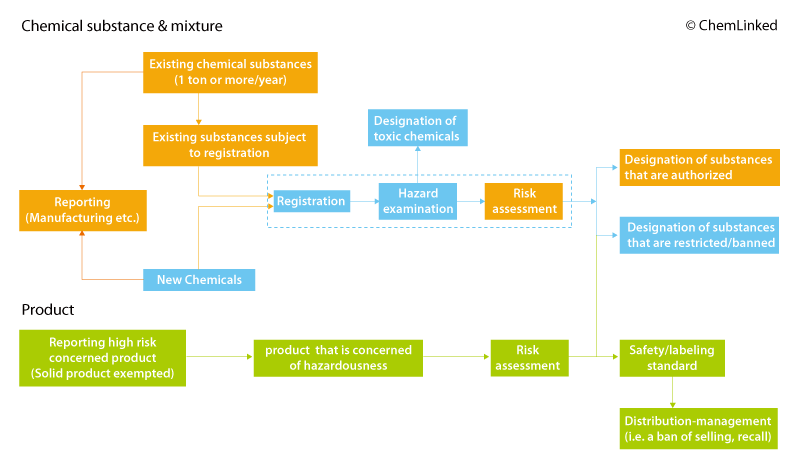
The diagram below depicts the overall K-REACH management scheme, shared by Mr Hwang.
K-REACH, compared with its precedent TCCA, comes with more demanding registration data requirements. In terms of the data requirements, unlike its China counterpart, there is no specific requirement for local data (maintained principle from TCCA), and non-real test data would be readily acceptable, including QSAR and read-across. These might serve as a great relief for the industry stakeholders facing the registration obligation.
Besides all new chemical substances, priority environmental chemicals (PECs) which are screened out of the existing chemicals, will be subject to registration under K-REACH if exceeding 1 ton/year threshold. Staggered grace period would be allowed for different list of PECs, i.e. 2, 5, 8 years for 1st, 2nd, 3rd PECs, respectively, from the publication date of the substances.
K-REACH will operate on the basis of the grandfather inventory, the Korea Existing Chemical Inventory (KECI), in identifying the new and existing chemicals. According to Ms Ami Fukuroi from the Korea Testing & Research Institute, the priority list of 2,086 substances has been drafted. Since Korea has been conducting circulation survey every two years, the government has been well informed of the chemicals on the market and has very specific idea of the screening criteria for priority substances (total tonnage circulating in the market and hazardous/risk characteristics are two major factors).
Unlike the mechanism adopted in EU REACH and China NCSN (a.k.a. China REACH), Korean MOE will take the responsibility to conduct the hazard evaluation and risk assessment of the registered substances and the follow-up designation of substances for authorization, restriction and ban. Nevertheless, the risk information needs to be submitted by the industry and submitted before the various deadlines determined by tonnage band of the chemicals manufactured or imported.
Table 1. Deadline of Risk Information Submission
| tonnage band | Deadline of Risk Information Submission |
| 100 ton/year | 2015 |
| 70 ton/year | 2017 |
| 50 ton/year | 2018 |
| 20 ton/year | 2019 |
| 10 ton/year | 2020 |
As early as May 2012, the pilot study was conducted to identify problems, find the corresponding solution and develop registration guidance on 4 different topics. 16 volunteers with 7 substances are involved in the pilot project and most of the issues were related to the consortium agreement, data sharing (ownership, patent, CBI, license, uses and other issues on data produced), management of consortium (administration, organization and members) as well as cost sharing mechanism.
The strong intention of going for EU REACH style in terms of the joint submission could be sensed from presentations of both Mr Hwang and Mr Jun Ho Lee from the Korea Testing & Research Institute (KTR). Mr Lee even mentioned that the government has already started to consider to make consortium a compulsory option for companies, which means that the formation of consortium would be taken as a prerequisite before any essential registration work. What is also worth mentioning is that the government may also accept consortium from non-Korea countries leading the establishment and management of the consortium responsible for K-REACH registration, when being questioned by the inorganic pigment consortium headquarted in Europe.
Even though the strenuous efforts made to elucidate the K-REACH framework and share with the industry the knowledge and experience obtained through the pilot project conducted from May 2012 to Feb 2013, the expert board of the Korea seminar seems to be receiving more practical questions than they expected from the industry which already have their head buried in the upcoming K-REACH Act.
One could be tempted to speculate that a chaotic transition period from the current chemical management scheme TCCA to the forthcoming K-REACH could be induced during its initial enforcement. The identification of the "new chemical substance" under K-REACH could be one of the confusing scenarios.
Posed by one industry representative during the Q&A session, Mr Hwang from the Korea MOE claimed that those registered under TCCA will be considered as already registered under the upcoming K-REACH.
However, there is another saying that only chemicals published on the national gazette would be considered as existing chemicals and exempted from registration under K-REACH, according to the NIER statement in one of the recent conference. (see ChemLinked news release)
There is reason to believe that the MOE might intend to exempt those chemicals already registered under TCCA, considering the ultimate purpose of the TCCA overhaul is to avoid the administrative redundancy between TCCA and K-REACH.
The difficulty to fully address those questions could be easily contributed by the lack of usable practical guidance for the industry and case study experiences accumulated at the moment. Unlike EU, which has rich experience when formulating the REACH chemical management system, most of the Asian countries are at their infant stage of going forward the mature management scheme. Korea has made its steady and robust step towards that goal.
For the future
The industry's concern on the progress of K-REACH has been well addressed in the K-REACH seminar. According to Mr. Hwang, draft subordinate law will be prepared by Aug 2013 and a consultative group would be opened for opinion gathering since then till Dec 2013. Enactment procedure would also be formulated by Jan 2014 to prepare for the official enforcement of K-REACH on Jan, 2015. One data-processing system similar to REACH-IT under EU REACH would be developed during 2013-2014. To assist the full implementation of K-REACH, some technical guidance and standard will be released during 2013-2014. Last but not least, the list of substances subject to registration (PECs) is expected to be published by 2014.
Even if the official subordinate laws are yet to be released to add specific decorations to the regulation's framework, strong wishes from the industry were voiced from Mr Chandra Dantam, director of Asia-Pacific regulatory affairs of P&G in his presentation. The 7 wishes for the K-REACH quoted form Mr Dantam might be echoed by other chemical companies to be faced with the Korean REACH and it is intriguing to see how many of the listed intention would be adopted by the Korean government:
1. Low volume exemption and grace period for existing LVE chemical
2. R&D exemption
3. Registration data to be balanced
4. Get simplified registration and registration certificate sharing for downstream users
5. Risk management of substances should be based on risk and not hazard only
6. Limit the scope and interval for annual reporting
7. CBI protection during annual report and supplier chain communication