Request a Demo
On February 11, 2020, the Malaysia Department of Occupational Safety and Health (DOSH) promulgated the Industry Code of Practice on Chemicals Classification and Hazard Communication (Amendment) 2019 Part 1 [1] (ICOP 2019 Part 1) as a guidance to chemical suppliers to comply with the provisions in Part II of the Occupational Safety and Health (Classification, Labelling and Safety Data Sheet of Hazardous Chemicals) Regulations 2013 [2] (aka. the CLASS Regulations, hereinafter is referred to as "the Regulations").
The Regulations, which were promulgated under the Occupational Safety and Health Act 1994 [3], set requirements for the chemical suppliers to do the classification, labeling, preparation of Safety Data Sheet, packaging and chemicals inventory information submission, aiming to ensure the suppliers provide sufficient information on hazards of chemicals that they supply, so as to mitigate the risk of accidents happening in the workplace, thus providing a safe and healthy working environment and condition.
In 2014, the Industry Code of Practice on Chemicals Classification and Hazard Communication 2014 [4] (hereinafter is referred to as "ICOP 2014") was published to assist suppliers in complying with the Regulations. ICOP 2014 is consists of four parts, List of Classified Chemicals, Chemicals Classification, Hazard Communication: Labelling and Safety Data Sheet (SDS), and Confidential Business Information (CBI). In fact, the newly released ICOP 2019 Part 1 is an update of the List of Classified Chemicals in the 2014 version. According to the Regulations, suppliers shall classify a chemical as a hazardous chemical in accordance with the List of Classified Chemicals, and if the chemical to be classified is not listed, the classification of the chemical as a hazardous chemical shall be in accordance with the physical, health and environmental hazard of the chemical as specified in Part 2 of the ICOP.
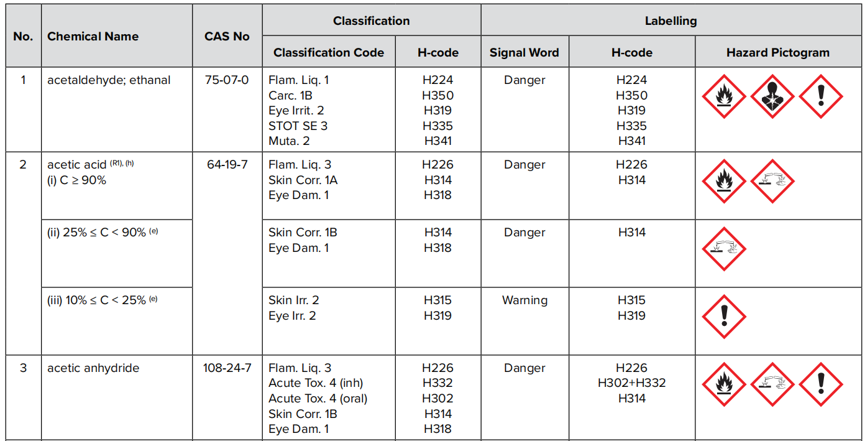 Figure 1. Sample of the new List of Classified Chemicals
The List of Classified Chemicals provides the suppliers with information of chemicals, including the classification code, H-code, signal word, and hazard pictogram. Comparing the updated List to the old one in ICOP 2014, the number of chemicals listed has significantly increased from 229 to 662. What's more, the classification for some chemicals has changed in accordance with their different state. For example, the classifications for acetic acid in different concentrations are different now, while there is no such information in the old List.
"The ICOP is a legally binding document to fulfill the requirements under the Regulations," as DOSH introduces. DOSH also states that the classifications of previous classified chemicals were reviewed based on the currently available information and data, and the List will be updated from time to time.