Request a Demo
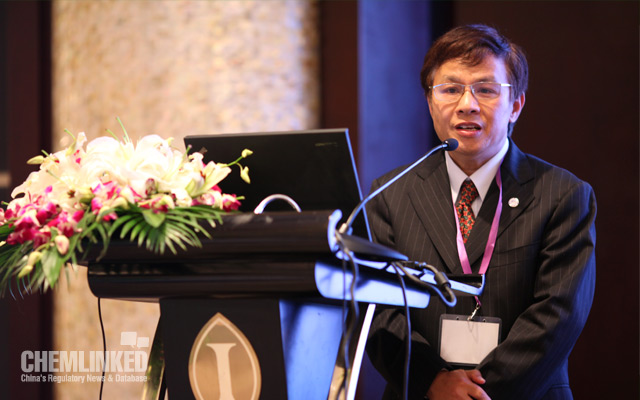 Dr. Yuan Shaw-Ying, Director of Taiwan EPA's Department of Environmental Sanitation and Toxic Substances Control at Shanghai CRAC on 21 Oct, 2013.
The revised Taiwan’s Toxic Chemical Substance Control Act (TCSCA) will establish a system to regulate both new and existing chemicals. According to the current plan, the first stage of Taiwan’s existing chemical registration system will cover all the existing chemical manufactured or imported above 0.1 tonne per year which makes allowances for the fact that SMEs make up the vast proportion of Taiwan’s chemical industry. Procedurally pre-registration under EU REACH is similar, however, the purpose of both are quite different. Pre-registration under EU REACH affords industry a buffer period prior to registration while stage one registration under the revised TCSCA is a step for basic information collection allowing regulators to verify the information collected by Taiwan CLA in the process of voluntary ECN (Existing Chemical Substance Nomination) and SECN (Supplementary Existing Chemical Substance Nomination) for Taiwan’s existing chemical substances inventory (ECSI) updates. However according to Dr. Yuan Shaw-Ying, Director of the Environmental Protection Agency’s (EPA) Department of Environmental Sanitation and Toxic Substances Control, enterprise which failed to avail of the SECN period will be unable to have their substance included into the ECSI. For the second stage, priority chemical substances will be managed batch-wise and should comply with mandatory registration whereby higher tonnage bands will necessitate more data requirements, similar to the EU REACH registration.
Apart from chemicals used for R&D purposes and special exemptions, theoretically all the new chemical substances regardless of tonnage should be registered 90 days prior to manufacture or importation. Three registration types are possible which include standard registration, simplified registration, and low-quantity registration. For new chemicals classified as toxic, certain stipulations on their usage or handling will be required in proportion to their toxicological classification as defined by regulations (Class 1,2,3,4) It should be noted that Taiwan will include nanomaterials into the chemical registration system, however, the details will be specified in the subordinate implementation specifications.
So far, Taiwan's toxic chemical substances list (TCSL) has regulated 302 types of toxic chemical substances, covering 103 Class 1 substances, 100 Class 2 substances, 73 Class 3 substances and 92 Class 4 substances. These substances have been regulated for several years under the current chemical management system and will be exempted from the existing chemical registration under the revised TCSCA. According to statistics, about 5,384 handlers are regulated under the current TCSCA. As planned they will need to notify the EPA that their substances are already included in the TCSL and act in accordance with the current management practices. However, the management of toxic substances of Class 4 will be tightened on matters relating to toxicity and pollution control measures for labeling of containers, packaging, sites and facilities, and SDS.
(NB* some overlap exists between Class 1, Class 2 and Class 3)
The revised TCSCA does include a data submission mechanism for joint submission. However, in the draft proposal which has passed its first reading, joint submission is not a mandatory obligation as in EU REACH and K-REACH. Larger enterprises will favor individual submission and most likely reject collaboration with SMEs due to CBI concerns or to simply to exert their financial dominance on their competitors. In this case, the central competent authority may intervene to coordinate. For the new chemical substances, individual submission is suggested. Taiwan EPA hopes industry will naturally form “SIEF-like” panels to avoid repetition of tests. The central competent authority may intervene in the cost sharing if the registrants fail to reach an agreement about finances.
The adoption of only representative (OR) will be considered, which will allow non-Taiwanese companies to appoint a third party based in Taiwan to submit registrations on their behalf. However, such provisions haven’t been drafted into the proposal and considering Taiwan’s legislative history, bills passing the first reading and signed by caucus leaders are usually subject to only minor changes in the second and third reading. Additionally if the bill is passed unchanged into the revised TCSCA, there will be little possibility that follow-up regulations will include changes. However, according to Taiwan’s legislative process, before being signed into effect, the proposal should go through a public hearing. Stakeholders can put forward opinions and thus there is still chance for regulations on OR usage to be included.
As planned, a team of around 50 staff will be responsible for chemical management under the revised TCSCA. Some related matters may be outsourced to some groups and legal bodies, etc. Penalties will range from NT$200,000 to NT$2m for failing to register a new chemical substance or range from NT$30,000 to NT$300,000 for existing chemical substance. What’s more, if the violations persist and twice fail to be corrected within the given period, the company will be ordered to suspend operations or return imports.
The draft proposal will be put on the legislative Yuan’s review agenda late next month for a second and third reading and hopefully, the revised TCSCA will be passed this year. The revised provisions will take effect one year after the official promulgation.