

 Request a Demo
106 priority existing chemical substances will be subject to Taiwan’s standard registration according to the draft revisions to the “Regulation of New and Existing Chemical Substances Registration”(新化学物质及既有化学物质资料登录办法) published on Mar 27th, 2018. Taiwan EPA held a briefing session on supporting measures for registration of existing chemicals on Aug 22, 2018 with the aim of helping stakeholders understand standard registration measures before implementation of the new regulation, and to aid in timely preparation of documentation and data. The meeting was attended by both enterprises and industry representatives. Key takeaways from the meeting include:
1. How to determine if standard registration is required
Potential registrants can use the manufactured/imported tonnage data submitted for phase 1 registration (pre-registration/late pre-registration) to determine if standard registration is required. The tonnage threshold for standard registration is set at 1 ton per year, and chemicals with annual tonnage less than 1 ton are not subject to standard registration. (Flowchart in Fig.1) Company’s trade volume may change over time as the manufacture/import volume submitted in phase 1 registration is based on data compiled from 2012 to 2014. Based on this, the following suggestion has been made:
“The registration code applied in phase 1 registration can be retrospectively canceled if manufacture/import activity exists after standard registration is implemented. Enterprises could increase/decrease the tonnage in standard registration if only trade volume is changed after phase 1 registration.”
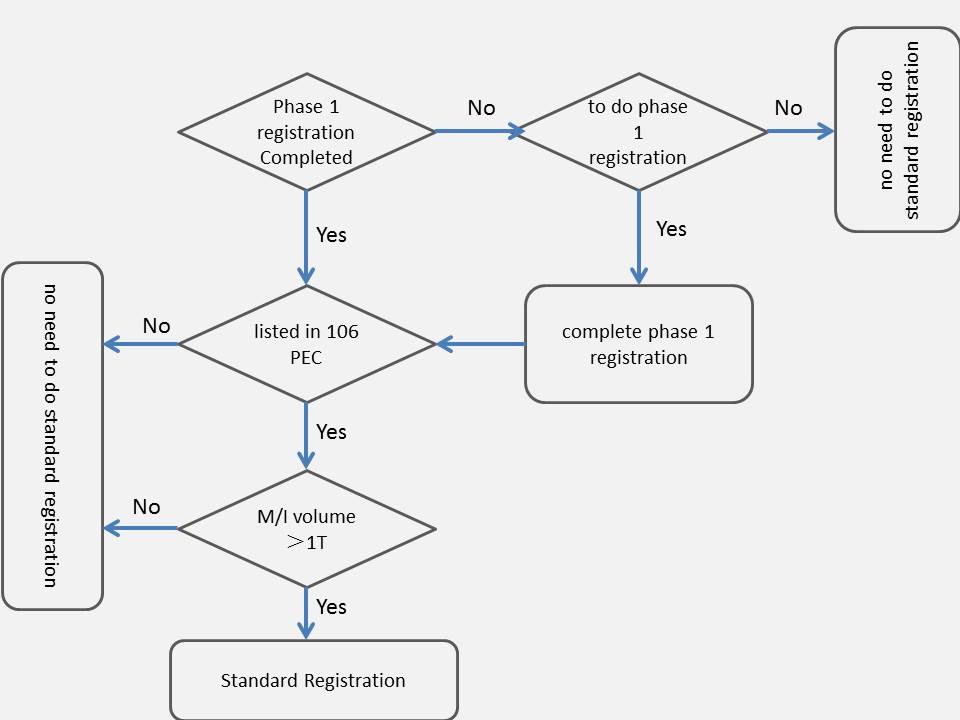 Fig.1
Fig.1
2. Registration Deadline
The registration deadline is based on the volume indicated when applying for phase 1 registration (pre-registration/late pre-registration) and the date on which the phase 1 registration number is obtained.
Phase 1 registration No. Obtained | Tonnage Band | Registration grace period for standard registration | ||
Before Implementation of Standard Registration |
| 100+t/y | 2 years after implementation of standard registration | |
1-100t/y | 3 years after implementation of standard registration | |||
Tonnage band: 100kg-1t | 1t+/y before implementation of standard registration | 3 years after implementation of standard registration | ||
1t+/y after implementation of standard registration | 3 years after tonnage reaches to 1t | |||
After Implementation of Standard registration | 100+t/y | 2 years after tonnage reaches to 1t | ||
1-100t/y | 3 years after tonnage reaches to 1t | |||
Re-application when phase 1 registration No. was repealed | Re-application for phase 1 registration before the deadline | 100+t/y | 2 years according to the original deadline | |
1-100t/y | 3 years according to the original deadline | |||
Re-apply for phase 1 registration after the deadline | 1+t/y | Complete standard registration whilst applying phase 1 registration | ||
*Deadline here refers to the grace period indicated in first applying the registration No.
3. Information requirements and forms of acceptance
Standard registration of existing chemicals requires submission of 9 classes of information:
Basic identification of the registrant and substance
Manufacture, use and exposure info
Hazard classification and labeling
Safe use information
Physical and chemical properties
Toxicological information
Eco-toxicological information
Hazard assessment
Exposure assessment
Consistent with data requirements of new chemical registration, hazard assessment and exposure assessment are required for band II standard registration and all subsequent bands.
Acceptable testing data includes but is not limited to: test reports, QSAR method, systematic literature reviews etc. Rationality and reliability verified by accredited third part unit are required for data provided in the QSAR or the systematic literature review. The test plan should be written by a qualified laboratory.
4. Standard Registration Platform and Tool
A separate registration platform will be developed for existing chemical standard registration (separate to the system used for new chemical registration and phase 1 existing chemical registration). In the platform, registrants could use the registration code to identify whether a substance requires standard registration. A simple “YES” or “NO” conclusion is outputted by the system. Administrative officials will not proactively contact companies to inform them of their registration obligations, for further data about the registration band and deadline, companies should review (or contact the Third Party Representative to view) the phase 1 registration information. The registration tool is designed to receive diversified data. For an instance, companies could submit either multiple test reports, or test reports and read across data for acute oral toxicity.
5. Joint Registration
Joint registration is optional for each registrant. Registrants still have to submit their own registration dossier and are responsible for subsequent updates and amendments if involved in joint registration. Joint registration does not have to involve a linear process from start to finish. For example if a registrant’s dossier is approved, it can authorize subsequent registrants to use part of the data, including item 3,5,6,7 and 8. Items 1, 2, 4 and 9 need to be submitted separately by each registrant. Registrants negotiate and collaborate on which data(s) to be shared in joint registration with no interference from authorities. In cases where agreement on cost sharing cannot be reached, the authority can act as an independent arbitrator.
6. ‘SIEF’ platform
In addition to the widely used standard registration platform used for new chemical registration, another new platform, the “SIEF” platform, for sharing and communicating on existing chemical standard registration information will be launched. The aim is to facilitate joint registration for all parties involved in existing chemical standard registration.
The platform will set up 106 groups corresponding to the first batch of 106 PECs. Stakeholders could use information including phase 1 registration code, CAS number or POA, etc. related to 106 chemicals to apply to join an information exchange joint registration group. After approval by authorities, stakeholders could search for other companies who are willing to do joint registration or publish their own contact information on the platform. Joining the platform is optional and completely at the discretion of registrants.
7. Existing chemical standard registration process
The existing chemical standard registration process is mainly divided into:
→Use the specified tool to create a registration file
→Upload the registration file to the registration platform
→Obtain the receiving code
→Payment
→Complete the registration or correction
In general, it is basically the same as the new chemical registration process, however the corresponding file creation tool and registration platform differs significantly. In addition, the official verification time for existing chemical standard registration is 90 days and for new chemicals is 45 days.
8. Other instructions
During the meeting it was reiterated that 2 separate registration systems have been developed for existing chemical standard registration and new chemical registration/existing chemical phase 1 registration. In addition different third party representative could be used in standard registration and phase 1 registration. Importers can authorize a new TPR without canceling the authorization of the TPR used in phase 1 registration.
Authorities will also release an agreement template on joint registration data purchase. Companies can make suitable amendment of the agreement. Authorities will refer to the method of EU-REACH and K-REACH in purchasing data during joint registration, i.e. the data will be passed to the purchaser in the form of a token from the data holder and the purchaser cannot obtain the complete test data.
Authorities also stated there is at least a 6-month grace period from promulgation of this regulation to standard registration implementation. REACH24H Consulting Group reminds all stakeholders to prepare for Taiwan’s existing chemical standard registration.
Any registration consultation, please contact Mr. Kintan Xu in REACH24H:
Tel: 0571-87007590
Email: [email protected]
Or contact ChemLinked directly.




