Request a Demo
On June 23, 2025, the Thai Ministry of Commerce (MoC) issued the MoC Notification on Classifying E-waste as Illegal for Admission into the Kingdom of Thailand B.E.2568 (2025). It took effect immediately and superseded the previous regulation - MoC Notification on Classifying E-waste as Illegal for Admission into the Kingdom of Thailand B.E.2563 (2020).
According to the MoC notification, “E-waste” is defined as “Electrical and electronic assemblies or scrap (not included scrap from electric power generation) containing such as accumulators and other batteries, mercury-switches, glass from cathode-raytubes and other activated glasses and PCB-capacitors, or contaminated with Cadmium, Mercury, Lead, Polychlorinated Biphenyl”. This aligns with the Entry No. 2.18 in the Sub-list 5.2 (Chemical Wastes) of Annex 5 to the List of Hazardous Substances B.E. 2556 (2013) under the Hazardous Substances Act (HSA) B.E.2535 (1992).
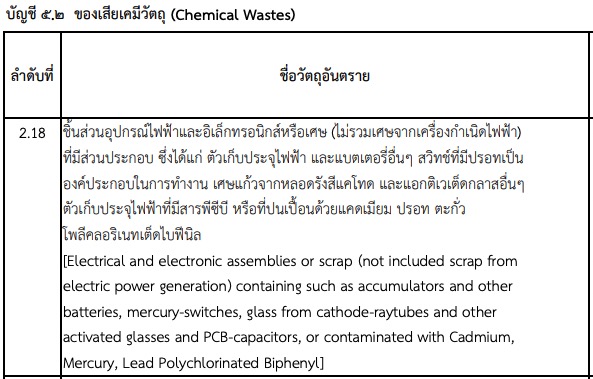 Screenshot of Sub-list 5.2 (Chemical Wastes)
Compared to the 2020 notification, the MoC Notification 2025 expands the scope of ban on e-waste imports as the banned e-waste items have increased from 428 to 463. This broader scope now includes printed circuit boards which may be used to extract precious metals in unsafe methods, primary cells and batteries, electrical or electronic components containing cadmium, mercury, lead, or polychlorinated biphenyls (PCBs), etc. The updated list of banned E-wastes is attached to the MoC Notification 2025.
Look Ahead
Currently, under HSA, Entry No. 2.18 in the Sub-list 5.2 (Chemical Wastes) is classified as Type 3 hazardous substances, which require Hazardous Substance Permit for relevant activities (e.g., import, export, having in possession). Now, the MoC Notification 2025 prohibits the import of such e-wastes containing hazardous residues. Maybe the hazard type of Entry No. 2.18 will be elevated to Type 4 for comprehensive prohibition.