

 Request a Demo
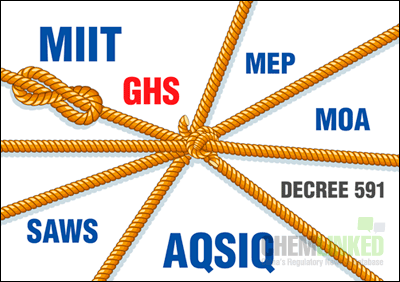
As an senior regulatory analyst working in the field for many years, I would like to share my opinion about issues surrounding the revision of the Catalogue, based on my knowledge of governmental decision-making mechanism and all relevant information collected from various sources. The obstacles that hinder the issuance of the Catalogue are discussed in five aspects as follows with the first few points elaborating on the specific duties of various Chinese ministries in conjunction with the status quo of chemical management in China.
GHS Implementation in China
Ministry of Information Technology (MIIT) is the primary authority responsible for GHS implementation in China. MIIT has collaborated with other agencies such as the UNITAR in hosting training sessions and forming expert committee of China GHS. However, it seems that the MIIT lacks necessary enforcing approaches for solid GHS implementation. The formulation and enactment of the revised Catalogue appears to be a good opportunity to reinforce GHS implementation, and I believe that the MIIT will be more than happy to publish a Catalogue containing GHS classification.
Standardization Administration of the People’s Republic of China (SAC) under that General Administration of Quality Supervision, Inspection and Quarantine (AQSIQ) is responsible for the formulation and revising of national standards (i.e. GB). China National Technical Committee for Standardization of Dangerous Chemicals Management (CNSTC) is a branch of the SAC who is in charge of formulation of the GHS-related GBs such as GB20576--GB20602-2006 (Safety rules for Classification, Precautionary Labeling and Precautionary Statements of Chemicals) and GB13690-2009 (General rule for classification and hazard communication of chemicals). It is noteworthy that the standard formulation process only involves editorial adjustment without any modification to the technical content. The GHS reference document (i.e. Purple Book) is revised every two years, however it is set that the GBs will only be revised at least five years after the last amendment date. Besides, it normally takes three years to complete the amendment process from its initiation, WTO notification to formal issuance. All these factors together make it impossible for China GHS to be synchronized with the global GHS.
The registration of hazardous chemicals supervised by the State Administration of Work Safety (SAWS), in conjunction with the import/export inspection carried out by the General Administration of Quality Supervision, Inspection and Quarantine (AQSIQ) and the new chemical notification required by the Ministry of Environmental Protection (MEP) have all provided thrust for GHS implementation in China.
Definition of Hazardous Chemicals
GHS provides guidance of chemical classification but not hazardous chemical classification specifically, in this sense, whether a chemical is considered as hazardous depends on the building blocks adopted by different government legislators.
There are two different kinds of hazardous chemicals in China, the “official hazardous chemicals “(this is not an established name and was given by the author for communication purpose only) and the GHS-defined hazardous chemicals.
Official hazardous chemicals refer to those which have been listed in the Catalogue of Hazardous Chemicals. Enterprises that handle the “official hazardous chemicals” need to carry out hazardous chemical registration and obtain certain certificates such as the Safe Production Permit. GHS-defined hazardous chemicals refer to those chemicals that are included in the GHS building blocks adopted by China GHS while have not been listed in the Catalogue of Hazardous Chemicals. Chemical Safety Data Sheet (SDS) as well as the safety label are required for the GHS-defined hazardous chemicals throughout the supply chain, yet the handlers of such chemicals are not obligated to register or obtain Safe Production Permit (Possibility exists that GHS-defined hazardous chemicals will need to get registered in the future).
Context of the Formulation of the Catalogue of Hazardous Chemicals
The conception of the catalogue of hazardous chemicals did not derive from the former hazardous chemical management legislation (Decree 344). SAWS independently published the List of Hazardous Chemicals (2002 Edition) with reference to the List of Dangerous Goods. The Catalogue of Hazardous Chemicals (2002 Edition) directly adopted most of the content in the List of Dangerous Goods and only minor modification was made. In the same year, the eight competent ministries including the SAWS, MPS, SEPA, MOH co-published the List of Highly-toxic chemicals (2002 Edition).
The to-be published Catalogue of Hazardous Chemicals will be co-issued by ten ministries, therefore it is theoretically a brand new inventory with strong legal effect.
Course of Catalogue of Hazardous Chemicals Formulation
The formulation process of the Catalogue of Hazardous Chemical adopts the veto system rather than the principle of majority. Due to the necessity for unanimity and full consensus the process is extremely time consuming. The major obstacle to the final issuance of the Catalogue sources from conflicting opinions among different ministries. The MIIT intends to incorporate a comprehensive GHS classification into the Catalogue and therefore it perceives the scope of the Catalogue as the broader the better. SAWS wants to keep the new Catalogue largely consistent with the List of Hazardous Chemicals (2002 Edition) with only minor modification to be made on the portion originating from the List of Dangerous Goods. With the aim to ease the burden on the industry, the Ministry of Agriculture (MOA) hopes the Catalogue to exclude as many pesticides as possible. The Ministry of Environmental Protection (MEP) wishes to intensify chemical management over the enterprises as a result of its awareness of the serious environmental pollution. The exclusion of chemicals easily used for poisoning is opposed by the Ministry of Public Security (MPS) as this may hinder the conviction process of some cases.
Function of Catalogue of Hazardous Chemicals
To ministries such as SAWS, AQSIQ and MEP, the Catalogue serves as a law enforcing document which clearly discriminates their duty and obligation. The competent authorities may issue certain kinds of permits according to the fact that whether the concerned item is listed on the Catalogue. In this perspective, the Catalogue should not contain too many chemicals in consideration of the pressure on the enterprises as well as their capability to afford the supervision from the authority. However, if the Catalogue will not be used as the law enforcing document but only a GHS classification for public reference, the scope of the Catalogue could be as broad as possible.
According to SAWS order 41 (Measures on Management of Safe Production Permit for Hazardous Chemicals Companies), Safe Production Permit is required for manufacturing hazardous chemicals listed in the Catalogue of Hazardous Chemicals. That means the number of chemicals listed in the Catalogue will not increase dramatically in comparison to the List of Hazardous Chemicals (2002 Edition).
Conclusion
GHS classification of a certain chemical may change with time as a result of experience gained during GHS implementation and emerging scientific evidence, while at the same time, consensus across ten ministries involved is required for the formulation and the subsequent amendment of the Catalogue. Once the GHS classification is incorporated in the Catalogue, expectation could be drawn that any modification to the classification would experience extreme difficulty. Fortunately, based on the most updated information, the Catalogue of Hazardous Chemicals and the GHS classification will be issued individually. In addition, the draft of the Catalogue will be available for public comments in the short future.
About the Author
 Mr Jim Wei is the CEO and co-founder of the REACH24H Consulting Group. Mr Wei has worked as the official in the Safety Test Laboratory of Zhejiang Inspection & Quarantine Bureau (CIQ) for 9 years. As one of the experts of EU REACH compliance WG of AQSIQ China, Mr Wei has many expereicnes on EU REACH regualtion project.
English version of this article is contributed by Olivia Sun and Yvonne Huang.




