Request a Demo
Aiming to provide reference for the further implementation of GHS and the sound management of chemicals by relevant authorities and enterprises, this article generally introduces the coming changes of main technical contents in the 8th revised edition of UN GHS Purple Book (GHS rev. 8). These changes were included in the amendments(ST/SG/AC.10/46/Add.3)[1] to the seventh revised edition of UN GHS Purple Book(ST/SG/AC.10/30/Rev.7)[2], which was published by the Committee of Experts on TDG and GHS of the UNECE on 18th March, 2019. By the way, the GHS Purple Book Revision 8 (GHS Rev.8) is expected to be published in July 2019.
1. Foreword
The Globally Harmonized System of Classification and Labelling of Chemicals (GHS) is a scientific, unified standardized chemical classification labelling system based on the current systems in many countries, under the coordination of relevant UN agencies and after years of international consultations. GHS defines the physical, health and environmental hazards of chemicals and establishes classification criteria. It also specifies how to classify chemical hazards based on the best available data and standardizes the labelling elements in the chemical label and safety data sheet, including pictograms, signal words, hazard statements and precautionary statements. The implementation of the system means that all existing chemical classification and labelling systems in countries around the world must be adapted to GHS in order to achieve effective harmonization of global chemical classifications and labels.
GHS is dynamic, and it is revised and updated every two years with the accumulation of experience in the implementation process, making it more complete and effective. The revision and update of the GHS document is carried out under the auspices of the Subcommittee of Experts on the Globally Harmonized System of Classifications (UNSCEGHS) under the United Nations Economic and Social Council (ECOSOC) to reflect the experience gained in national, regional and international implementation processes. As of July 2017, the GHS Purple Book has been revised and updated seven times in succession, and the GHS Purple Book (Revision 7) is the most recent version currently implemented.
On 18th March, 2019, the Committee of Experts on TDG and GHS of the UNECE published amendments to the seventh revised edition of GHS (ST/SG/AC.10/30/Rev.7) , and the GHS Purple Book (Revision 8) is expected to be officially released in July 2019. In order to achieve the 2020 goal of SAICM, the competent authorities of countries around the world are revising and adjusting their own chemical management laws and regulations and management policies, adopting the implementation of GHS and its latest revision. This article generally introduces the coming changes of main technical contents in the 8th revised edition of GHS Purple Book, based on the approved amendments to the seventh revised edition of GHS.
2. Main technical revisions in GHS Rev.8
a. Physical hazards
i. Change of Classification Criteria for Aerosols
Aerosols are classfied in one of the three categories of this hazard class,in accordance with Table 1,depending on:
their flammable properties;
their heat of combustion; and
if applicable, test results from the ignition distance test, the enclosed space ignition test and the aerosol foam flammability test, performed in accordance with sub-sections 31.4, 31.5 and 31.6 of the United Nations Recommendations on the Transport of Dangerous Goods, Manual of Tests and Criteria.”
Table 1. Criteria for aerosols
Category | Criteria |
1 | (1) Any aerosol that contains ≥ 85% flammable components (by mass) and has a heat of combustion of ≥ 30 kJ/g; (2) Any aerosol that dispenses a spray that, in the ignition distance test, has an ignition distance of ≥ 75 cm; or (3) Any aerosol that dispenses a foam that, in the foam flammability test, has: (a) a flame height of ≥ 20 cm and a flame duration of ≥ 2 s; or (b) a flame height of ≥ 4 cm and a flame duration of ≥ 7 s. |
2 | (1) Any aerosol that dispenses a spray that, based on the results of the ignition distance test, does not meet the criteria for Category 1, and which has: (a) a heat of combustion of ≥ 20 kJ/g; (b) a heat of combustion of < 20 kJ/g along with an ignition distance of ≥ 15 cm; or (c) a heat of combustion of < 20 kJ/g and an ignition distance of < 15 cm along with either, in the enclosed space ignition test: - a time equivalent of ≤ 300 s/m3; or - a deflagration density of ≤ 300 g/m3; or (2) Any aerosol that dispenses a foam that, based on the results of the aerosol foam flammability test, does not meet the criteria for Category 1, and which has a flame height of ≥ 4 cm and a flame duration of ≥ 2 s. |
3 | (1) Any aerosol that contains ≤ 1% flammable components (by mass) and that has a heat of combustion < 20 kJ/g; or (2) Any aerosol that contains > 1% (by mass) flammable components or which has a heat of combustion of ≥ 20 kJ/g but which, based on the results of the ignition distance test, the enclosed space ignition test or the aerosol foam flammability test, does not meet the criteria for Category 1 or Category 2. |
ii. New Hazard Category: Chemicals under PressureChemicals under pressure is newly added to the aerosol content in Chapter 2.3. Although aerosols and pressurized chemicals have similar risks, GHS (Revision 8) divides aerosols and pressurized chemicals into two separate individual sub-species and stipulates the definition, classification criteria, hazard communication elements, decision logic and guidance of chemicals under pressure.
According to the GHS Purple Book, chemicals under pressure are liquids or solids (e.g., pastes or powders), pressurized with a gas at a pressure of 200 kPa (gauge) or more at 20 °C in pressure receptacles other than aerosol dispensers and which are not classified as gases under pressure. It is noticed that chemicals under pressure typically contain 50% or more by mass of liquids or solids whereas mixtures containing more than 50% gases are typically considered as gases under pressure.
Chemicals under pressure are classified in one of three categories of this hazard class, in accordance with Table 2, depending on their content of flammable components and their heat of combustion.
Table 2. Criteria for chemicals under pressure
Category | Criteria |
1 | Any chemical under pressure that: (a) contains ≥ 85% flammable components (by mass); and (b) has a heat of combustion of ≥ 20 kJ/g. |
2 | Any chemical under pressure that: (a) contains > 1 % flammable components (by mass); and (b) has a heat of combustion < 20 kJ/g; or that: (a) contains < 85 % flammable components (by mass); and (b) has a heat of combustion ≥ 20 kJ/g. |
3 | Any chemical under pressure that: (a) contains ≤ 1% flammable components (by mass); and (b) has a heat of combustion of < 20 kJ/g. |
NOTE 1: The flammable components in a chemical under pressure do not include pyrophoric, self-heating or water-reactive, substances and mixtures because such components are not allowed in chemicals under pressure in accordance with the Recommendations on the Transport of Dangerous Goods, Model Regulations.
NOTE 2: Chemicals under pressure do not fall additionally within the scope of section 2.3.1 (aerosols), chapters 2.2 (flammable gases), 2.5 (gases under pressure), 2.6 (flammable liquids) and 2.7 (flammable solids). Depending on their contents, chemicals under pressure may however fall within the scope of other hazard classes, including their labelling elements.
The corresponding label elements for chemicals under pressure are shown in Table 3.
Table 3. Label elements for chemicals under pressure
Category 1 | Category 2 | Category 3 | |
Symbol | Flame Gas cylinder | Flame Gas cylinder | Gas cylinder |
Signal word | Danger | Warning | Warning |
Hazard statement | Extremely flammable chemical under pressure: May explode if heated | Flammable chemical under pressure: May explode if heated | Chemical under pressure: May explode if heated |
b. Health hazards
The GHS Purple Book (Revision 8) makes major textual changes to the classification criteria and test methods for skin corrosion/irritation of health hazards.
Skin Corrosion/Irritation Classification Based on In Vitro/Ex Vivo Data
The currently available individual in vitro/ex vivo test methods address either skin irritation or skin corrosion, but do not address both endpoints in one single test. Therefore, GHS revision 8 will provide detailed new guidance on how to use in vitro/ex vivo test data to classify a substance or mixture for skin corrosion/irritation. Applicable methods and relevant classification criteria are provided.
To classify skin corrosion/irritation, it is necessary to collect all available and relevant skin corrosion/irritationinformation and evaluate the data quality for its adequacy and reliability. Whenever possible, the classification should be based on data generated by internationally validated and recognized methods, such as OECD test guidelines or equivalent methods. GHS Revision 8 respectively provides clear classification criteria and guidance for classification based on human data, classification based on animal in vitro/in vivo test data, classification based on chemical extreme pH values, classification based on non-test methods such as QSARs and classification using a tiered approach.
The applicability of in vitro/ex vivo test methods for skin corrosion/irritation is shown in Table 4.
Skin corrosion criteria for in vitro/ex vivo methods is shown in Table 5.
Skin irritation criteria for in vitro methods is shown in Table 6.
Table 4. Applicability of in vitro/ex vivo test methods for skin corrosion/irritation
Test Methods | Corresponding Chinese national standards | |
Skin corrosion | (1)OECD Test Guideline 430:Transcutaneous Electrical Resistance test method (2)OECD TG 431: Recondstructed human Epidermis test methods (3)OECD TG 435: Membrane barrier test method | (1)GB/T27828-2011:Chem-Test method of in vitro skin corrosion-Transcutaneous electrical resistance test(TER) (2)GB/T27830-2011:Chemicals-Test method of in vitro skin corrosion-Human skin model test (3)GB/T27829-2011:Chemicals-in vitro test of skin corrosion-Membrane barrier method |
Skin irritation | (4)OECD TG 439: Reconstructed Human Epidermis test methods | (4)N/A |
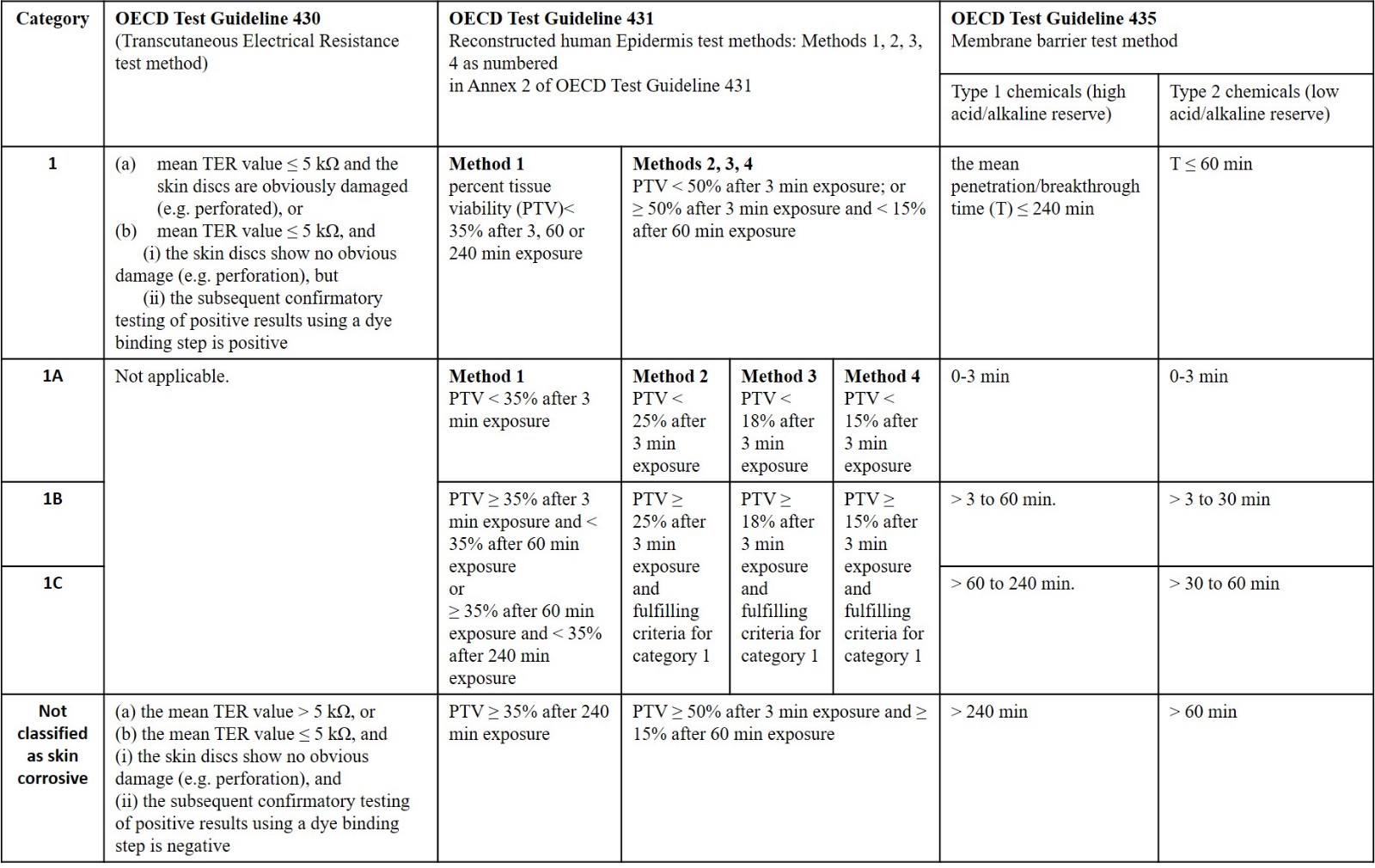 Table 6. Skin irritation criteria for in vitro methods
| Categoey | Test Guideline 439 Reconstructed Human Epidermis test methods |
| 1or2 | Mean percent tissue viability(≤)50%. Note:The RhE test method covered by this Test Guideline cannot resolve between GHS categories 1 and 2.Further information on skin corrision will be required to decide on its final classification [seealso the OECD Guidance document 203]. |
| 2 | Mean percent tissue viability ≤50% and the test chemical is found to be noncorrosive (e.g. based on TG 430,431 or 435) |
Not classified as skin irritant or category 3 | Mean percent tissue viability>50% Note:The RhE test methods covered by this TG cannot resolve between GHS optional category 3 and not classified as skin irritation irritation. Further infrmation on skin irritation is required for those authorities that want to have more than one skin irritation category. |
3. Hazards label elements
The GHS Purple Book (Rev. 8) annexes provide a series of additional changes to the chemical hazard label elements. For example, according to the above-mentioned revision of chemicals under pressure and their classification standards, the contents of the label elements of chemicals under pressure are inserted in Annex 1 Classification and Labelling Summary Tables after the heading A1.3 aerosol; the contents of the hazard statements for chemicals under pressure are inserted in Annex 3 Hazard statements, coding and use of precautionary statements, examples of hazard pictograms and precautionary pictograms, and some precautionary statements and other texts for Tables A3.2.2 and A3.2.3 of Section 2 are added, deleted or modified; the contents of related label elements of chemicals under pressure are also inserted in the Section 3 Matrix of Precautionary Statements by Hazard Class/Category after the tables applicable to Aerosols (Chapter 2.3), the heading is amended from Use of Precautionary Statements. What’s more, precautionary statements used in the Response column for many types of health hazard are amended in the matrix of Section 3, Annex 3, more information can be found in the official document.
In addition to the above changes, the main changes to GHS (Revision 8) are:
i. new precautionary pictograms for precautionary statement P102
Two new recommended precautionary pictograms for precautionary statement P102 Keep out of reach of children are added in Section 5 of GHS Revision 8 Annex 3. The information provided by the precautionary statement and precautionary pictograms is very important for the labelling of chemical products supplied to the public. One pictogram was recommended by International Association for Soaps, Detergents and Maintenance Products (AISE, Figure 1), the other was recommended by Japan Soap and Detergent Association (JSDA, Figure 2).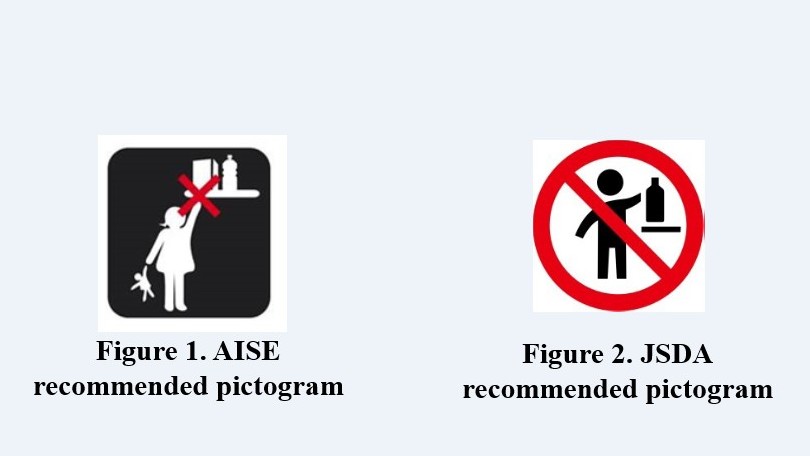 ii. new labelling examples of sets or kits
In Annex 7 Examples of Arrangements of the GHS Label Elements of GHS Revision 8, new labelling examples for sets or kits are added. Generally, a set or kit contains two or more small removable inner containers. Each inner container contains different products which can be hazardous or not hazardous substances or mixtures. This example illustrates ways to label sets or kits where the manufacturer/supplier or competent authority has determined there is insufficient space to place together on each inner container within the kit, the GHS pictogram(s), signal word and hazard statement(s). Two different scenarios where this may arise are illustrated, together with ways to provide the necessary GHS information. The Scenario A labels are shown in Figure 3 and 4.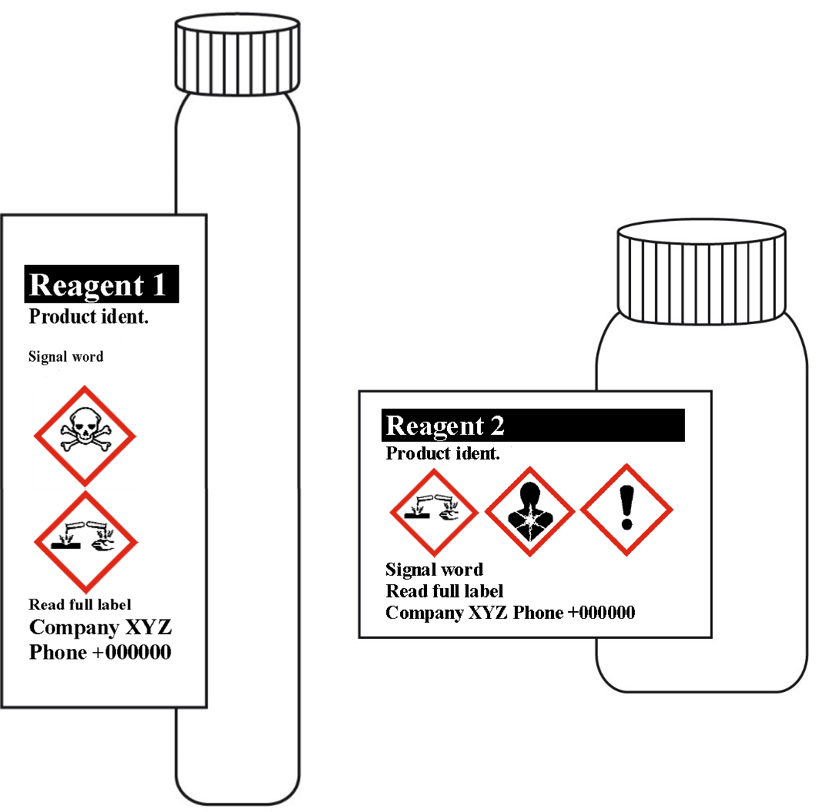 Figure 3. Inner container labels
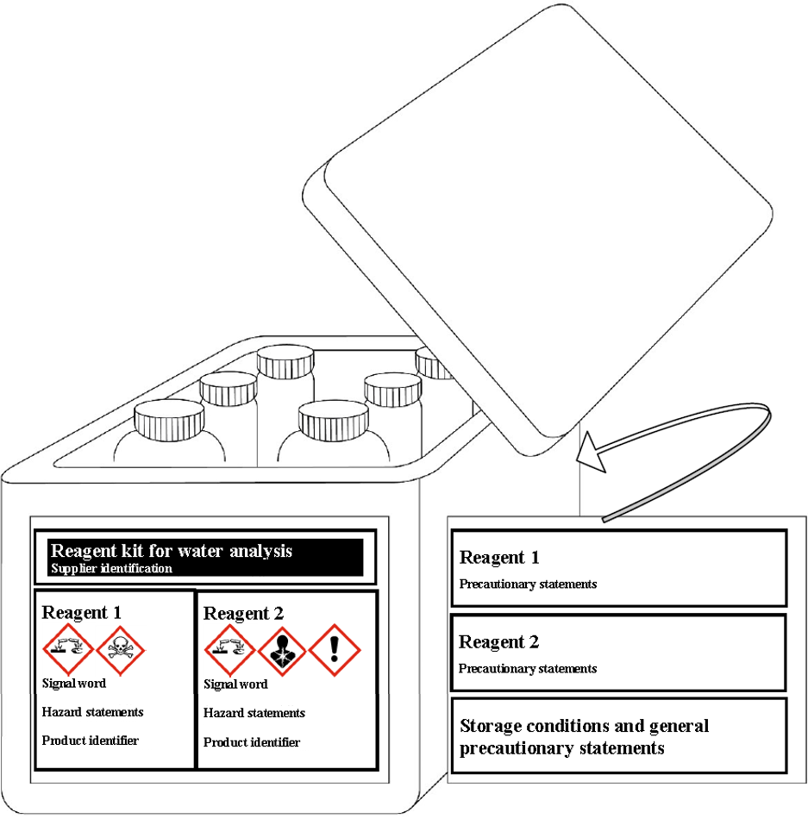 Figure 4. Outer packaging labels
iii. new Annex 11 Guidance on Other Hazards not Resulting in Classification
This guidance provides information that facilitates the identification of hazards which do not result in classification, but may need to be assessed and communicated. Currently, this annex only contains information about Dust explosions. Guidance on the factors that contribute to a dust explosion hazard and on hazard identification and the need for risk assessment, prevention, mitigation, and communication is provided in the annex.
Any solid substance or mixture, which is combustible, may pose a dust explosion risk when in the form of fine particles in an oxidizing atmosphere such as air. A risk assessment may be needed for many substances, mixtures, or solid materials, not just those classified as flammable solids in accordance with Chapter 2.7. In addition, dusts may be formed (intentionally or unintentionally) during transfer or movement, or in a facility during handling or mechanical processing (e.g., milling, grinding) of substances/mixtures/solid materials (e.g., agricultural commodities, wood products, pharmaceuticals, dyes, coal, metals, plastics). Thus, the possibility of the formation of small particles and their potential accumulation should also be assessed. Where a dust explosion risk is identified, effective preventive and protective measures should be implemented as required by national legislation, regulations, or standards.
Guidance in Annex 11 can be used to identify when flammable dust may be present and to determine when the risk of a dust explosion should be considered. The guide is divided into the following six sections:
Definitions
These common terms are defined and described:
Combustible dust, Dust deflagration index (Kst), Limiting oxygen concentration (LOC), Maximum explosion pressure, Minimum Explosible Concentration (MEC)/Lower Explosible Limit (LEL), Minimum ignition energy (MIE), etc.
Identification of combustible dust
A flow chart that helps to identify whether a substance or mixture is a combustible dust and hence whether the risk of a dust explosion has to be assessed is presented. Detailed explanations and guidance on the interpretation of each box used in the flow chart are also provided.
Factors contributing to a dust explosion
The factors include particle characteristics (size and shape), concentration of combustible dust, air or other oxidizing atmospheres, ignition sources and other factors impacting the severity of a dust explosion (temperature, pressure, oxygen availability, humidity and confinement).
Hazard prevention, risk assessment and mitigation
The principles of dust explosion protection are summarized. The precautions and mitigation measures, related safety features, precautions against dust explosion during operation and processing, etc. are introduced.
Supplemental information for hazard and risk communication
Competent authorities may require these additional information, or suppliers may choose these to add as supplementary information on their own initiative. Each party producing or distributing a product that is determined to be hazardous, including if it becomes hazardous during downstream processing, should create and provide their downstream user with appropriate information, in the form of a Safety Data Sheet (SDS) or another format as appropriate, to alert the user to the hazards and risks. For substances, mixtures, or solid materials, how to provide information on combustible dusts in sections 2, 5, 7, and 9 of the SDS, and how to communicate combustible dust hazards and a potential risk of dust explosions in a standardized manner are described in the section.
Reference
This section describes and lists the accepted and scientifically validated test methods and standards that should be used in assessing dust explosiveness, including,
International standards: ISO/IEC 80079-20-2, "Explosive atmospheres - Part 20-2: Material characteristics ‒ Combustible dusts test methods".
National standards: ASTM E1226, “Standard Test Method for Explosibility of Dust Clouds”; VDI* 2263-1, "Dust Fires and Dust Explosions; Hazards ‒ Assessment ‒ Protective Measures; Test Methods for the Determination of the Safety Characteristics of Dusts".
The guidance also lists relevant regulations and guidance documents issued by the European Union and the American Fire Protection Association for the minimization or elimination of dust explosions on wood, coal, sulphur, combustible metals, and agricultural and food materials.