Request a Demo
On May 20, 2024, Occupational Safety and Health Administration (OSHA) released the amended Hazard Communication Standard (HCS) on the Federal Register to conform to the United Nations’ Globally Harmonized System of Classification and Labelling of Chemicals (GHS), primarily Revision 7 (Rev. 7), partially Rev. 8. This final rule shall take effect on July 19, 2024.
The HCS was last updated in 2012 to align with GHS Rev. 3. This amendment addresses issues that arose during the implementation of the 2012 update to the HCS, and provides better alignment with other U.S. agencies and international trading partners while enhancing the effectiveness of the standard.
The modifications to the standard involve classification criteria, labeling, SDS, CBI, etc. Highlights of the revision are summarized below:
Updates on classification for physical hazards and health hazards
a. Classification criteria updates
|
b. Revisions on determination methods
|
Labeling updates
a. Precautionary statement
|
b. Small container labeling
For a container ≤100 ml the chemical manufacturer, importer, or distributor must include the following information on the label: (A) Product identifier; (B) Pictogram(s); (C) Signal word; (D) Chemical manufacturer's name and phone number; and (E) A statement that the full label information for the hazardous chemical is provided on the immediate outer package. For a container ≤3 ml, where the chemical manufacturer, importer, or distributor can demonstrate that any label interferes with the normal use of the container, no label is required, but the container must bear the product identifier. For the abovementioned cases for small containers, the following information must be indicated on the immediate outer package: l The full label information for each hazardous chemical. l A statement that the small container(s) inside must be stored in the immediate outer package bearing the complete label when not in use. |
c. The exclamation mark pictogram is permitted for HNOCs as long as the words “Hazardous Not Otherwise Classified” or the letters “HNOC” appear below the pictogram as shown below:
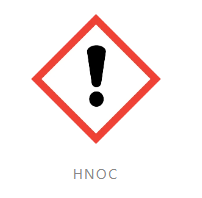
d. For chemicals that have been released for shipment and are awaiting future distribution, those containers may not be relabeled. However, an updated label for each individual container with each shipment must be provided, or with the agreement of the receiving entity, transmit the labels by electronic or other technological means.
SDS updates
| Section | Amended points |
| 1 | Must include U.S. telephone number of the chemical manufacturer, importer, or other responsible party |
| 3 |
|
| 9 | Add “particle characteristics”; delete“odor threshold” (included in “odor”) and “evaporation rate” (included in “vapor pressure”) |
| 11 | Add “interactive effects”; if specific chemical data or information is not available, the preparer must indicate if alternative information is used and the method used to derive the information (e.g., SAR, QSAR, read-across) |
CBI updates
The exact concentration range of the substance in a mixture may be withheld as confidential business information (CBI). The prescribed ranges are shown below:
(A) from 0.1% to 1%;
(B) from 0.5% to 1.5%;
(C) from 1% to 5%;
(D) from 3% to 7%;
(E) from 5% to 10%;
(F) from 7% to 13%;
(G) from 10% to 30%;
(H) from 15% to 40%;
(I) from 30% to 60%;
(J) from 45% to 70%;
(K) from 60% to 80%;
(L) from 65% to 85%; and
(M) from 80% to 100%.
The prescribed concentration range used must be the narrowest range possible. If the exact concentration range falls between 0.1% and 30% and does not fit entirely into one of the prescribed concentration ranges, a single range created by the combination of two applicable consecutive ranges may be disclosed instead. The combined ranges can not fall entirely outside the exact concentration range.
Transition period
Chemical manufacturers, importers, and distributors need to comply with the modified provisions:
For substances, no later than January 19, 2026 and provide employee training by July 20, 2026;
For mixtures, no later than July 19, 2027 and provide employee training by January 19, 2027.
The final rule can be accessed here.